Introduction
All living organisms depend on one another for energy and survival. In nature, energy does not exist independently but flows from one organism to another through feeding relationships. These relationships form structured pathways through which energy and nutrients move within ecosystems. Two important concepts that explain these relationships are the food chain and the food web.
In the field of Ecology, the study of food chains and food webs helps scientists understand how ecosystems function and how different organisms are interconnected. Every organism, whether plant, herbivore, carnivore, or decomposer, plays a specific role in the transfer of energy through the ecosystem.
A balanced ecosystem depends on the proper functioning of these feeding relationships. Any disruption in food chains or food webs can disturb ecological balance and affect biodiversity. Therefore, understanding the concept of food chains and food webs is essential for environmental conservation and ecosystem management.
Meaning and Concept of Food Chain
Definition of Food Chain
What is a Food Chain?
A food chain refers to the linear sequence of organisms through which energy and nutrients pass as one organism consumes another. It represents a simple pathway of energy flow from producers to consumers and finally to decomposers.
In simple terms, a food chain shows who eats whom in an ecosystem.
Energy in a food chain originates from the Sun and moves through different trophic levels as organisms consume one another. The chain usually begins with plants or other photosynthetic organisms and ends with top predators.
Characteristics of a Food Chain
Food chains possess several important characteristics that explain their ecological role.
1. Linear Energy Transfer
A food chain represents a straight or linear pathway through which energy flows from one organism to another.
2. Begins with Producers
Every food chain starts with producers such as green plants or algae that can produce food through photosynthesis.
3. Consists of Different Trophic Levels
Each step in a food chain is known as a trophic level, representing the position of an organism in the chain.
4. Ends with Decomposers
Decomposers break down dead organisms and recycle nutrients back into the ecosystem.
5. Limited Length
Food chains usually consist of four to five trophic levels because energy decreases at each step due to heat loss.
Components of a Food Chain
The food chain includes several groups of organisms that perform different ecological functions.
Producers
Role of Producers
Producers are organisms that make their own food using sunlight through the process of photosynthesis. They form the base of the food chain because they convert solar energy into chemical energy.
Examples include:
- Green plants
- Algae
- Phytoplankton
Producers are essential because they supply energy for all other organisms in the ecosystem.
Primary Consumers
Role of Herbivores
Primary consumers are herbivores that feed directly on producers.
Examples include:
- Grasshoppers
- Rabbits
- Deer
- Cows
These organisms transfer energy from plants to higher trophic levels.
Secondary Consumers
Role of Carnivores
Secondary consumers are carnivores that feed on primary consumers.
Examples include:
- Frogs
- Small birds
- Lizards
They help regulate herbivore populations.
Tertiary Consumers
Role of Top Predators
Tertiary consumers are large carnivores that feed on secondary consumers.
Examples include:
- Eagles
- Snakes
- Tigers
These organisms are often called top predators because they occupy the highest trophic level in the food chain.
Decomposers
Role of Decomposers
Decomposers break down dead plants and animals into simpler substances.
Examples include:
- Bacteria
- Fungi
They recycle nutrients back into the soil, making them available for producers again.
Types of Food Chains
Food chains are generally classified into two major types.
Grazing Food Chain
Concept
The grazing food chain begins with green plants that capture energy from sunlight.
Example:
Grass → Grasshopper → Frog → Snake → Eagle
In this chain, energy flows from plants to herbivores and then to carnivores.
Detritus Food Chain
Concept
The detritus food chain begins with dead organic matter rather than living plants.
Example:
Dead leaves → Earthworms → Small birds → Hawks
Decomposers and detritivores play an important role in this type of food chain.
Trophic Levels in a Food Chain
A trophic level refers to the position that an organism occupies in a food chain.
First Trophic Level
Producers such as plants and algae.
Second Trophic Level
Primary consumers or herbivores.
Third Trophic Level
Secondary consumers or carnivores.
Fourth Trophic Level
Tertiary consumers or top predators.
Fifth Trophic Level
Decomposers that recycle nutrients.
Energy decreases as it moves from one trophic level to the next.
Concept of Food Web
Definition of Food Web
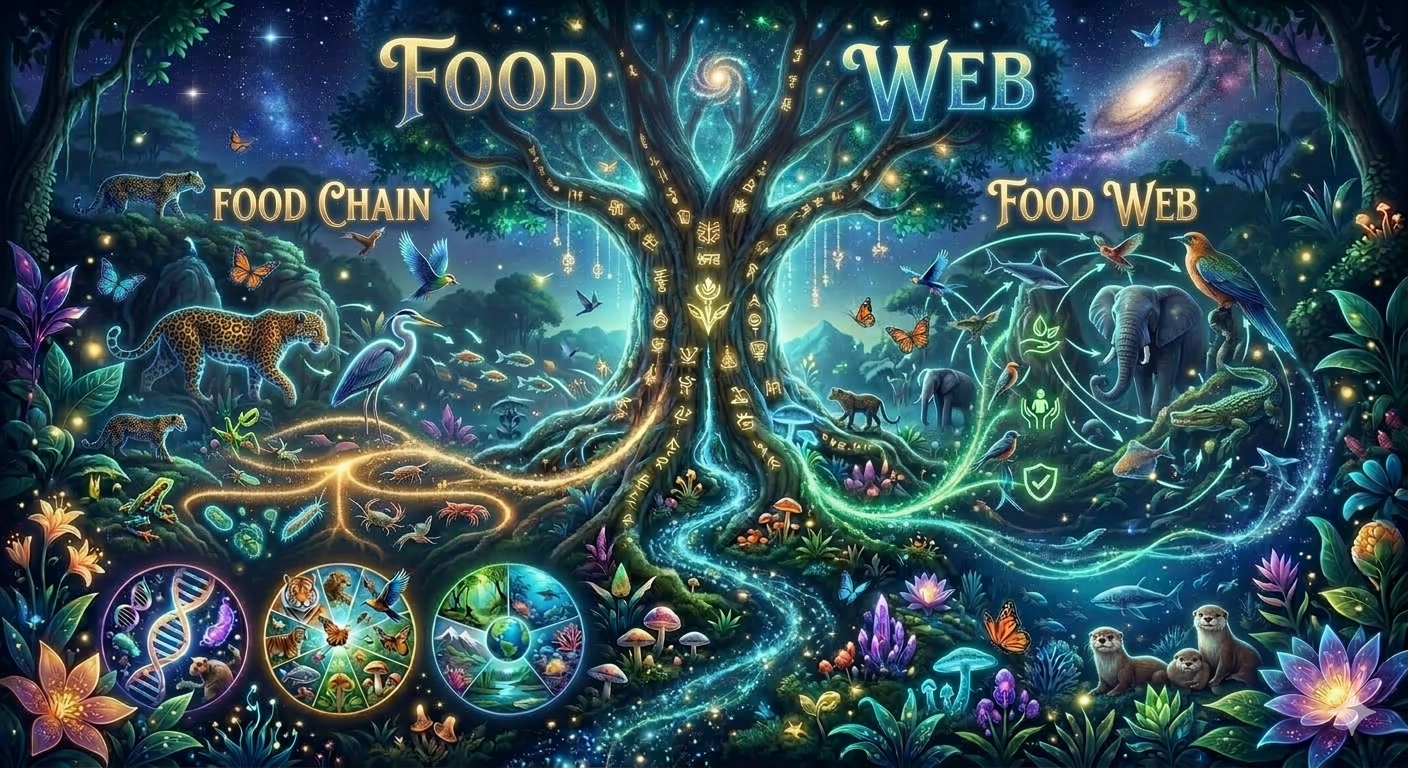
A food web is a complex network of interconnected food chains that shows multiple feeding relationships among organisms in an ecosystem.
Unlike a food chain, which follows a single path, a food web includes many overlapping feeding relationships.
Food webs provide a more realistic representation of how energy flows through ecosystems because most organisms consume more than one type of food.
Characteristics of a Food Web
Food webs possess several important features.
1. Complex Structure
Food webs consist of multiple interconnected food chains.
2. Multiple Feeding Relationships
Organisms may feed on several different species.
3. Greater Stability
Food webs make ecosystems more stable because organisms have alternative food sources.
4. Reflect Real Ecosystem Interactions
Food webs represent the actual complexity of ecological interactions.
Structure of a Food Web
A food web includes various trophic levels similar to a food chain but with multiple connections.
Producers
Plants and algae serve as the foundation of the food web by producing energy through photosynthesis.
Herbivores
Herbivores consume plants and transfer energy to carnivores.
Examples include:
- Insects
- Rabbits
- Deer
Carnivores
Carnivores feed on herbivores and other carnivores.
Examples include:
- Foxes
- Wolves
- Hawks
Omnivores
Omnivores consume both plants and animals.
Examples include:
- Humans
- Bears
- Some birds
Decomposers
Decomposers recycle nutrients by breaking down dead organisms.
Differences Between Food Chain and Food Web
Although both concepts describe energy flow, they differ in several ways.
Structure
- Food Chain: Simple and linear pathway.
- Food Web: Complex network of interconnected food chains.
Feeding Relationships
- Food Chain: Each organism has only one source of food.
- Food Web: Organisms may have multiple food sources.
Stability
- Food Chain: Less stable because disruption of one species affects the entire chain.
- Food Web: More stable because alternative feeding paths exist.
Representation of Ecosystems
- Food Chain: Simplified model of energy flow.
- Food Web: Realistic representation of ecosystem interactions.
Importance of Food Chain and Food Web
Food chains and food webs play an essential role in maintaining ecological balance.
Energy Transfer
They explain how energy flows from the Sun to plants and then to animals and decomposers.
Maintenance of Ecological Balance
Food chains regulate species populations and prevent overpopulation or extinction.
Nutrient Cycling
Through feeding and decomposition, nutrients circulate within ecosystems.
Biodiversity Conservation
Food webs support biodiversity by connecting various species in ecological networks.
Ecosystem Stability
Complex food webs increase ecosystem resilience and help ecosystems recover from disturbances.
Human Impact on Food Chains and Food Webs
Human activities can disturb feeding relationships in ecosystems.
Deforestation
Destruction of forests eliminates habitats and disrupts food chains.
Pollution
Chemical pollution can kill organisms and interrupt energy flow.
Overfishing
Excessive fishing can reduce fish populations and disturb marine food webs.
Climate Change
Changes in temperature and weather patterns affect species distribution and feeding relationships.
Conservation of Food Chains and Food Webs
Protecting ecosystems helps maintain stable feeding relationships.
Wildlife Conservation
Protecting animals helps maintain natural predator-prey relationships.
Habitat Protection
Preserving forests, wetlands, and oceans ensures ecosystem stability.
Sustainable Resource Use
Responsible use of natural resources prevents ecological imbalance.
Environmental Awareness
Public awareness encourages people to protect ecosystems.
Conclusion
Food chains and food webs are fundamental concepts in ecology that explain how energy and nutrients move through ecosystems. A food chain represents a simple linear pathway of energy transfer from producers to consumers and decomposers, while a food web represents a complex network of interconnected food chains.
These ecological relationships ensure the proper functioning of ecosystems by maintaining energy flow, nutrient cycling, and population balance among species. Food webs provide stability to ecosystems by offering multiple feeding pathways and alternative food sources.
However, human activities such as deforestation, pollution, and climate change can disrupt these natural systems. Protecting ecosystems and maintaining biodiversity are essential for preserving stable food chains and food webs.
Understanding these concepts helps us appreciate the delicate balance of nature and highlights the importance of conserving ecosystems for the survival of all living organisms on Earth.