Introduction
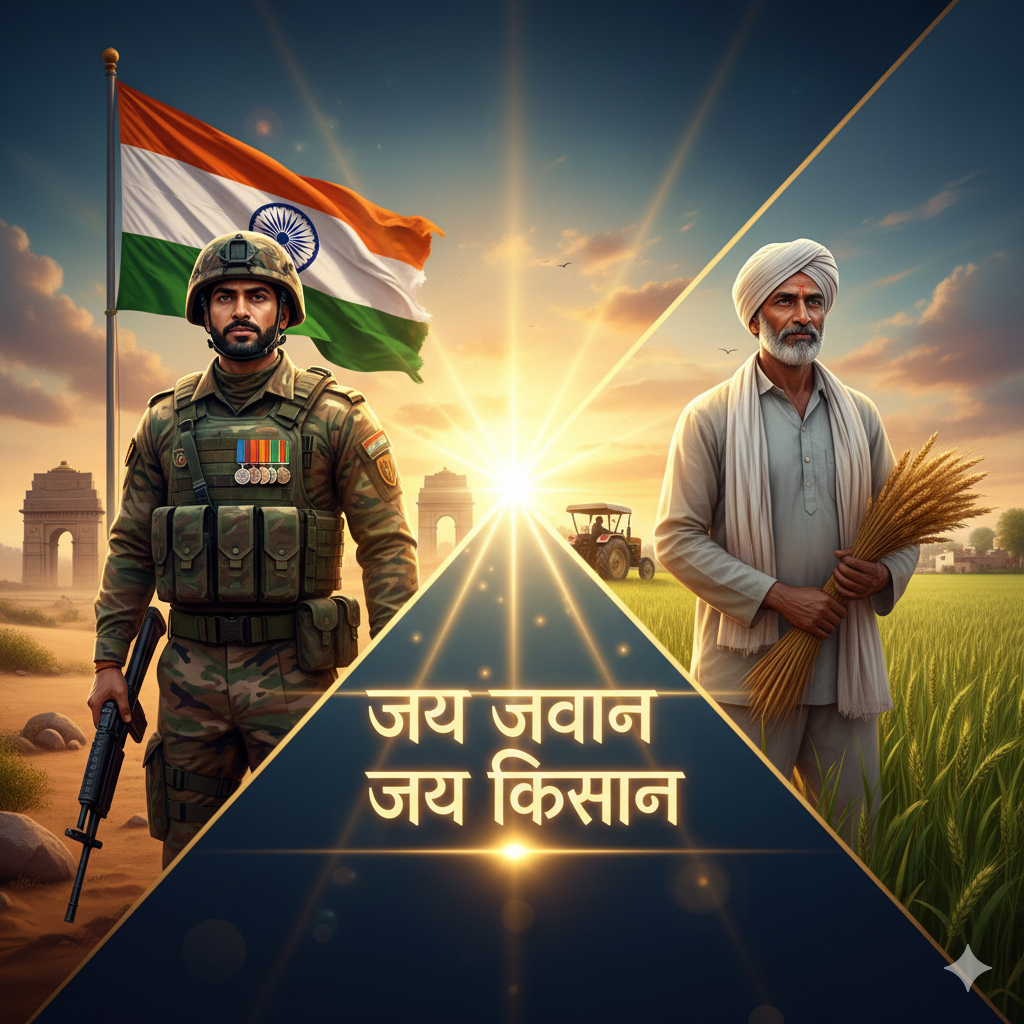
Slogans often capture the spirit of an era. In India’s post-Independence journey, few slogans have carried as much symbolic weight as “Jai Jawan Jai Kisan” (Hail the Soldier, Hail the Farmer). Coined by Prime Minister Lal Bahadur Shastri in the mid-1960s, this phrase encapsulated two pillars considered vital for national survival—defence and agriculture.
Emerging at a time of military conflict and food scarcity, the slogan was not merely rhetorical. It reflected India’s strategic priorities and moral vision during a period of acute crisis. Over time, it evolved from an immediate wartime appeal into a broader philosophy linking national security with food security.
This critical note traces the historical evolution of the slogan, examines its socio-economic significance, and evaluates its continuing relevance in contemporary India.
Historical Context: India in the 1960s
The early 1960s were among the most challenging years for independent India. The country faced multiple crises simultaneously:
- The 1962 war with China exposed military weaknesses.
- The 1965 conflict with Pakistan strained defence resources.
- Severe droughts led to food shortages and dependence on imports.
- Economic growth was sluggish, and rural poverty remained widespread.
India relied heavily on foreign grain under the PL-480 program, raising concerns about sovereignty and self-reliance. Against this backdrop, Prime Minister Lal Bahadur Shastri articulated the slogan “Jai Jawan Jai Kisan” in 1965, emphasizing the inseparable roles of soldiers and farmers in safeguarding the nation.
Evolution of the Slogan
Origin under Lal Bahadur Shastri
The slogan first gained prominence during the Indo-Pak War of 1965. Shastri sought to boost morale among troops while simultaneously encouraging farmers to increase agricultural output.
His message was clear: territorial integrity and food security were equally critical to national strength.
Unlike abstract nationalist rhetoric, this slogan directly addressed India’s material challenges. It called for collective sacrifice, discipline, and unity.
Institutionalization in National Consciousness
Over time, the slogan became embedded in public discourse, textbooks, political speeches, and popular culture. It shaped policy narratives and reinforced respect for both defence personnel and agricultural workers.
Later leaders expanded the slogan—most notably adding “Jai Vigyan” to acknowledge science and technology—but the original phrase remains foundational.
Significance of “Jai Jawan”
1. Recognition of Military Sacrifice
“Jai Jawan” symbolized gratitude toward soldiers who defend India’s borders under difficult conditions. It elevated the status of the armed forces in national life and fostered civic respect for military service.
This recognition helped strengthen civil-military relations and encouraged youth participation in defence services.
2. Emphasis on National Security
The slogan underscored the idea that peace is sustained through preparedness. It highlighted defence as a core responsibility of the state and legitimized investment in military modernization.
In a geopolitically sensitive region, this emphasis reinforced India’s commitment to sovereignty.
3. Psychological Unity during Crisis
During wartime, morale is as important as material strength. “Jai Jawan” provided emotional reassurance, reinforcing national solidarity and collective resilience.
Significance of “Jai Kisan”
1. Centrality of Agriculture in India’s Economy
At the time the slogan emerged, agriculture employed a majority of Indians and contributed significantly to GDP. “Jai Kisan” acknowledged farmers as the backbone of the nation.
It highlighted that food production was not merely an economic activity but a strategic necessity.
2. Catalyst for Agricultural Transformation
The slogan helped mobilize political and public support for agricultural reforms that later culminated in the Green Revolution. Investments in irrigation, seeds, fertilizers, and rural infrastructure followed.
Farmers were encouraged to adopt new technologies, leading to increased productivity in several regions.
3. Dignifying Rural Labor
By placing farmers alongside soldiers, the slogan elevated agricultural work to a position of national honor. This symbolic recognition challenged urban-centric development narratives and reaffirmed rural dignity.
Interlinking Defence and Development
One of the slogan’s most profound contributions was its framing of defence and development as interconnected rather than separate domains.
A nation cannot defend itself if its people are hungry, and it cannot feed itself without security. This integrated perspective influenced policy thinking, promoting balanced investment in both sectors.
Role in Shaping Public Policy
The slogan reinforced two long-term policy priorities:
- Strengthening defence preparedness
- Achieving food self-sufficiency
These objectives guided resource allocation and institutional reforms. Agricultural research bodies were strengthened, while defence production gradually expanded domestically.
Expansion of the Slogan: Changing Times, Changing Priorities
In later decades, additional phrases were appended to reflect evolving national needs:
- “Jai Vigyan” emphasized science and technology.
- “Jai Anusandhan” highlighted research and innovation.
These extensions illustrate how the original slogan provided a flexible framework adaptable to new developmental challenges.
Critical Evaluation: Achievements and Limitations
While “Jai Jawan Jai Kisan” remains inspirational, a critical analysis reveals certain limitations.
1. Symbolism versus Structural Reform
The slogan raised awareness but could not, by itself, resolve systemic problems. Farmers continue to face issues such as:
- Income instability
- Indebtedness
- Market access challenges
Similarly, soldiers confront concerns related to welfare, pensions, and rehabilitation.
Symbolic recognition must be matched by sustained policy support.
2. Uneven Outcomes of Agricultural Growth
The Green Revolution increased food production but also created regional disparities and environmental stress. Small farmers often benefited less than large landholders.
Thus, the agricultural success inspired by “Jai Kisan” was not uniformly inclusive.
3. Changing Nature of Security
Modern security threats include cyber warfare, climate change, and pandemics. While “Jai Jawan” remains relevant, national security today requires broader institutional coordination beyond traditional military strength.
Contemporary Relevance
Despite changing contexts, the slogan retains strong resonance.
Farmers remain central to food security, especially amid climate variability. Soldiers continue to safeguard borders in a complex geopolitical environment.
The spirit of “Jai Jawan Jai Kisan” aligns with current priorities such as:
- Atmanirbhar Bharat (self-reliant India)
- Domestic defence production
- Sustainable agriculture
Its core message—respect for those who feed and protect the nation—remains timeless.
Philosophical Dimensions
Beyond policy, the slogan reflects a moral vision of nationhood. It celebrates service over status and contribution over privilege.
By honoring both manual and military labor, it promotes social equality and collective responsibility.
Conclusion
“Jai Jawan Jai Kisan” emerged from a moment of national vulnerability but evolved into a lasting symbol of India’s resilience. It articulated a holistic understanding of strength—one rooted equally in security and sustenance.
While the slogan alone cannot solve structural challenges faced by farmers and soldiers, it has played a crucial role in shaping national priorities and public consciousness. Its enduring relevance lies in reminding citizens that true nation-building depends on those who defend the land and those who cultivate it.
In an era of rapid technological change and global uncertainty, the essence of this slogan continues to offer guidance: a nation prospers when it values both its protectors and its producers.