Introduction
The reign of Muhammad bin Tughlaq (1325–1351 CE) is one of the most debated phases in the history of the Delhi Sultanate. Known for his intelligence, vision, and ambitious ideas, Muhammad bin Tughlaq attempted several administrative and military reforms to strengthen and expand his empire.
However, despite his innovative approach, many of his policies failed due to practical limitations, poor implementation, and lack of public support. His reign is often described as a paradox of brilliance and failure.
Administrative Reforms of Muhammad bin Tughlaq
Centralization of Administration
Muhammad bin Tughlaq aimed to establish a highly centralized administrative system. He tried to exercise direct control over all regions of his vast empire.
In theory, this reform was meant to strengthen governance and reduce corruption. However, due to the vast geographical extent of the empire and lack of efficient communication, maintaining centralized control became difficult.
Key Features
- Strong authority of the Sultan
- Direct supervision over provinces
- Reduction of autonomy of local officials
Transfer of Capital (Delhi to Daulatabad)
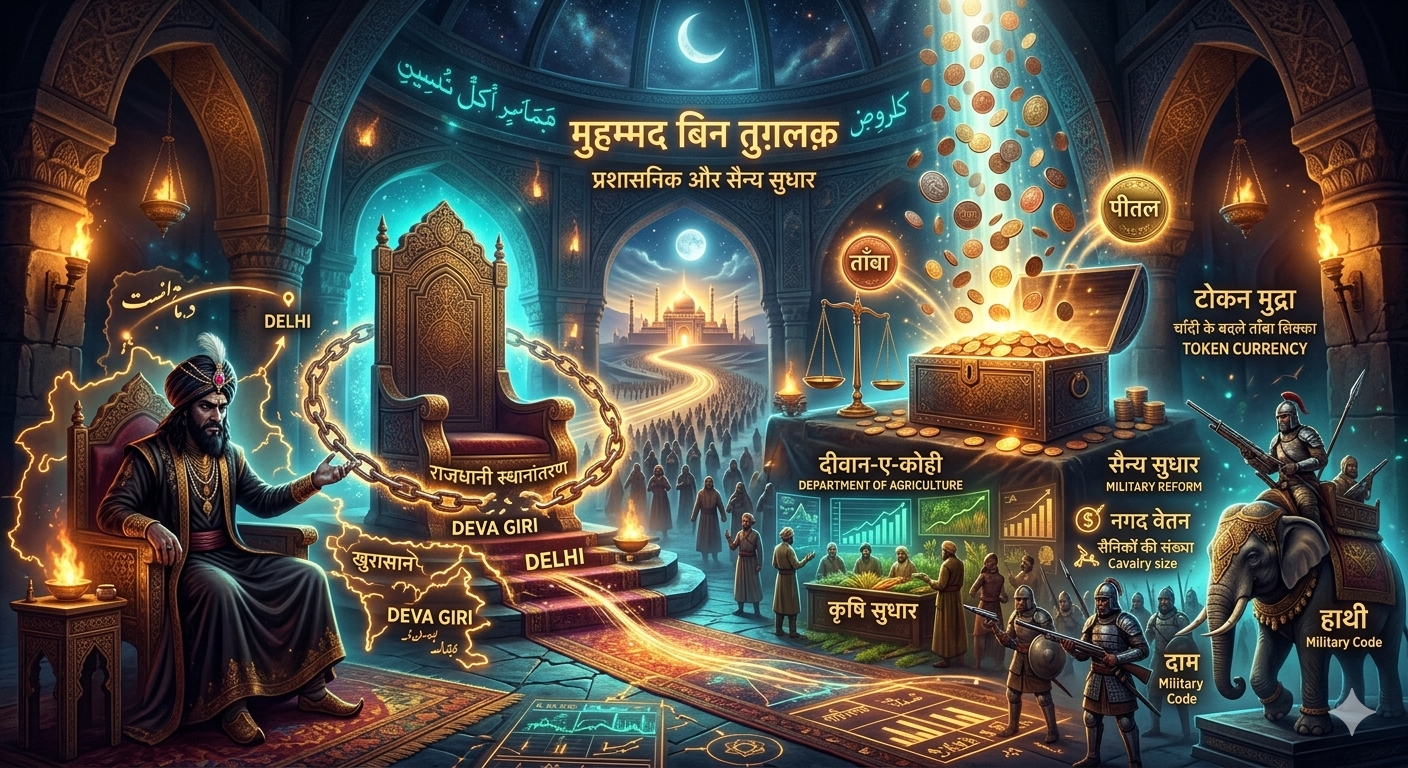
One of his most controversial reforms was the decision to shift the capital from Delhi to Daulatabad (in present-day Maharashtra).
In his view, Daulatabad was centrally located and strategically important for controlling both North and South India. It was also considered safer from Mongol invasions.
Objectives
- Better administrative control over the Deccan
- Strategic location for defense
- Integration of the empire
Outcome
Despite good intentions, the forced migration of people caused immense hardship, leading to widespread dissatisfaction. Eventually, the capital was shifted back to Delhi.
Token Currency Experiment
Muhammad bin Tughlaq introduced token currency made of copper and brass, which had the same value as silver coins.
The idea was innovative and aimed at overcoming the shortage of precious metals and facilitating trade.
Features
- Introduction of non-precious metal coins
- State-backed value system
Outcome
Due to lack of proper regulation and control, people started minting fake coins. This led to economic chaos and forced the Sultan to withdraw the policy.
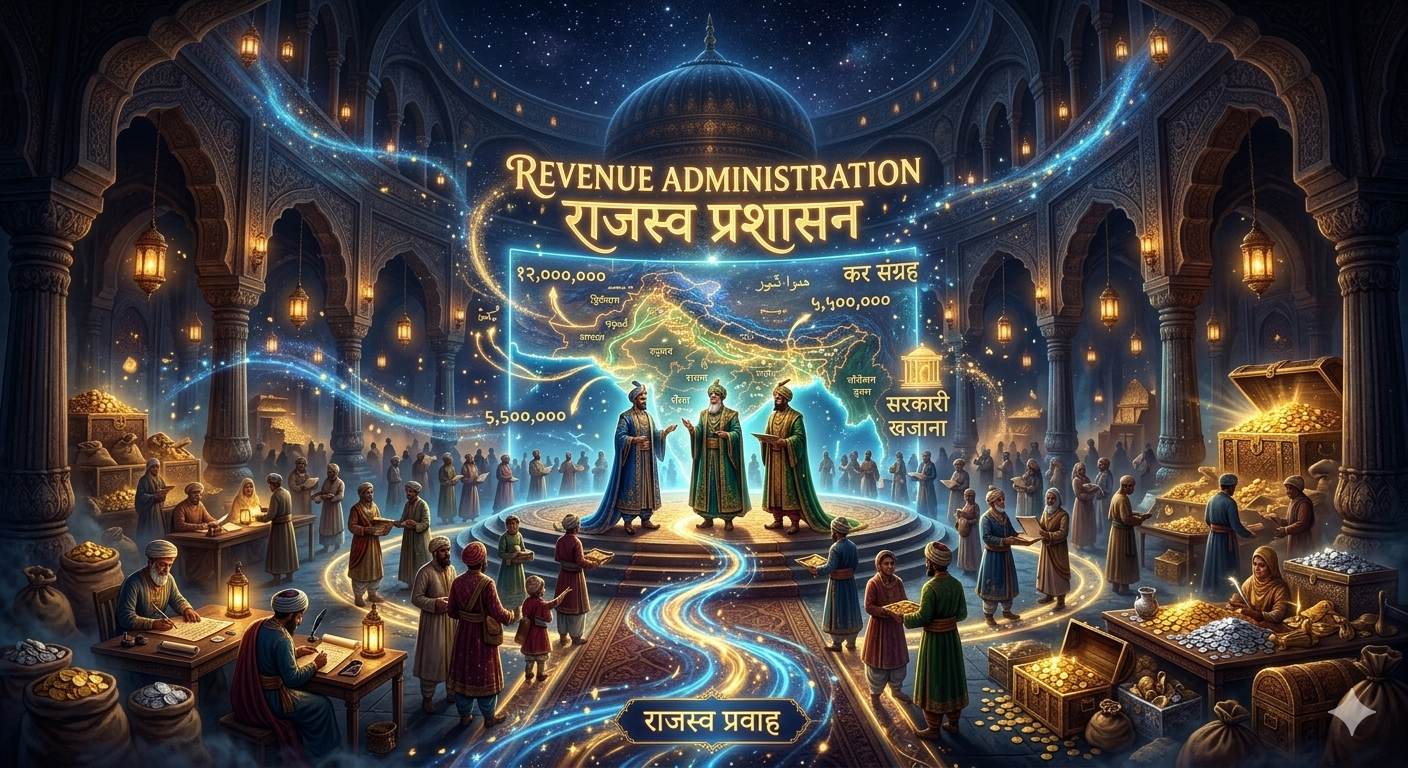
Revenue Reforms in the Doab Region
The Sultan increased taxes in the fertile Doab region (between Ganga and Yamuna rivers).
The aim was to increase state revenue and strengthen the treasury.
Key Aspects
- Higher land revenue demand
- Strict collection measures
Outcome
The policy coincided with famine conditions, leading to peasant revolts and agricultural decline.
Agricultural Reforms (Diwan-i-Kohi)
Muhammad bin Tughlaq introduced agricultural reforms to improve cultivation.
Objectives
- Bring wasteland under cultivation
- Provide loans to farmers
Outcome
Due to corruption and poor implementation, the scheme failed to produce desired results.
Military Reforms of Muhammad bin Tughlaq
Expansionist Military Policy
Muhammad bin Tughlaq had ambitious plans to expand his empire beyond India.
He planned campaigns towards regions like Central Asia and Khurasan.
Key Features
- Recruitment of large armies
- Preparation for foreign expeditions
Outcome
These campaigns were never successfully executed, resulting in wastage of resources.
Large Standing Army
To support his expansionist policies, the Sultan maintained a large standing army.
Features
- Regular payment of soldiers
- Direct control by the Sultan
However, maintaining such a large army required huge financial resources, which strained the treasury.
Introduction of New Military Strategies
- Emphasis on mobility and cavalry
- Attempts to improve military organization
Despite these efforts, lack of proper planning led to inefficiency.
Reasons for the Failure of His Policies
Lack of Practical Planning
Although Muhammad bin Tughlaq was intellectually advanced, many of his policies lacked practical feasibility.
- Decisions were taken without considering ground realities
- Overestimation of administrative capacity
Poor Implementation
Even well-conceived ideas failed due to weak execution.
- Corruption among officials
- Lack of supervision
- Inefficient प्रशासनिक machinery
Harsh and Hasty Decisions
The Sultan often implemented policies abruptly.
- Forced migration to Daulatabad
- Sudden introduction of token currency
These decisions created panic and resistance among people.
Economic Mismanagement
- Failure of token currency led to financial instability
- Excessive military expenditure
- Decline in state revenue
Natural Calamities
- Famine in the Doab region worsened the impact of revenue reforms
- Agricultural distress led to revolts
Public Discontent and Revolts
The policies led to widespread dissatisfaction:
- Peasant uprisings
- Rebellions by nobles
- Loss of public trust
Overambitious Nature
Muhammad bin Tughlaq’s ambitions exceeded the capacity of his administration.
- Attempted too many reforms simultaneously
- Lack of prioritization
Evaluation of Muhammad bin Tughlaq’s Reforms
Positive Aspects
1. Visionary Ideas
Many of his reforms, like token currency and agricultural development, were ahead of their time.
2. Administrative Innovation
He attempted to modernize governance and economy.
3. Strong Central Authority
His efforts aimed at strengthening the state.
Negative Aspects
1. Lack of Practicality
Ideas were not suited to contemporary conditions.
2. Administrative Weakness
Failure to ensure proper implementation.
3. Loss of Credibility
Repeated failures reduced trust in the ruler.
Historical Significance
The reign of Muhammad bin Tughlaq is significant for understanding:
- The challenges of governance in a large empire
- The importance of practical implementation
- The risks of overambitious policies
His rule highlights the gap between theoretical brilliance and practical success.
Critical Analysis
Muhammad bin Tughlaq is often described as a “misunderstood genius”. While his ideas were innovative, they were poorly executed. His reign demonstrates that:
- Good intentions alone are not sufficient
- Administrative efficiency is crucial
- Public support is essential for policy success
Conclusion
The administrative and military reforms of Muhammad bin Tughlaq reflect a ruler with extraordinary vision but limited practical success. While his policies aimed at strengthening the Delhi Sultanate, their failure led to instability, economic crisis, and widespread discontent.
Thus, his reign serves as an important lesson in governance, emphasizing the need for balance between innovation and practicality.