Introduction
The reign of Alauddin Khalji (1296–1316 CE) is considered one of the most dynamic phases in the history of the Delhi Sultanate. Faced with continuous Mongol invasions, internal rebellions, and the need to maintain a large standing army, Alauddin Khalji introduced a series of far-reaching economic and market reforms.
These reforms were not merely administrative adjustments but represented a systematic attempt to control the economy, regulate markets, and strengthen the financial base of the state. His policies were highly centralized, interventionist, and often strict, aimed primarily at ensuring political stability and military efficiency.
Objectives Behind Economic Reforms
1. Strengthening the Military
Alauddin needed a large and well-paid standing army to defend against Mongol invasions.
- Lower prices ensured that soldiers could live comfortably on fixed salaries.
- Reduced financial burden on the state without increasing salaries.
2. Curbing the Power of Nobility
The Sultan aimed to weaken the economic base of nobles to prevent rebellions.
- Restricted accumulation of wealth by nobles
- Prevented hoarding and black marketing
3. Ensuring Price Stability
Inflation control was a major objective.
- Stable prices ensured economic predictability
- Reduced exploitation of common people
4. Centralization of Authority
Economic reforms helped the Sultan exercise direct control over resources and markets.
Major Economic and Market Reforms
1. Market Control Policy
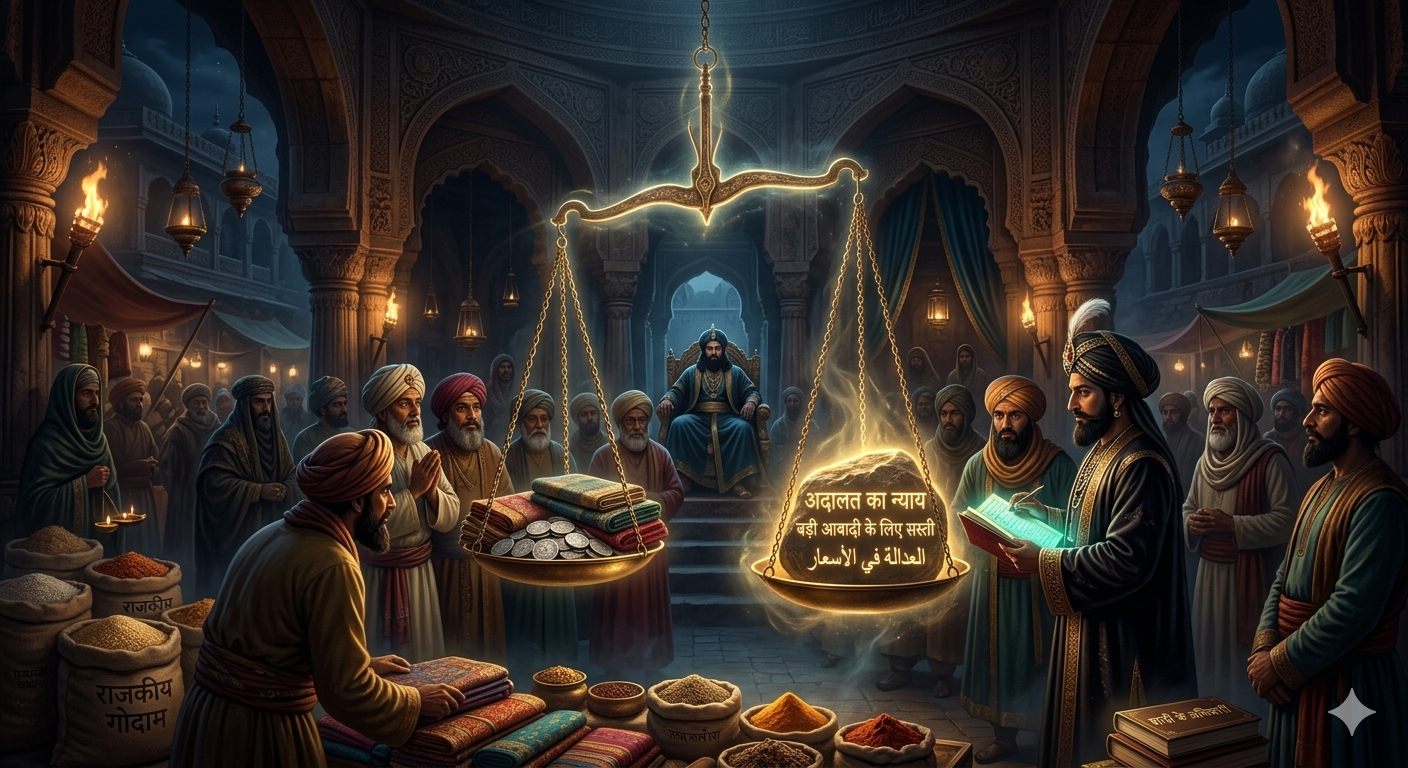
One of the most remarkable features of Alauddin’s reforms was his strict market regulation system.
(a) Establishment of Separate Markets
He organized markets in Delhi into different categories:
- Grain Market (Mandi)
- Cloth and Luxury Goods Market
- Horse, Slave, and Cattle Market
Each market was supervised by officials to ensure smooth functioning.
(b) Fixation of Prices
- Prices of essential commodities were fixed by the state.
- Traders were not allowed to charge above prescribed rates.
Examples of Controlled Commodities:
- Wheat, rice, barley
- Cloth and sugar
- Horses and slaves
(c) Appointment of Market Officials
- Shahna-i-Mandi – Chief market controller
- Barids (intelligence officers) – Reported irregularities
- Munhiyans (secret spies) – Ensured compliance
This multi-layered system ensured strict monitoring.
(d) Strict Enforcement and Punishments
- Harsh punishments for hoarding, black marketing, and overpricing
- Confiscation of goods and fines
This created a climate of fear but ensured discipline.
2. Regulation of Supply and Storage
(a) Control over Grain Supply
- Grain was brought directly from villages to markets
- Ban on hoarding by traders
(b) State Granaries
- Large granaries were maintained by the state
- Used to stabilize prices during shortages
(c) Transportation Arrangements
- Efficient transport system ensured regular supply
- Prevented artificial scarcity
3. Revenue Reforms
(a) Measurement of Land
Alauddin introduced systematic land measurement in the Doab region (between Ganga and Yamuna).
- Ensured accurate assessment of land revenue
- Reduced corruption by intermediaries
(b) Increase in Land Revenue
- Land revenue was fixed at around 50% of the produce
- Collected directly from peasants
(c) Elimination of Intermediaries
- Reduced role of local chiefs (Khuts, Muqaddams)
- Direct collection strengthened central authority
(d) Additional Taxes
- Ghari (house tax)
- Charai (grazing tax)
These increased state income significantly.
4. Control over Trade and Merchants
(a) Registration of Traders
- All merchants were required to register with the government
- Ensured accountability
(b) Licensing System
- Only licensed traders could operate
- Prevented illegal trading activities
(c) Ban on Hoarding and Black Marketing
- Strict surveillance ensured fair trade
- Traders could not store goods to manipulate prices
5. Regulation of Weights and Measures
Standardized weights and measures were introduced
- Prevented cheating and ensured fairness
6. Horse Trade Reforms
- Horses were essential for cavalry
- Prices of horses were fixed
- Quality was strictly inspected
This ensured a strong and efficient military force.
7. Control over Nobility and Wealth Accumulation
- Nobles were prohibited from extravagant spending
- Confiscation of excess wealth
- Restrictions on social gatherings and marriages
These measures reduced the chances of rebellion.
Impact of Economic Reforms
1. Impact on the Military
- Enabled maintenance of a large standing army
- Soldiers could sustain themselves with low wages due to low prices
- Strengthened defense against Mongols
2. Impact on the Economy
- Stabilized prices of essential goods
- Reduced inflation
- Ensured availability of commodities
3. Impact on Society
- Peasants faced heavy taxation
- Traders suffered due to strict regulations
- Common people benefited from stable prices
4. Impact on Administration
- Strengthened central authority
- Reduced corruption
- Improved efficiency in governance
Evaluation of Effectiveness
1. Successes of the Reforms
(a) Strong Central Control
- The Sultan maintained tight control over markets and resources
- Reduced autonomy of local elites
(b) Efficient Military System
- Economic reforms directly supported military expansion
- Ensured stability against external threats
(c) Price Stability
- One of the earliest examples of price control in history
- Successfully controlled inflation
(d) Prevention of Rebellions
- Economic restrictions weakened nobles
- Reduced chances of internal uprisings
2. Limitations of the Reforms
(a) Harsh and Authoritarian Nature
- Policies were enforced through fear and punishment
- Lack of voluntary compliance
(b) Burden on Peasants
- High land revenue caused distress
- Reduced agricultural incentives
(c) Impact on Traders
- Profit margins were restricted
- Discouraged trade expansion
(d) Lack of Sustainability
- System depended heavily on Alauddin’s personal authority
- Collapsed after his death
Comparison with Other Rulers
- Unlike earlier rulers of the Delhi Sultanate, Alauddin introduced direct economic intervention.
- His policies were more systematic than those of predecessors.
- Later rulers, including those of the Mughal Empire, adopted some elements like land measurement but avoided extreme market control.
Historical Significance
- First large-scale attempt at state-controlled economy in India
- Demonstrated the link between economy and military power
- Influenced later administrative reforms
Critical Analysis
Alauddin Khalji’s economic reforms were pragmatic rather than ideological. His primary aim was not public welfare but political stability and military strength.
While the reforms were effective in the short term, they lacked institutional backing and sustainability. The heavy reliance on strict enforcement and the absence of administrative continuity led to their decline after his death.
However, his ability to regulate markets, control prices, and manage resources on such a large scale highlights his administrative genius.
Conclusion
The economic and market reforms of Alauddin Khalji were revolutionary in the context of medieval India. They successfully strengthened the financial and military foundations of the Delhi Sultanate, ensuring stability during his reign.
Despite their limitations, these reforms remain a landmark in Indian economic history, showcasing an early example of centralized economic planning and state intervention.