Introduction
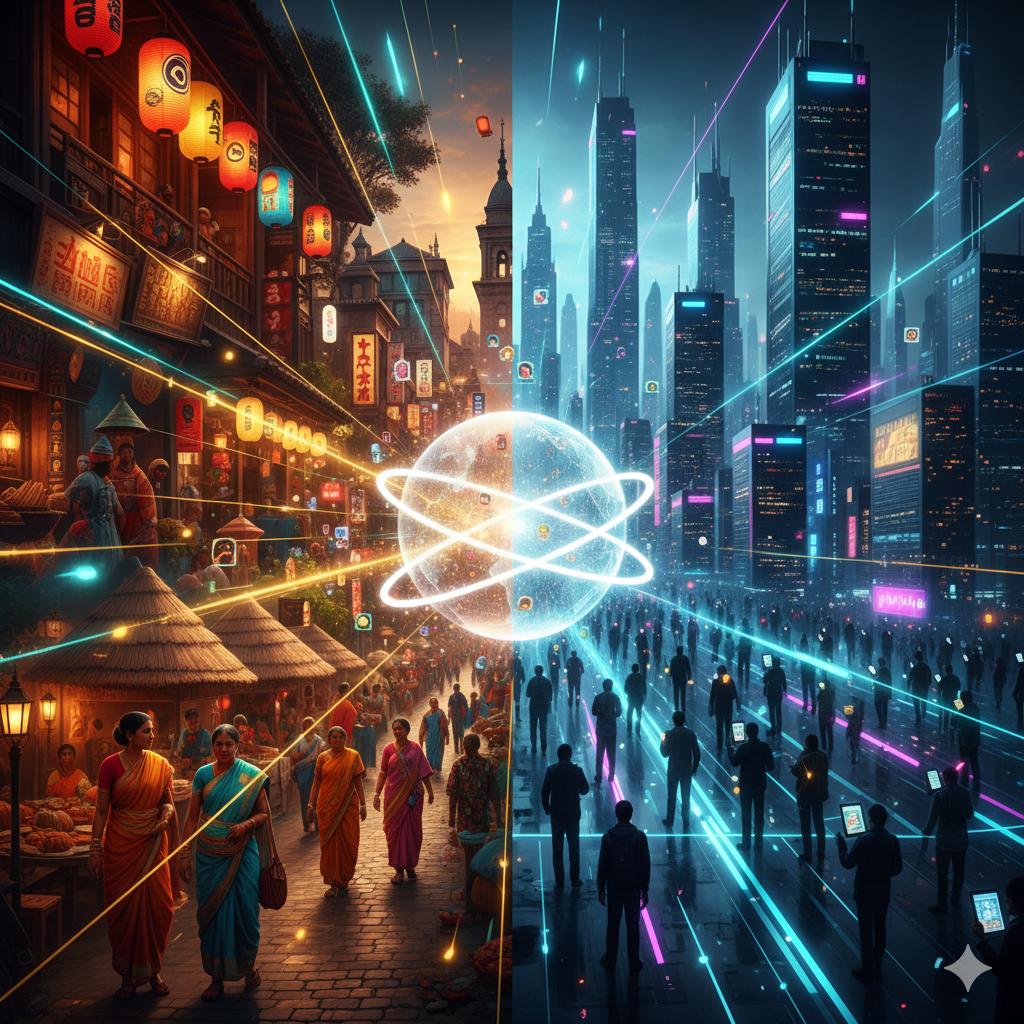
The 21st century is defined by unprecedented global interconnectedness. Advances in communication, transportation, and digital technology have compressed distances and blurred boundaries between nations and cultures. Ideas, lifestyles, fashion, food habits, and work practices now travel across continents within seconds. While this global integration has created immense economic opportunities and cultural exchanges, it has also raised a fundamental question: Are we gradually losing our local identities in the pursuit of a global identity?
Local identity refers to the traditions, languages, customs, art forms, social values, and collective memories that define a community. Global identity, on the other hand, reflects shared modern lifestyles influenced by international media, consumer culture, and standardized professional norms. The tension between these two forces is increasingly visible in societies like India, where ancient cultural roots coexist with rapid modernization.
This essay critically examines whether globalization is eroding local identities or reshaping them, and explores how societies can balance cultural preservation with global participation.
Understanding Local and Global Identity
Local identity emerges from geography, history, and social experience. It includes regional languages, festivals, food habits, architecture, folk arts, and community relationships. These elements provide individuals with a sense of belonging and continuity.
Global identity represents a shared modern consciousness shaped by multinational corporations, digital platforms, global education systems, and cosmopolitan lifestyles. English as a working language, fast food chains, Western fashion, and standardized corporate culture are examples of global influences.
The interaction between these two identities is not always confrontational; often it is complex and layered.
Drivers of Global Identity
Several forces accelerate the spread of global identity:
Globalization of Markets
International brands dominate retail spaces, replacing local crafts and traditional products. Shopping malls and online platforms offer uniform experiences across cities worldwide.
Digital Revolution
Social media, streaming services, and global news networks expose people to similar content regardless of location, shaping aspirations and behavior patterns.
Urbanization
Cities attract migrants from diverse regions and encourage cosmopolitan lifestyles. Urban living often weakens traditional community structures.
Education and Employment
Global curricula and multinational workplaces prioritize universal skills over local knowledge, influencing youth perspectives.
Signs of Erosion of Local Identity
1. Decline of Regional Languages
English increasingly dominates professional and educational spaces. Many young people struggle to read or write in their mother tongues. As language fades, cultural expressions also weaken.
2. Homogenization of Lifestyle
Food chains, clothing brands, and entertainment preferences appear similar across countries. Traditional attire and indigenous cuisines are often reserved for festivals rather than daily life.
3. Marginalization of Folk Arts and Crafts
Handloom weaving, folk music, traditional dance, and rural craftsmanship face declining patronage as mass-produced alternatives become cheaper and more accessible.
4. Changing Family and Community Structures
Joint families are giving way to nuclear households. Neighborhood bonds weaken as mobility increases. Rituals once practiced collectively now occur privately or disappear altogether.
5. Cultural Simplification Through Media
Complex traditions are reduced to stereotypes or aesthetic visuals on digital platforms, stripping them of philosophical depth.
Is Global Identity Entirely Negative?
While concerns about cultural loss are valid, globalization also brings positive transformations.
Cultural Exchange and Mutual Learning
Global interaction allows communities to learn from one another. Yoga, Ayurveda, Indian cuisine, and meditation have gained global recognition, illustrating how local practices can achieve universal relevance.
Empowerment Through Connectivity
Digital platforms enable artisans, writers, and performers to reach international audiences. Local voices are no longer confined by geography.
Modern Values and Social Reform
Global exposure promotes ideas of gender equality, human rights, and environmental awareness, sometimes accelerating social change.
Hybrid Identities
Rather than replacing local identity, globalization often creates hybrid cultures—where traditional practices coexist with modern lifestyles.
Indian Context: A Case of Cultural Adaptation
India offers a unique example of cultural resilience. Despite global influences, regional festivals, languages, and traditions remain vibrant.
Examples include:
- Durga Puja celebrated in metros
- Regional food streets in urban centers
- Revival of handloom through digital markets
- Classical music festivals attracting young audiences
These demonstrate adaptation rather than extinction.
However, challenges persist, especially among urban youth who may feel disconnected from ancestral heritage.
Economic Dimensions of Identity Loss
Global supply chains favor standardized products over localized production. Small farmers and artisans struggle to compete with multinational corporations.
This economic displacement leads to cultural erosion, as livelihoods linked to tradition decline.
Education and Cultural Disconnect
Modern education emphasizes technical competence but often neglects cultural literacy. Students learn global history but remain unaware of local folklore, philosophy, and heritage.
Without institutional support, cultural transmission depends solely on families.
Identity Crisis Among Youth
Young people frequently navigate conflicting expectations: traditional values at home and global norms outside. This can create confusion, alienation, and a sense of rootlessness.
Are We Losing Identity or Transforming It?
Rather than a complete loss, what is occurring is cultural transformation.
Local identities are being reinterpreted in contemporary contexts. Traditional weddings incorporate modern elements; folk music blends with electronic rhythms; regional cuisines adapt to health-conscious trends.
This evolution reflects continuity through change.
Need for Cultural Balance
Sustainable development requires cultural grounding.
Key Strategies
Strengthening Regional Languages
Integrate mother tongues into early education.
Supporting Local Economies
Promote handicrafts, indigenous agriculture, and cultural tourism.
Cultural Education
Include heritage studies in school curricula.
Digital Preservation
Use technology to document and share traditions.
Community Participation
Encourage intergenerational storytelling and local festivals.
Role of Policy and Governance
Governments must:
- Protect heritage sites
- Fund cultural institutions
- Support creative industries
- Encourage decentralized development
Civil society and media also play vital roles in shaping cultural narratives.
Conclusion
We are not necessarily losing our local identity to a global one; rather, we are navigating a complex cultural transition. Globalization presents both risks and opportunities. While unchecked homogenization can weaken traditions, conscious engagement can strengthen cultural confidence.
Local identity need not oppose global belonging. A society rooted in its heritage can participate globally without surrendering its uniqueness. The challenge lies in preserving cultural depth while embracing modernity.
Ultimately, identity is not static—it evolves. The task before us is to ensure that this evolution remains inclusive, respectful, and anchored in collective memory. Only then can globalization become a force for cultural enrichment rather than erasure.