Introduction
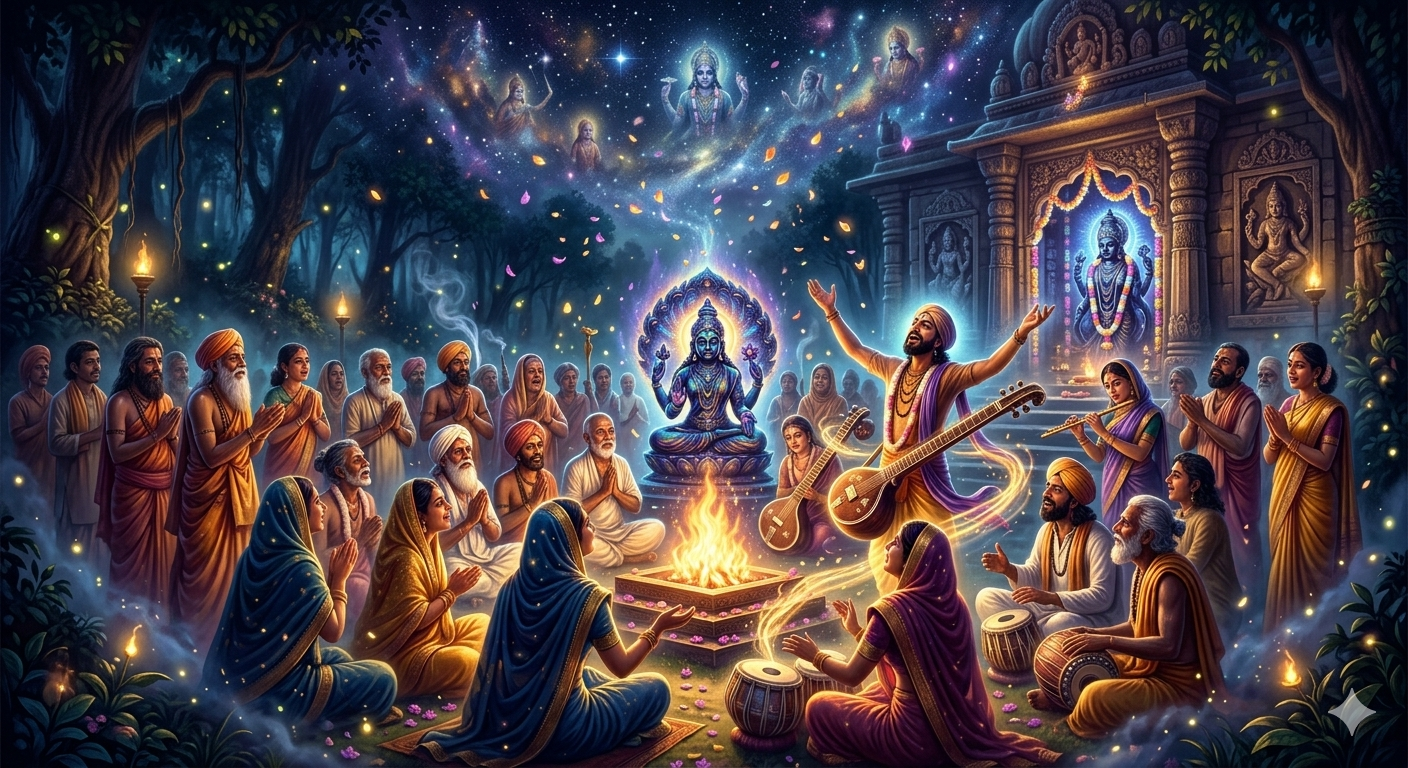
The Bhakti Movement was a major socio-religious transformation in medieval India that emphasized devotion as the primary path to salvation. Emerging first in South India and later spreading across the subcontinent, it brought religion closer to the common people by simplifying spiritual practices and rejecting rigid orthodoxy. Saints like Kabir, Guru Nanak, and Mirabai played a crucial role in spreading its message of love, equality, and devotion.
The movement not only transformed religious practices but also deeply influenced Indian society, culture, and language.
Causes of the Bhakti Movement
Reaction Against Ritualism and Religious Complexity
During the medieval period, religion had become dominated by elaborate rituals and priestly authority, making it inaccessible to the common people. The Brahmanical system emphasized ceremonies, sacrifices, and strict adherence to religious texts, which required the mediation of priests. This created a sense of exclusion among the masses, especially the lower castes.
In this context, the Bhakti Movement emerged as a reformative force that advocated direct connection with God through devotion, eliminating the need for intermediaries. It simplified religious practices, making spirituality more personal and inclusive.
Opposition to the Rigid Caste System
The caste system had become highly rigid, leading to widespread social discrimination and inequality. Lower castes were deprived of religious rights and social dignity, and untouchability was prevalent.
Bhakti saints strongly opposed these divisions. For example, Kabir openly criticized caste-based discrimination and emphasized that all human beings are equal in the eyes of God. This message resonated deeply with the marginalized sections of society and became a powerful force for social change.
Influence of Islam and the Sufi Movement
The advent of Islam in India introduced new ideas such as monotheism, equality, and simplicity in worship. The Sufi saints, in particular, emphasized love, devotion, and a direct relationship with God, which had striking similarities with Bhakti ideals.
This interaction between Hindu and Islamic traditions created a syncretic environment that encouraged the growth of the Bhakti Movement. It helped in fostering mutual understanding and religious harmony.
Political Instability and Need for Spiritual Solace
The period of the Delhi Sultanate was marked by political upheavals, invasions, and economic challenges. Such instability led to insecurity among the people, who sought emotional and spiritual comfort.
The Bhakti Movement provided this solace by promoting devotion, faith, and inner peace. It offered a sense of hope and stability in uncertain times.
Rise of Vernacular Languages
Another important factor behind the growth of the Bhakti Movement was the emergence of regional languages. Sanskrit, being the language of the elite, was not accessible to the masses.
Bhakti saints composed their teachings in local languages such as Hindi, Tamil, Marathi, and Bengali. This made their message more relatable and understandable, enabling the movement to reach a wider audience.
Nature and Features of the Bhakti Movement
Emphasis on Personal Devotion
At the core of the Bhakti Movement was the idea of personal devotion to a chosen deity. Devotees could establish a direct emotional connection with God without the need for rituals or priestly mediation. This democratization of religion made spirituality accessible to all sections of society.
Rejection of Rituals and Formalism
Bhakti saints rejected elaborate rituals, sacrifices, and religious formalities. They believed that true devotion lay in pure love and surrender to God, not in outward practices. This approach challenged the authority of traditional religious institutions.
Equality and Universal Brotherhood
A defining feature of the movement was its emphasis on equality. It rejected caste distinctions and promoted the idea that all individuals are equal before God. This principle helped in reducing social barriers and fostering a sense of unity.
Use of Vernacular Language and Literature
The use of regional languages played a crucial role in the spread of the Bhakti Movement. Saints composed devotional songs, poems, and hymns that were easily understood by the masses. This led to the growth of vernacular literature and enriched regional cultures.
Impact of the Bhakti Movement on Indian Society
Reduction in Social Inequalities
The Bhakti Movement played a significant role in challenging the rigid caste system. By emphasizing equality and dignity for all, it provided a voice to the marginalized sections of society. Although it could not completely eradicate caste discrimination, it certainly weakened its rigid structure.
Social Integration and Unity
By promoting universal brotherhood and rejecting religious divisions, the movement contributed to social harmony. It encouraged interaction between different communities and reduced tensions between Hindus and Muslims. This spirit of inclusiveness strengthened the social fabric of India.
Empowerment of Women
The Bhakti Movement also provided space for women to participate in religious life. Saints like Mirabai challenged traditional gender roles and expressed their devotion openly. This helped in improving the status of women in society, at least at the spiritual level.
Development of Regional Literature and Culture
The movement led to a rich tradition of devotional literature in various regional languages. Poems, songs, and hymns composed by Bhakti saints became an integral part of Indian cultural heritage. This literary development also strengthened regional identities.
Impact on Religion
Simplification of Religious Practices
The Bhakti Movement made religion simple and accessible. It shifted the focus from rituals and ceremonies to devotion and moral values. This transformation allowed people from all backgrounds to engage in spiritual practices.
Promotion of Religious Tolerance
One of the most important contributions of the Bhakti Movement was the promotion of religious tolerance. Saints like Guru Nanak emphasized the unity of God and rejected religious divisions. This helped in fostering harmony between different religious communities.
Foundation for New Religious Traditions
The teachings of Bhakti saints led to the emergence of new religious traditions, most notably Sikhism. These traditions combined elements of devotion, equality, and social justice, reflecting the core values of the Bhakti Movement.
Critical Evaluation
Positive Aspects
The Bhakti Movement brought about significant social and religious reforms. It challenged orthodoxy, promoted equality, and made religion more accessible. Its emphasis on love, compassion, and devotion had a lasting impact on Indian society.
Limitations
Despite its achievements, the movement had certain limitations. It could not completely eliminate caste discrimination, and some of its teachings remained confined to spiritual domains without leading to major political changes. Additionally, over time, some Bhakti sects themselves developed rigid structures.
Conclusion
The Bhakti Movement was a transformative force that reshaped Indian society and religion. By promoting devotion, equality, and simplicity, it challenged the rigid structures of medieval society and made spirituality accessible to the masses.
Its influence continues to be visible in Indian culture, literature, and religious practices, making it a crucial topic for understanding the socio-cultural evolution of India.