Introduction
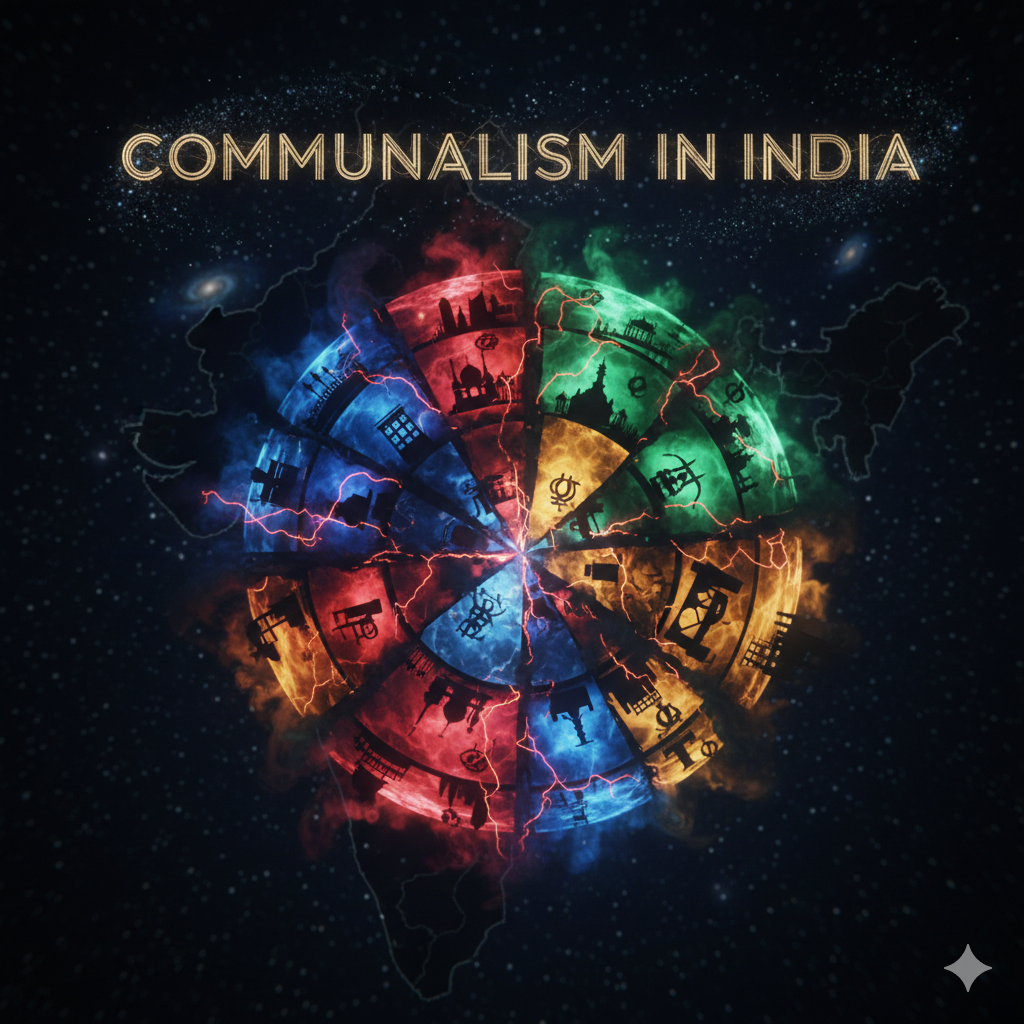
Communalism refers to a social phenomenon in which religious identity becomes the primary basis for political mobilization, social conflict, and group loyalty. In plural societies like India, communalism poses a serious challenge to social harmony and democratic governance. While communal tensions are often portrayed as outcomes of religious differences, a deeper sociological analysis reveals that communalism rarely emerges spontaneously from faith alone.
Instead, communalism is frequently rooted in power struggles and feelings of relative deprivation. Competing elites use religious identities to consolidate political power, while economically or socially marginalized groups may turn to communal ideologies to express frustration and insecurity. This essay argues that communalism is best understood as a product of political competition and perceived inequality rather than merely religious antagonism.
Conceptual Understanding of Communalism
Communalism involves the mobilization of religious communities for political, economic, or social advantage. It transforms religion from a personal belief system into a collective identity used to assert dominance or resist marginalization.
Key characteristics include:
- Politicization of religious identity
- Construction of “us versus them” narratives
- Mobilization through symbols, myths, and historical grievances
- Use of fear and insecurity to gain support
Thus, communalism operates less as a theological issue and more as a socio-political strategy.
Power Struggle as a Root Cause of Communalism
Political Competition and Vote Bank Politics
In democratic systems, political parties often seek mass support by appealing to group identities. Religion becomes a convenient mobilizing tool, especially in regions where socio-economic grievances are high.
Electoral competition encourages leaders to:
- Polarize communities
- Emphasize historical injustices
- Project themselves as protectors of religious interests
Such strategies convert religious differences into political capital.
Elite Manipulation
Communal narratives are frequently shaped by elites who benefit from social divisions. By diverting attention from governance failures, unemployment, or corruption, communal polarization helps maintain political dominance.
Illustration: During periods of intense electoral rivalry, communal rhetoric often intensifies, suggesting that power struggles drive identity-based mobilization.
Historical Illustrations of Power-Based Communalism
Colonial Period
British colonial policies institutionalized religious divisions through separate electorates and census classifications. This administrative segregation intensified Hindu-Muslim identities and laid the foundation for communal politics.
The eventual partition of India reflected elite negotiations over power rather than mass religious hatred alone.
Post-Independence Politics
In independent India, communalism resurfaces during periods of political instability or leadership transitions. Competing groups invoke religious identity to consolidate support and challenge rivals.
Relative Deprivation and Communal Mobilization
Understanding Relative Deprivation
Relative deprivation refers to the perception of being disadvantaged compared to others, even if absolute living standards improve. When communities feel excluded from opportunities, they become vulnerable to identity-based mobilization.
Such feelings may arise due to:
- Economic inequality
- Lack of employment
- Educational disparities
- Regional underdevelopment
- Social discrimination
Communal ideologies provide emotional comfort and a sense of belonging.
Economic Insecurity and Identity Politics
Marginalized populations often experience frustration due to limited access to resources. Political actors redirect this frustration toward religious “others,” framing deprivation as the result of favoritism or conspiracy.
This transforms economic grievances into communal hostility.
Urbanization and Communal Tensions
Rapid urbanization creates competition over housing, jobs, and services. Migrant communities struggle for survival in informal settlements, where scarcity intensifies group identities.
In such contexts, religious affiliation becomes a marker of solidarity and protection, enabling leaders to mobilize collective anger.
Youth Unemployment and Communal Radicalization
Young people facing joblessness and social exclusion are particularly susceptible to communal narratives. Identity-based movements offer purpose, recognition, and a sense of power otherwise lacking in their lives.
This explains why communal mobilization often targets youth populations during periods of economic slowdown.
Role of Historical Memory and Symbolism
Political actors frequently revive historical grievances to legitimize present-day power struggles. Selective interpretations of history create narratives of victimhood and heroism.
These symbolic constructions deepen communal divides and justify contemporary political agendas.
Media and Social Media Amplification
Modern communication technologies amplify communal sentiments. Misinformation and emotionally charged content spread rapidly, reinforcing perceptions of injustice and threat.
Digital platforms enable rapid mobilization, turning localized disputes into widespread communal conflicts.
Illustrations from Indian Society
Electoral Polarization
Communal narratives often intensify before elections, highlighting the link between power competition and identity mobilization.
Economic Backward Regions
Communal tensions are more frequent in areas experiencing chronic poverty or unemployment, supporting the argument that relative deprivation fuels resentment.
Local Resource Conflicts
Disputes over land, temples, mosques, or marketplaces are frequently framed in religious terms, though underlying causes involve economic or political control.
Communalism as a Distraction from Development
By focusing public attention on identity conflicts, leaders avoid accountability for development failures. Communal polarization weakens collective demands for education, healthcare, and employment.
Thus, communalism serves as a tool for maintaining unequal power structures.
Counterarguments: Is Religion Alone Responsible?
Some argue that religious differences inherently cause conflict. However, India’s long history of coexistence contradicts this view. Communities lived peacefully for centuries before modern political mobilization.
Religious diversity becomes problematic primarily when manipulated for power or when social inequalities remain unresolved.
Role of Institutions in Mitigating Communalism
Strong institutions reduce the appeal of communal politics. Transparent governance, inclusive development, and effective law enforcement can address grievances before they turn into identity conflicts.
Education promoting constitutional values also weakens divisive narratives.
Toward a Non-Communal Society
Combating communalism requires:
- Inclusive economic growth
- Fair political representation
- Dialogue across communities
- Responsible media practices
- Strengthening secular institutions
Reducing inequality and ensuring dignity for all citizens are essential for long-term harmony.
Conclusion
Communalism does not arise merely from religious differences; it is deeply embedded in struggles for power and perceptions of relative deprivation. Political elites exploit identity to secure authority, while marginalized groups seek meaning and security through communal affiliations.
Indian experience clearly demonstrates that communalism thrives where inequalities persist and democratic competition turns divisive. Addressing economic injustice, strengthening institutions, and promoting social cohesion are therefore critical to countering communalism.
Ultimately, sustainable peace depends not on suppressing identities but on creating a society where power is shared equitably and development reaches every community.