Introduction
The religious policies of Mughal rulers played a crucial role in shaping the political and social stability of the empire. Among them, Akbar and Aurangzeb stand out as two contrasting figures.
While Akbar is known for his policy of tolerance and inclusiveness, Aurangzeb is often associated with religious orthodoxy. Their differing approaches had profound consequences on the cohesion, legitimacy, and long-term stability of the Mughal Empire.
Religious Policy of Akbar
Philosophy of Sulh-i-Kul (Universal Tolerance)
Akbar’s religious policy was based on the principle of Sulh-i-Kul (peace with all).
Key Features
- Equal respect for all religions
- Promotion of harmony among diverse communities
- Separation of religion from state politics
This approach helped in creating an inclusive empire where subjects of different faiths felt secure.
Abolition of Discriminatory Taxes
Akbar took significant steps to reduce religious discrimination:
- Abolished Jizya (tax on non-Muslims)
- Removed pilgrimage taxes
These reforms improved the economic and social conditions of non-Muslims and enhanced loyalty towards the state.
Religious Debates and Intellectual Exchange
Akbar encouraged discussions on religion:
- Established Ibadat Khana at Fatehpur Sikri
- Invited scholars from different religions—Hindus, Muslims, Christians, Jains, and Zoroastrians
This fostered a culture of intellectual openness and mutual respect.
Din-i-Ilahi: A Syncretic Experiment
Akbar introduced Din-i-Ilahi, a spiritual order combining elements of various religions.
- Emphasized ethical conduct and loyalty
- Not a mass religion, but a personal initiative
Though limited in scope, it reflected Akbar’s attempt to transcend religious divisions.
Inclusion of Non-Muslims in Administration
Akbar adopted an inclusive administrative policy:
- Appointed Hindus, especially Rajputs, to high positions
- Strengthened alliances through marriages
This integration ensured political stability and administrative efficiency.
Religious Policy of Aurangzeb
Orthodox Sunni Approach
Aurangzeb followed a more conservative interpretation of Islam.
Key Features
- Emphasis on Islamic law (Sharia)
- Reversal of some liberal policies of Akbar
- Promotion of orthodox practices
Reimposition of Jizya
Aurangzeb reintroduced the Jizya tax on non-Muslims:
- Symbolized religious discrimination
- Created resentment among Hindu subjects
This move weakened the bond between the ruler and a large section of the population.
Temple Policies
Aurangzeb’s policies towards temples included:
- Destruction of some temples (especially in politically sensitive areas)
- Restrictions on construction of new temples
These actions contributed to tensions between communities.
Exclusionary Tendencies in Administration
Although some Hindus continued to serve, Aurangzeb’s policies showed:
- Reduced emphasis on inclusivity
- Preference for orthodox elements
This limited the broad-based support that earlier rulers had enjoyed.
Religious Regulations
Aurangzeb imposed stricter social controls:
- Banned certain practices considered un-Islamic
- Enforced moral regulations
These measures affected cultural freedom and diversity.
Comparison of Religious Policies
1. Ideological Approach
- Akbar: Liberal, inclusive, and secular outlook
- Aurangzeb: Conservative, orthodox, and religion-centered
Akbar sought unity through diversity, while Aurangzeb emphasized religious conformity.
2. Treatment of Non-Muslims
- Akbar: Equal treatment, abolition of Jizya
- Aurangzeb: Reimposition of Jizya, discriminatory policies
This difference significantly affected social harmony.
3. Role of Religion in Governance
- Akbar: Religion kept separate from administration
- Aurangzeb: Religion closely linked with governance
4. Cultural Impact
- Akbar: Encouraged cultural synthesis and pluralism
- Aurangzeb: Restricted certain cultural practices
5. Administrative Inclusivity
- Akbar: Inclusive and merit-based
- Aurangzeb: Relatively narrow and less inclusive
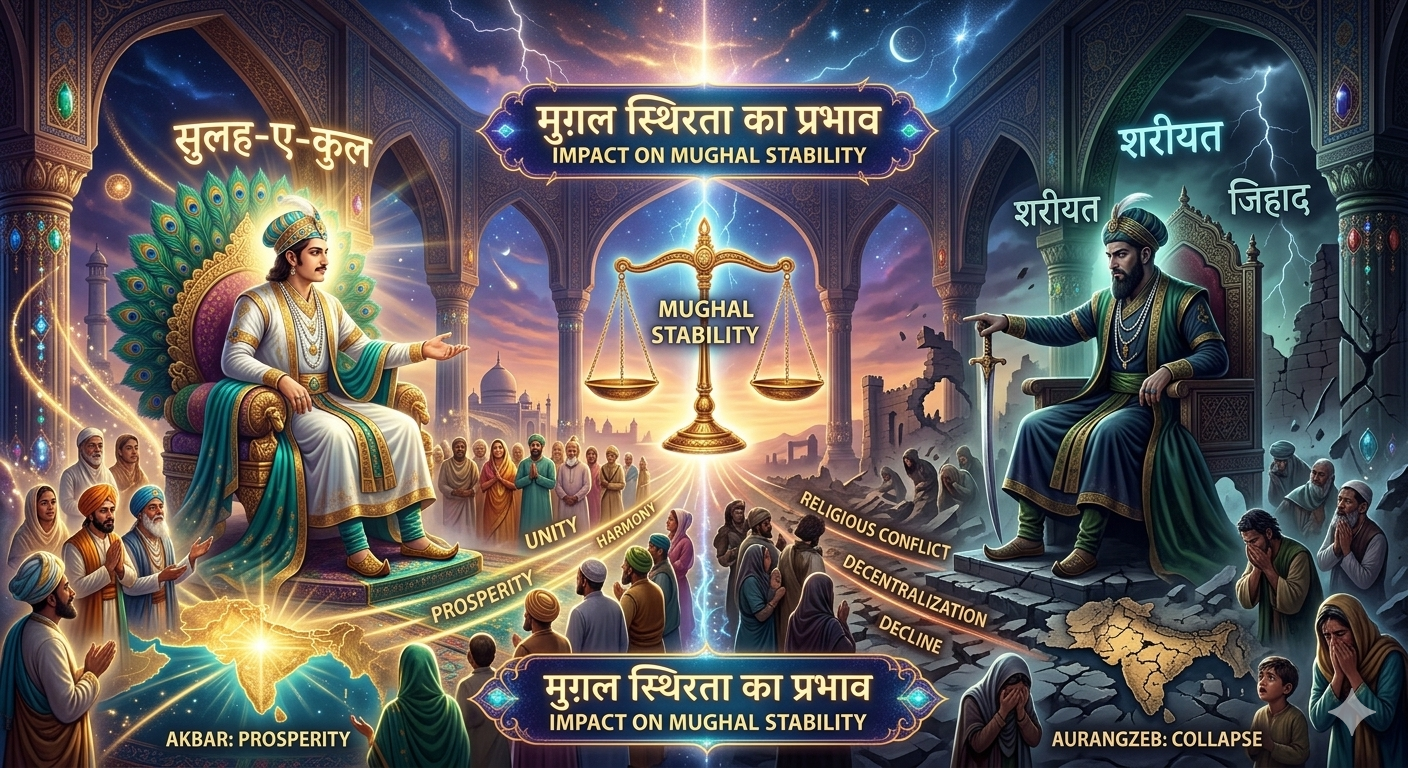
Impact on Stability of the Mughal Empire
Impact of Akbar’s Policies
1. Political Stability and Expansion
Akbar’s inclusive policies:
- Won loyalty of diverse groups
- Facilitated expansion of the empire
Rajput alliances played a key role in strengthening the state.
2. Social Harmony
- Reduced religious conflicts
- Promoted unity among different communities
This created a stable and cohesive society.
3. Economic Growth
- Removal of discriminatory taxes encouraged trade and agriculture
- Increased participation of various communities in economic activities
4. Strong Legitimacy
Akbar was seen as a just and fair ruler, enhancing the legitimacy of his rule.
Impact of Aurangzeb’s Policies
1. Rise of Regional Revolts
Aurangzeb’s policies contributed to rebellions:
- Marathas under Shivaji
- Jats, Sikhs, and Rajputs
These revolts weakened the empire.
2. Decline in Social Cohesion
- Increased religious tensions
- Alienation of non-Muslim population
3. Administrative Weakness
- Reduced cooperation from local elites
- Difficulty in managing vast territories
4. Economic Strain
- Continuous wars and revolts drained resources
- Decline in revenue collection
5. Loss of Legitimacy
Aurangzeb’s policies reduced the perception of the emperor as a universal ruler, limiting his support base.
Critical Evaluation
Strengths of Akbar’s Approach
- Promoted unity in diversity
- Ensured long-term stability
- Created a strong administrative base
Limitations of Akbar’s Policy
- Din-i-Ilahi lacked mass appeal
- Some opposition from orthodox sections
Strengths of Aurangzeb’s Approach
- Strong personal discipline
- Attempt to enforce moral order
Limitations of Aurangzeb’s Policy
- Alienated large sections of society
- Increased internal conflicts
- Overemphasis on religious orthodoxy
Historical Significance
The contrasting policies of Akbar and Aurangzeb highlight two different models of governance:
- Inclusive and pluralistic
- Exclusive and orthodox
The success of Akbar’s model demonstrates the importance of tolerance in a diverse society, while Aurangzeb’s policies illustrate the risks of rigid approaches.
Conclusion
The religious policies of Akbar and Aurangzeb had a profound impact on the stability of the Mughal Empire.
Akbar’s inclusive and tolerant approach strengthened the empire by fostering unity, loyalty, and economic growth. In contrast, Aurangzeb’s orthodox policies contributed to divisions, rebellions, and eventual decline.
Thus, the comparison clearly shows that religious tolerance and inclusivity were key factors in maintaining political stability in a diverse empire like Mughal India.