Introduction
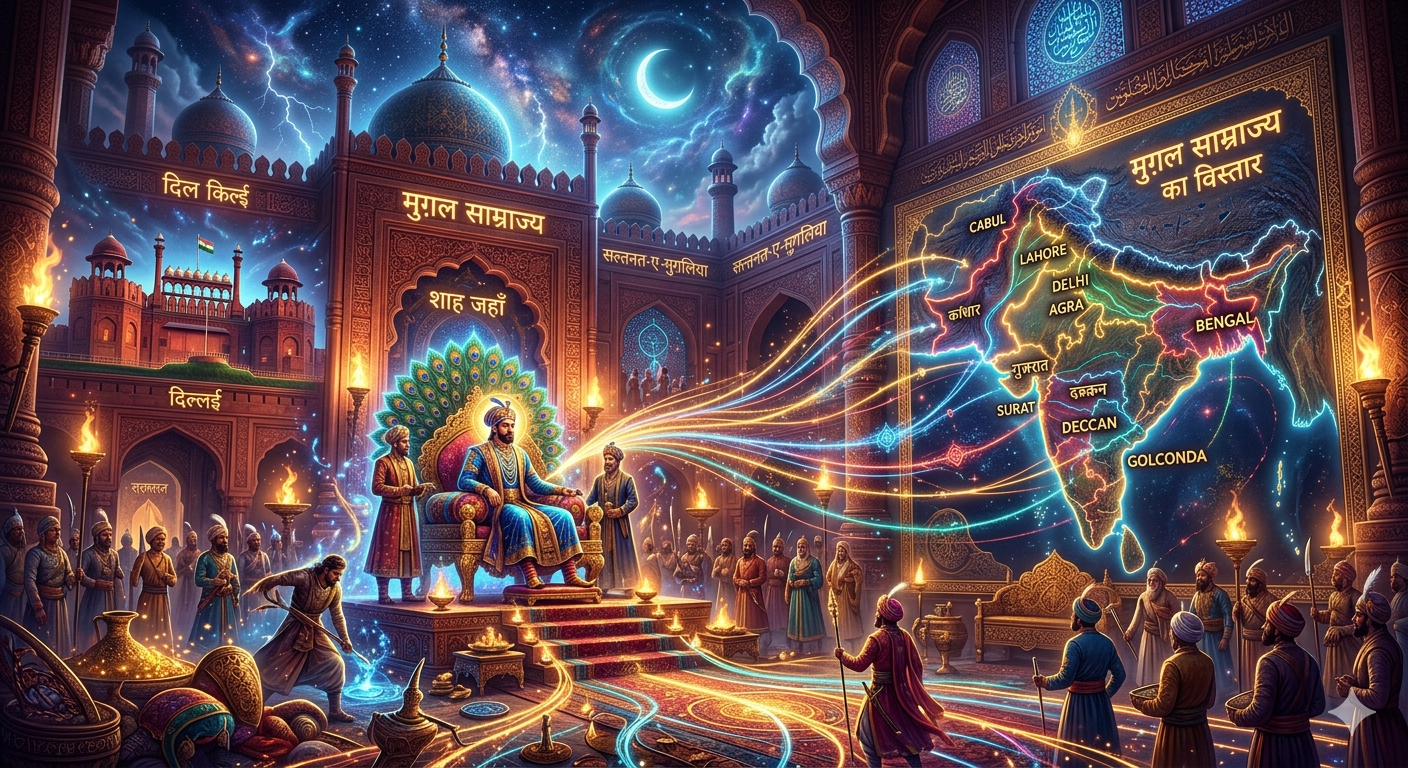
The Mughal Empire was one of the most powerful and sophisticated empires in Indian history, ruling large parts of the Indian subcontinent from the early 16th to the mid-18th century. Founded by Babur in 1526, the empire reached its zenith under rulers like Akbar, Jahangir, and Shah Jahan. However, after the long reign of Aurangzeb, the empire began to decline rapidly.
The decline of the Mughal Empire was not a sudden event but a gradual process caused by a combination of political, administrative, economic, military, and social factors. Its consequences were far-reaching, leading to the fragmentation of power and the eventual establishment of colonial rule in India.
Major Causes of the Decline of the Mughal Empire
Political Causes
Weak Successors after Aurangzeb
After Aurangzeb’s death in 1707, the Mughal Empire suffered from a lack of strong leadership.
- His successors were largely incompetent and lacked administrative skills.
- Frequent succession wars weakened central authority.
- Emperors became puppets in the hands of powerful nobles.
This leadership vacuum significantly contributed to the disintegration of the empire.
War of Succession
The Mughal tradition of no fixed law of succession led to continuous conflicts.
- Every emperor’s death triggered civil wars among princes.
- Resources were wasted in internal conflicts rather than governance.
- Political instability weakened the empire’s foundations.
Rise of Regional Powers
As central authority declined, regional powers began asserting independence.
- The Marathas, Sikhs, Jats, and Rajputs challenged Mughal authority.
- Governors of provinces like Bengal, Awadh, and Hyderabad became autonomous.
Impact
- Fragmentation of the empire into smaller states.
- Loss of revenue and control over territories.
Administrative Causes
Breakdown of the Mansabdari System
The Mansabdari system, which was the backbone of Mughal administration, began to deteriorate.
- Corruption and inefficiency increased among officials.
- Jagirdars exploited peasants to maximize revenue.
- Shortage of jagirs created conflicts among nobles.
Over-Centralization of Power
- The Mughal system relied heavily on the emperor’s personal authority.
- Weak rulers failed to maintain control over distant provinces.
- Lack of institutional stability led to administrative collapse.
Economic Causes
Agrarian Crisis
The Mughal economy was primarily agrarian.
- Heavy taxation burdened peasants.
- Frequent wars disrupted agricultural production.
- Peasant revolts became common.
Decline in Trade and Commerce
- Continuous warfare disrupted trade routes.
- Decline in internal and external trade reduced state revenue.
- European trading companies began dominating trade.
Financial Crisis
- Excessive military expenditure drained the treasury.
- Luxurious lifestyles of rulers and nobles added to economic strain.
- Decline in revenue collection efficiency worsened the situation.
Military Causes
Weakening of the Mughal Army
- The Mughal army became outdated and inefficient.
- Lack of modernization in weapons and tactics.
- Soldiers were poorly trained and less disciplined.
Failure in Deccan Campaigns
Aurangzeb’s prolonged campaigns in the Deccan weakened the empire.
- Drained financial and military resources.
- Failed to fully control the region.
- Strengthened enemies like the Marathas.
Religious and Social Causes
Religious Intolerance under Aurangzeb
- Re-imposition of Jizya tax created resentment among non-Muslims.
- Destruction of temples led to alienation of Hindu subjects.
- Policies weakened the unity established by Akbar.
Rise of Social and Religious Movements
- Sikh and Maratha movements gained strength.
- Peasant uprisings and local rebellions increased.
- Social unrest destabilized the empire.
External Causes
Foreign Invasions
The weakened Mughal Empire became vulnerable to foreign invasions.
- Nadir Shah invaded India in 1739.
- He looted Delhi and took immense wealth, including the Peacock Throne.
- Ahmad Shah Abdali conducted repeated invasions.
- His invasions further destabilized North India.
Impact
- Massive economic loss.
- Loss of prestige and authority of the Mughal rulers.
Role of European Powers
- European companies like the British East India Company gained influence.
- They exploited political instability for economic and territorial gains.
- Gradually, they replaced Mughal authority.
Consequences of the Decline of the Mughal Empire
Political Consequences
Fragmentation of the Empire
- The Mughal Empire broke into several regional states.
- Independent kingdoms like Bengal, Awadh, and Hyderabad emerged.
Rise of the Maratha Power
- The Marathas became the dominant power in India.
- They expanded their influence across large parts of the subcontinent.
Emergence of New Regional States
- Sikhs established power in Punjab.
- Jats and Rajputs strengthened their positions.
Economic Consequences
Economic Decline
- Decline in agriculture and trade.
- Destruction caused by wars and invasions.
Exploitation by Foreign Powers
- European companies exploited India’s resources.
- Wealth drain began during this period.
Social Consequences
Instability and Insecurity
- Continuous warfare created chaos.
- People suffered from violence and uncertainty.
Peasant Distress
- Heavy taxation and exploitation increased poverty.
- Frequent revolts reflected social unrest.
Cultural Consequences
Decline of Mughal Patronage
- Reduced support for art, architecture, and literature.
- Cultural activities declined due to lack of resources.
Regional Cultural Growth
- Rise of regional cultures and languages.
- Decentralization led to cultural diversity.
Impact on Indian History
Foundation for British Rule
- Political fragmentation made it easier for the British to establish control.
- The decline of centralized authority facilitated colonial expansion.
End of a Centralized Empire
- Marked the end of a powerful centralized state in India.
- Transition to regional and colonial rule.
Critical Evaluation
Was Aurangzeb Responsible?
While Aurangzeb’s policies contributed to the decline:
- Structural weaknesses already existed.
- Over-expansion made governance difficult.
- Economic and administrative issues played a major role.
Thus, the decline cannot be attributed to a single ruler alone.
Combination of Factors
The decline of the Mughal Empire was due to multiple interconnected causes:
- Political instability
- Administrative inefficiency
- Economic crisis
- Military weakness
- External invasions
No single factor can fully explain the collapse.
Conclusion
The decline of the Mughal Empire was a complex and gradual process shaped by internal weaknesses and external pressures. Weak leadership after Aurangzeb, administrative breakdown, economic crisis, and rising regional powers collectively led to its downfall.
The consequences of this decline were profound, resulting in political fragmentation, economic disruption, and the eventual rise of British colonial rule in India. Despite its fall, the Mughal Empire left a lasting legacy in Indian culture, architecture, and governance.
Understanding its decline provides valuable insights into the dynamics of empire-building and the challenges of sustaining a vast and diverse political system.