Introduction
The administrative system of the Delhi Sultanate (1206–1526 CE) marked a significant transformation in the governance of the Indian subcontinent. Established by Turkish rulers, the Sultanate introduced a centralized, military-oriented, and Islamic-based administrative framework. It combined elements of Persian, Central Asian, and indigenous Indian traditions, creating a unique administrative model. This system not only ensured political control over vast territories but also laid the foundation for later Mughal governance.
Understanding the administrative structure of the Delhi Sultanate is crucial for analyzing how medieval India transitioned from decentralized regional kingdoms to a more centralized imperial system.
Administrative Structure of the Delhi Sultanate
1. The Sultan: Supreme Authority
At the apex of the administrative hierarchy stood the Sultan, who was the absolute ruler.
- The Sultan was the head of the state, government, judiciary, and military.
- He derived legitimacy from Islamic principles and, in some cases, recognition from the Caliph.
- The Sultan exercised both executive and legislative powers.
- His authority was theoretically absolute, but in practice, it was limited by nobles, religious leaders, and administrative constraints.
Key Functions of the Sultan
- Law-making and enforcement
- Appointment of officials
- Military command
- Revenue administration
- Protection of the state and religion
The personality and capability of the Sultan greatly influenced the efficiency of administration. Strong rulers like Alauddin Khalji and Muhammad bin Tughlaq centralized power effectively, whereas weak rulers faced rebellions and instability.
2. Central Administration
The central administration consisted of various departments headed by high-ranking officials, each responsible for specific functions.
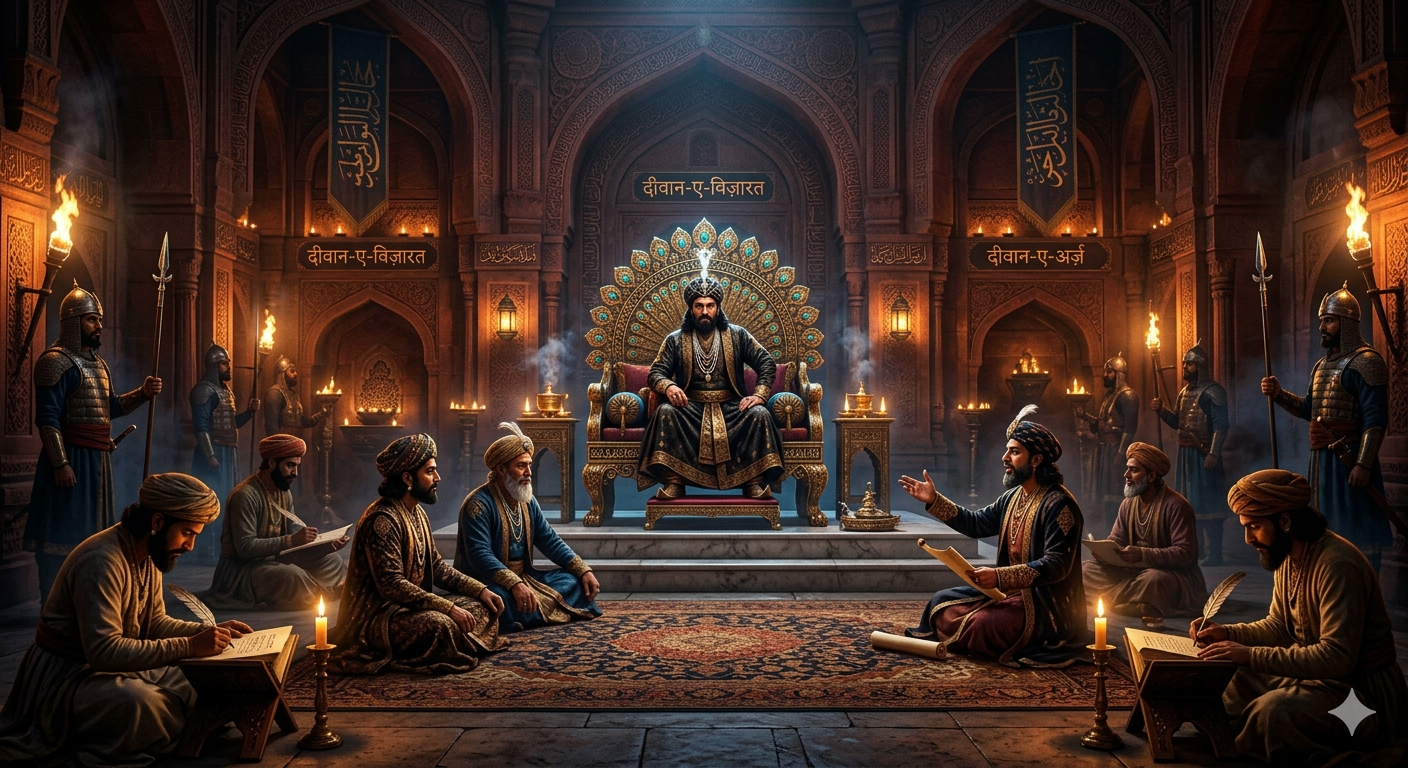
(a) Diwan-i-Wizarat (Finance Department)
- Headed by the Wazir (Prime Minister equivalent).
- Responsible for revenue collection, financial management, and expenditure.
- Maintained records of income from land revenue and other sources.
Functions:
- Assessment and collection of taxes
- Supervision of provincial revenue administration
- Management of state treasury
(b) Diwan-i-Arz (Military Department)
- Headed by the Ariz-i-Mamalik.
- Managed the recruitment, organization, and payment of soldiers.
Key Responsibilities:
- Maintenance of army records
- Inspection of horses (branding system under Alauddin Khalji)
- Payment of salaries
This department ensured a strong and disciplined army, which was essential for maintaining the Sultanate.
(c) Diwan-i-Insha (Royal Correspondence Department)
- Handled official communications and documentation.
- Drafted royal orders, letters, and state documents.
Importance:
- Ensured smooth communication between the Sultan and provincial governors
- Maintained diplomatic correspondence
(d) Diwan-i-Risalat (Religious Affairs Department)
- Dealt with religious matters and endowments.
- Managed grants to scholars, mosques, and religious institutions.
Functions:
- Supervision of Islamic religious practices
- Distribution of charity and religious funds
3. Judicial Administration
The judicial system was based primarily on Islamic law (Sharia).
- The Sultan was the highest judicial authority.
- The Chief Qazi (Qazi-ul-Quzat) administered justice at the central level.
- Local qazis handled cases in provinces and districts.
Features of Judicial System
- Based on Quran, Hadith, and Islamic jurisprudence
- Separate courts for civil and criminal cases
- Non-Muslims were often governed by their own customary laws in personal matters
Justice was often influenced by the Sultan’s will, especially in political cases.
4. Provincial Administration
The empire was divided into provinces known as Iqtas.
(a) Iqta System
The Iqta system was the backbone of provincial administration.
- Territories were assigned to nobles (Muqtis or Iqtadars).
- In return, they collected revenue and maintained law and order.
Functions of Iqtadars:
- Revenue collection
- Maintenance of troops
- Administration of justice
The central authority periodically transferred Iqtadars to prevent the formation of independent power bases.
(b) Provincial Officers
Each province had several officials:
- Amil – Revenue officer
- Qazi – Judicial authority
- Kotwal – Law and order in cities
This ensured that provincial administration remained under central control.
5. Local Administration
At the grassroots level, traditional village administration continued with minor modifications.
Village Administration
- Headed by village headmen (Muqaddam)
- Assisted by Patwari (record keeper)
- Panchayats resolved local disputes
Urban Administration
- Cities were governed by Kotwals
- Responsible for policing, sanitation, and market regulation
The Sultanate largely retained traditional Indian systems at the village level for efficiency.
6. Revenue Administration
Revenue was the main source of income for the Sultanate.
Types of Taxes
- Kharaj – Land tax
- Jizya – Tax on non-Muslims
- Zakat – Religious tax on Muslims
- Custom duties and trade taxes
Features
- Land revenue was the primary source
- Measurement of land introduced under reforms
- Strict control under rulers like Alauddin Khalji
Efficient revenue administration ensured a stable economy and strong military.
7. Military Administration
The Delhi Sultanate maintained a large standing army.
Key Features
- Direct recruitment by the Sultan
- Cash payment instead of land grants (especially under Alauddin Khalji)
- Branding of horses and descriptive rolls of soldiers
The army was crucial for defending the empire and suppressing rebellions.
8. Role of Nobility
The nobility played a significant role in administration.
- Comprised mainly of Turkish, Afghan, and Persian elites
- Held important administrative and military positions
- Sometimes acted as a check on the Sultan’s authority
Factionalism among nobles often led to political instability.
Differences Between Delhi Sultanate Administration and Earlier Indian Systems
1. Centralization of Power
Delhi Sultanate:
- Highly centralized authority under the Sultan
- Strong control over provinces
Earlier Systems (e.g., Gupta Empire):
- Decentralized administration
- Local rulers enjoyed greater autonomy
2. Military Orientation
Delhi Sultanate:
- Military was the backbone of administration
- Officials often had military responsibilities
Earlier Systems:
- Military was important but not central to administration
- Civil administration was more prominent
3. Iqta System vs Land Grants
Delhi Sultanate:
- Iqta system based on transferable assignments
- Prevented hereditary control
Earlier Systems:
- Land grants (like Jagirs) often became hereditary
- Led to feudal tendencies
4. Religious Influence
Delhi Sultanate:
- Administration influenced by Islamic law
- Presence of religious departments
Earlier Systems:
- Based on Dharmashastra and local customs
- Greater religious pluralism in administration
5. Revenue System
Delhi Sultanate:
- More organized and systematic revenue collection
- Introduction of measurement and assessment
Earlier Systems:
- Less standardized
- Dependent on local practices
6. Bureaucratic Structure
Delhi Sultanate:
- Well-defined departments like Diwan-i-Wizarat, Diwan-i-Arz
- Persian influence in administration
Earlier Systems:
- Less departmental specialization
- Simpler administrative structure
7. Role of Language and Culture
Delhi Sultanate:
- Persian as the official language
- Influence of Central Asian culture
Earlier Systems:
- Use of Sanskrit and regional languages
- Indigenous cultural dominance
8. Urban Administration
Delhi Sultanate:
- Strong urban governance with officials like Kotwal
- Focus on market regulation (especially under Alauddin Khalji)
Earlier Systems:
- Less emphasis on urban administration
- Villages were the main administrative units
Critical Evaluation
Strengths of Delhi Sultanate Administration
- Strong centralized control ensured political stability
- Efficient revenue system supported the army
- Military organization helped in territorial expansion
- Flexible integration of local administrative practices
Weaknesses
- Over-dependence on the Sultan’s personality
- Frequent rebellions by nobles and governors
- Religious discrimination (e.g., Jizya) created social divisions
- Lack of a stable succession system
Conclusion
The administrative system of the Delhi Sultanate represented a major shift in Indian governance. It introduced centralization, military efficiency, and bureaucratic specialization, distinguishing it clearly from earlier Indian administrative models. While it faced several challenges, its legacy profoundly influenced subsequent regimes, particularly the Mughal Empire.