Introduction
The Mughal period (1526–1857 CE) marks one of the most glorious chapters in Indian history, especially in the sphere of art and architecture. The Mughals not only consolidated political power across India but also left behind an enduring legacy of architectural excellence that transformed the visual landscape of North India. Among the regions that benefited the most from Mughal patronage, Uttar Pradesh (UP) occupies a preeminent position. Cities like Agra, Fatehpur Sikri, Allahabad (Prayagraj), and Lucknow became prominent centers of architectural innovation, blending Persian, Timurid, Indian, and Central Asian influences into a unique Indo-Islamic style.
Mughal architecture in Uttar Pradesh evolved from the early experimental phase of Babur and Humayun to the grandeur of Akbar, the refinement of Jahangir, the perfection of Shah Jahan, and the later adaptations under Aurangzeb and regional Nawabs. Each ruler contributed distinctively to the architectural heritage of the region, resulting in a series of monuments that continue to define the identity of Uttar Pradesh.
Historical Background of Mughal Architecture in Uttar Pradesh
The foundations of Mughal architecture in India were laid by Babur (1526–1530 CE), but it was his grandson Akbar (1556–1605 CE) who gave it a solid and indigenous form. Akbar’s architectural ventures in Agra and Fatehpur Sikri not only reflected imperial grandeur but also a deep engagement with Indian traditions. His successors — Jahangir (1605–1627 CE), Shah Jahan (1628–1658 CE), and Aurangzeb (1658–1707 CE) — each contributed to the evolution of Mughal architecture, with Uttar Pradesh serving as their favored canvas.
The Mughal period witnessed the fusion of several styles:
- Timurid and Persian elements such as domes, iwans (arched portals), and charbagh gardens.
- Indo-Islamic features like red sandstone construction and inlay work.
- Rajput and Hindu craftsmanship, visible in the intricate carvings, jharokhas, and chhatris.
Uttar Pradesh, with its fertile plains and strategic location on the Yamuna-Ganga river system, became the political heartland of the Mughal Empire — hosting capitals at Agra and Fatehpur Sikri, and later the provincial center at Allahabad.
Phases of Development of Mughal Architecture in Uttar Pradesh
1. Early Phase: Babur and Humayun (1526–1556 CE)
The early Mughals were still consolidating their power and had limited resources for monumental construction. However, Babur’s fascination with gardens led to the introduction of Persian-style gardens known as Charbaghs in Agra and nearby regions.
- Babur’s Gardens in Agra: The Aram Bagh (also known as Ram Bagh) in Agra is one of the earliest Mughal gardens in India. Designed on the charbagh pattern, it combined natural beauty with geometric precision, symbolizing paradise on earth.
- Humayun’s period: His reign was marked by instability, so fewer monuments were built in Uttar Pradesh. However, his exposure to Persian architecture during exile in Iran influenced later Mughal structures.
Thus, the early phase introduced garden planning, symmetrical layouts, and Persian inspiration — the groundwork for later developments.
2. The Akbar Era (1556–1605 CE): The Age of Innovation
Akbar was the true architect of Mughal architectural identity. His reign marked the indigenization of architecture, where Persian forms were combined with local Indian elements. Uttar Pradesh was the epicenter of this creative explosion.
Key Features of Akbar’s Architectural Style
- Use of red sandstone as the principal material.
- Emphasis on massive structures, bold lines, and domeless designs.
- Combination of Islamic arches and domes with Hindu chhatris and jharokhas.
- Rich carvings, geometric patterns, and ornamental brackets.
- Incorporation of Rajputana and Gujarati architectural influences.
- Balanced symmetry and proportion in design.
Important Monuments in Uttar Pradesh during Akbar’s Reign
- Agra Fort (1565–1573 CE)
- One of Akbar’s greatest architectural achievements.
- Built primarily in red sandstone along the Yamuna River.
- The fort is semi-circular and surrounded by double ramparts and deep moats.
- Major structures inside include Jahangir Mahal, Khas Mahal, Diwan-i-Aam, and Diwan-i-Khas.
- Symbolizes the transition from military to residential-cum-administrative complexes.
- Fatehpur Sikri (1571–1585 CE)
- A planned city near Agra and Akbar’s temporary capital.
- Represents the zenith of Akbar’s architectural vision.
- Blends Islamic, Persian, and Hindu elements.
- Key monuments include:
- Buland Darwaza (Victory Gate) — the tallest gateway in the world.
- Jama Masjid — magnificent mosque with grand iwan and domes.
- Panch Mahal — a five-storeyed open pavilion inspired by Buddhist viharas.
- Diwan-i-Khas — hall of private audience featuring the famous central lotus throne pillar.
- Jodha Bai’s Palace — showing Rajput influence in design and decoration.
- Fatehpur Sikri remains a UNESCO World Heritage Site and a symbol of cultural syncretism.
- Tomb of Akbar (Sikandra, Agra)
- Constructed by Jahangir, but designed under Akbar’s supervision.
- Combines elements of Hindu, Jain, and Islamic art.
- Set in a large charbagh garden with gateways adorned by marble inlay work.
Akbar’s reign in Uttar Pradesh laid the foundation of Mughal architectural aesthetics — grandeur balanced by restraint, strength balanced by grace.
3. The Jahangir Era (1605–1627 CE): The Period of Refinement
Jahangir inherited Akbar’s architectural legacy but introduced elegance, delicacy, and naturalism. His reign emphasized aesthetic refinement rather than monumental scale.
He was deeply influenced by Persian and Central Asian artistic traditions, and under him, marble began replacing red sandstone.
Key Features
- Use of white marble and inlay decoration.
- Introduction of pietra dura (floral stone inlay) technique.
- More refined arches, slender minarets, and floral motifs.
- A shift toward gardens and mausoleums rather than forts and palaces.
Prominent Structures in Uttar Pradesh
- Tomb of Itimad-ud-Daulah (Agra)
- Often called the “Baby Taj.”
- Built by Nur Jahan (Jahangir’s wife) for her father Mirza Ghiyas Beg.
- Constructed entirely in white marble, with exquisite pietra dura inlay work.
- First Mughal monument to extensively use marble, setting the stage for Shah Jahan’s masterpieces.
- Chini ka Rauza (Agra)
- Tomb of Afzal Khan, Jahangir’s poet and scholar.
- Known for its glazed tile work (chini), showcasing Persian influence.
Thus, Jahangir’s period in Uttar Pradesh saw the transition from sandstone to marble, marking a new aesthetic in Mughal architecture.
4. The Shah Jahan Era (1628–1658 CE): The Period of Perfection
Shah Jahan’s reign is regarded as the golden age of Mughal architecture. His architectural style reached a level of grace, balance, and symmetry never achieved before.
Uttar Pradesh, particularly Agra, became the heart of his architectural innovations.
Key Characteristics of Shah Jahan’s Architecture
- Extensive use of white marble.
- Mastery in pietra dura (inlay work).
- Emphasis on symmetry and proportion.
- Construction of grand domes, minarets, and marble screens (jali work).
- Integration of gardens, water channels, and fountains into architectural design.
Major Architectural Marvels in Uttar Pradesh
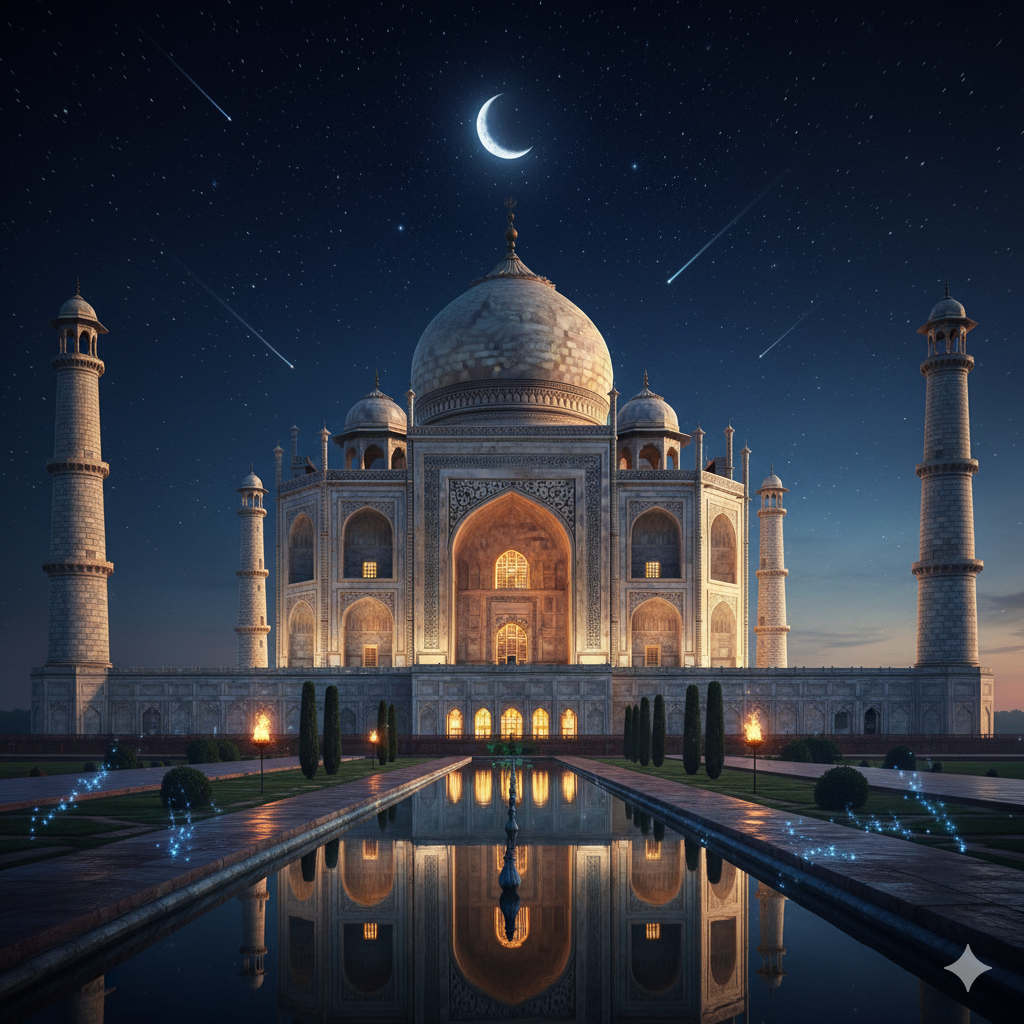
- Taj Mahal (Agra, 1631–1653 CE)
- The most celebrated example of Mughal architecture.
- Built in memory of Mumtaz Mahal, Shah Jahan’s wife.
- Combines Persian, Islamic, and Indian architectural principles.
- Features a large central dome flanked by four minarets, all perfectly symmetrical.
- The marble structure is richly decorated with floral motifs and Quranic inscriptions using precious stones.
- Set within a charbagh garden symbolizing paradise.
- Represents the pinnacle of Mughal architectural perfection and is a UNESCO World Heritage Site.
- Moti Masjid (Agra Fort)
- Known as the “Pearl Mosque.”
- Constructed with pure white marble and known for its simplicity and spiritual tranquility.
- Reflects Shah Jahan’s architectural philosophy of harmony and refinement.
- Shah Jahan’s Renovations in Agra Fort
- Replaced red sandstone with marble interiors in several palaces.
- Added structures like the Diwan-i-Khas, Khas Mahal, and Musamman Burj, where he was later imprisoned by Aurangzeb.
The Shah Jahan period brought aesthetic sophistication and perfection to Mughal architecture in Uttar Pradesh, creating landmarks that became eternal symbols of India’s cultural glory.
5. The Later Phase: Aurangzeb and Regional Nawabs (1658–1800 CE)
Aurangzeb’s reign saw a decline in grand architectural projects due to his religious austerity. However, his period still witnessed the construction of a few mosques and civic buildings.
Key Examples
- Badshahi Mosque (influence seen beyond UP) and smaller mosques in Agra and Allahabad continued the Mughal tradition but on a smaller scale.
- The later period saw Lucknow emerging as a new architectural center under the Nawabs of Awadh, especially after the decline of direct Mughal control.
Architecture of Nawabs in Uttar Pradesh
- Although not strictly Mughal, Awadhi architecture in Lucknow carried forward Mughal styles with local adaptations.
- Examples include:
- Bara Imambara and Rumi Darwaza (built by Nawab Asaf-ud-Daula).
- Blend of Mughal-Persian design with regional flair.
- Use of stucco ornamentation and domed structures.
This phase represents the continuation and regionalization of Mughal architectural traditions in Uttar Pradesh.
Salient Features of Mughal Architecture in Uttar Pradesh
- Fusion of Persian and Indian Styles: Integration of Islamic arches, Persian domes, and Hindu elements like chhatris and carvings.
- Use of Red Sandstone and Marble: Transition from sandstone (Akbar) to marble (Shah Jahan).
- Symmetry and Geometry: Every building designed with meticulous proportional harmony.
- Charbagh Garden Layouts: Symbolic representation of paradise.
- Ornamentation: Extensive use of pietra dura, jali work, calligraphy, and floral designs.
- Monumentality and Balance: Structures designed to inspire awe while maintaining spiritual serenity.
- Religious and Secular Harmony: Temples, mosques, palaces, and tombs coexisted as parts of the same cultural ecosystem.
Cultural Significance and Legacy
Mughal architecture in Uttar Pradesh is not merely a historical artifact — it is a living symbol of India’s composite culture. These monuments reflect:
- The fusion of different artistic traditions.
- The growth of urban centers like Agra, Fatehpur Sikri, and Lucknow.
- The advancement in engineering, geometry, and urban planning.
- The aesthetic unity of form and function, which later inspired colonial and modern Indian architecture.
Today, these sites are vital to tourism, cultural studies, and national heritage preservation. The architectural wonders of Uttar Pradesh stand as testimony to India’s golden artistic past.
Conclusion
The development of Mughal architecture in Uttar Pradesh represents a remarkable journey of artistic evolution — from the experimental beginnings of Babur to the sublime perfection of Shah Jahan and beyond. Uttar Pradesh, as the heartland of the Mughal Empire, witnessed the flowering of an architectural tradition that harmonized Persian elegance, Indian craftsmanship, and Islamic spirituality.
From the mighty Agra Fort to the eternal Taj Mahal, from the royal city of Fatehpur Sikri to the serene gardens and mosques, the Mughal architectural legacy in Uttar Pradesh continues to inspire historians, architects, and visitors from across the world. It remains an enduring testament to the creative genius and cultural synthesis that defined the Mughal era — a legacy that continues to enrich India’s cultural identity.