Introduction
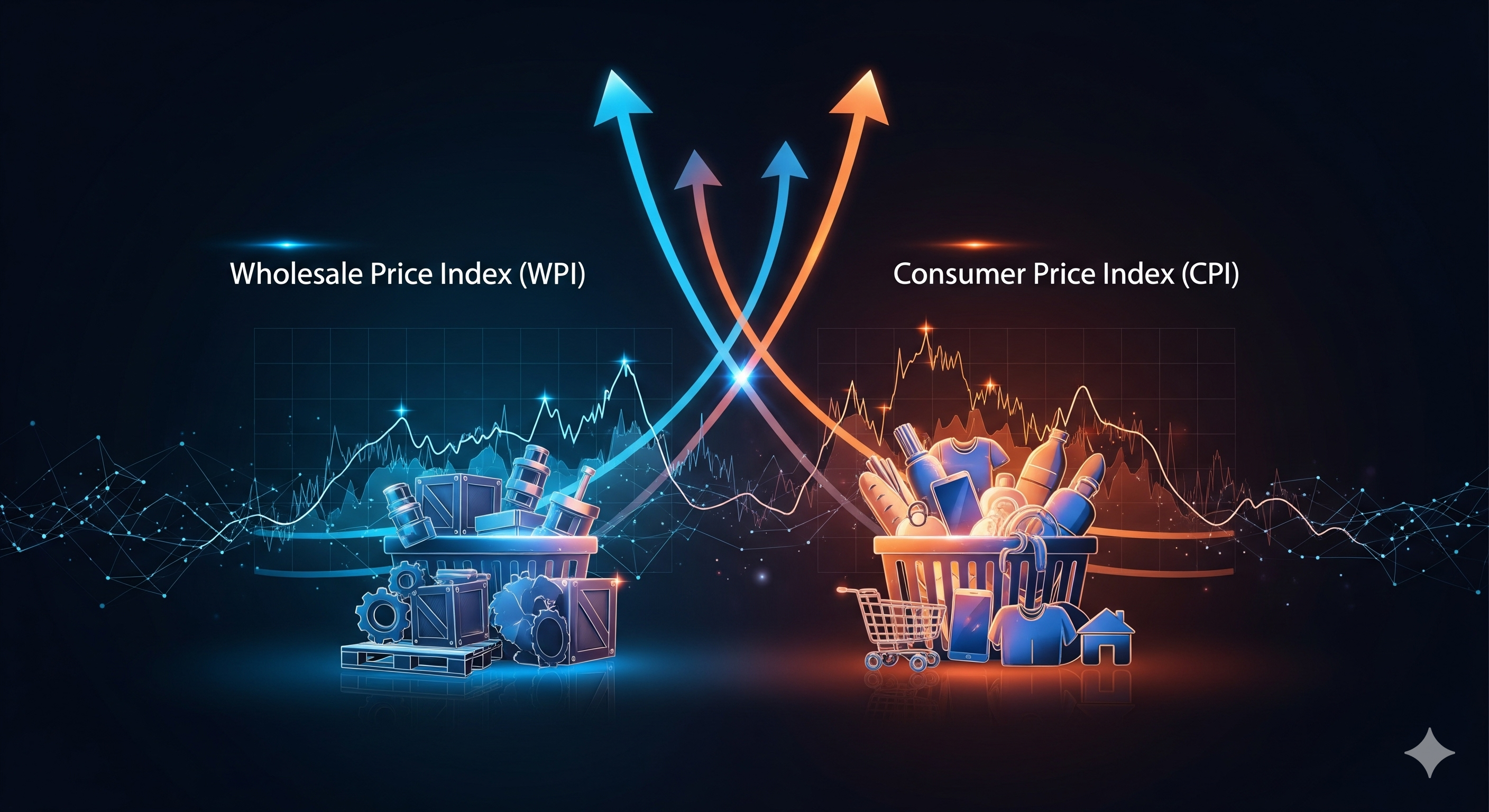
Inflation measurement plays a crucial role in understanding the health of an economy. Governments, central banks, businesses, and individuals depend on inflation indicators to make informed decisions about investment, consumption, and policy formulation. Two of the most widely used indicators for measuring inflation are the Wholesale Price Index (WPI) and the Consumer Price Index (CPI).
Although both indices measure changes in price levels, they differ significantly in terms of coverage, methodology, and purpose. While the WPI reflects price changes at the wholesale or producer level, the CPI measures retail price changes experienced by consumers. In India, both indices have been used at different times to measure inflation, but in recent years, CPI has gained more prominence as the benchmark for inflation targeting.
This article explains the meaning, methodology, differences, and importance of WPI and CPI in detail, along with their relevance to India’s economy.
Meaning of Wholesale Price Index (WPI)
The Wholesale Price Index (WPI) measures the average change in the prices of goods at the wholesale level—that is, before goods reach the retail market. It captures price movements of bulk transactions between producers and wholesalers.
Key Features of WPI:
- Measures price changes of goods at the wholesale stage.
- Does not include services, only goods.
- Compiled and published by the Office of the Economic Adviser (OEA), Ministry of Commerce and Industry, Government of India.
- Base year was revised to 2011–12 (earlier it was 2004–05).
- WPI covers three major groups:
- Primary Articles (food, minerals, etc.)
- Fuel and Power
- Manufactured Products
Thus, WPI focuses more on producer and bulk price changes rather than consumer-level price experience.
Meaning of Consumer Price Index (CPI)
The Consumer Price Index (CPI) measures the average change in prices of a basket of goods and services consumed by households. It reflects the cost of living and inflation from the consumer’s perspective.
Key Features of CPI:
- Measures price changes at the retail level.
- Includes both goods and services.
- Compiled by the National Statistical Office (NSO), Ministry of Statistics and Programme Implementation (MoSPI).
- India has multiple CPIs, but since 2011, a combined CPI has been used as the official inflation measure.
- CPI is categorized as:
- CPI for Industrial Workers (CPI-IW)
- CPI for Agricultural Labourers (CPI-AL)
- CPI for Rural Labourers (CPI-RL)
- CPI Combined (urban + rural)
CPI provides a clearer picture of how inflation impacts consumers’ daily lives.
Methodology of WPI vs. CPI
WPI Methodology
- Base Year: 2011–12
- Coverage: 697 items (117 primary articles, 16 fuel and power, 564 manufactured products)
- Weightage: Manufactured goods (64.2%), Primary articles (22.6%), Fuel and power (13.1%)
- Data Source: Wholesale markets and industrial establishments.
- Excludes: Services such as healthcare, education, and housing.
CPI Methodology
- Base Year: 2012
- Coverage: Around 299 items (including goods and services).
- Weightage: Food & beverages (45.9%), Housing (10%), Fuel & light (6.8%), Clothing & footwear (6.5%), Miscellaneous (28.3%).
- Data Source: Retail prices collected from markets across urban and rural areas.
- Includes: Services such as education, healthcare, and transportation.
Differences Between WPI and CPI
| Aspect | WPI (Wholesale Price Index) | CPI (Consumer Price Index) |
|---|---|---|
| Definition | Measures price changes at the wholesale level | Measures price changes at the retail/consumer level |
| Coverage | Only goods (primary, fuel, manufactured) | Goods + services (food, housing, education, healthcare, etc.) |
| Base Year (India) | 2011–12 | 2012 |
| Data Source | Wholesale markets, producers, bulk suppliers | Retail markets, household consumption |
| Weightage | Manufacturing goods have highest weightage | Food and beverages have highest weightage |
| Compiler | Office of Economic Adviser (Ministry of Commerce & Industry) | National Statistical Office (MoSPI) |
| Impact | Reflects producer price changes | Reflects cost of living for consumers |
| Usefulness | Useful for producers, businesses, and government contracts | Useful for households, workers, and monetary policy |
| Services | Excludes services | Includes services |
| Official Inflation Indicator in India | Earlier widely used | Now the benchmark (since 2014, RBI uses CPI for inflation targeting) |
Importance of WPI
- Business Contracts: WPI is used in long-term contracts to adjust prices for inflation.
- Industrial Sector Indicator: Helps understand producer price changes.
- Early Inflation Signal: Provides an early indicator of price rise before it reaches consumers.
- Policy Formulation: Assists in setting trade and industrial policies.
Importance of CPI
- Reflects Cost of Living: Measures the direct impact of inflation on households.
- Wage and Pension Adjustments: Used for dearness allowance (DA) and pension revisions.
- Monetary Policy: Since 2014, the RBI uses CPI (combined) as the main measure of inflation for its monetary policy framework.
- Social Impact Analysis: Captures the impact of inflation on rural and urban populations.
Why India Shifted Focus from WPI to CPI
- WPI ignored services, which form a large part of modern economies.
- WPI did not reflect the actual burden on consumers.
- CPI captures food and housing inflation, which directly affect households.
- Global practice also favors CPI as the main measure of inflation.
- RBI’s adoption of inflation targeting (4% ±2%) under the Monetary Policy Framework (2016) made CPI more relevant.
Relevance of WPI and CPI in the Indian Economy
WPI in India
- Still important for understanding wholesale price movements.
- Used by businesses, policymakers, and researchers.
- Acts as a leading indicator for consumer inflation.
CPI in India
- The official benchmark for inflation targeting.
- Directly impacts monetary policy decisions such as repo rate changes.
- Helps analyze consumption patterns in rural and urban India.
Challenges in WPI and CPI
WPI Challenges
- Excludes services, underestimating inflation in a service-oriented economy.
- Limited relevance for households.
- Outdated base years reduce accuracy if not revised regularly.
CPI Challenges
- Limited coverage of items in the basket compared to actual consumption.
- Price variations across states may not always be captured accurately.
- Data collection from rural areas faces challenges.
Global Perspective: WPI vs. CPI
- Most developed countries rely on CPI or similar consumer price indices as their primary measure of inflation.
- WPI or Producer Price Index (PPI) is still used, but as a supplementary measure.
- India’s shift toward CPI aligns with global practices.
Conclusion
Both WPI and CPI are vital tools for measuring inflation, but they serve different purposes. WPI focuses on price changes at the wholesale level and is more relevant for producers, traders, and industrial analysis. CPI, on the other hand, captures price changes experienced by consumers and is therefore more directly linked to the cost of living and monetary policy.
In India, WPI was traditionally used for inflation measurement, but with growing emphasis on consumer welfare and global alignment, CPI has become the primary measure since 2014. Policymakers, researchers, and businesses need to analyze both indices together for a complete picture of inflationary trends.