Introduction
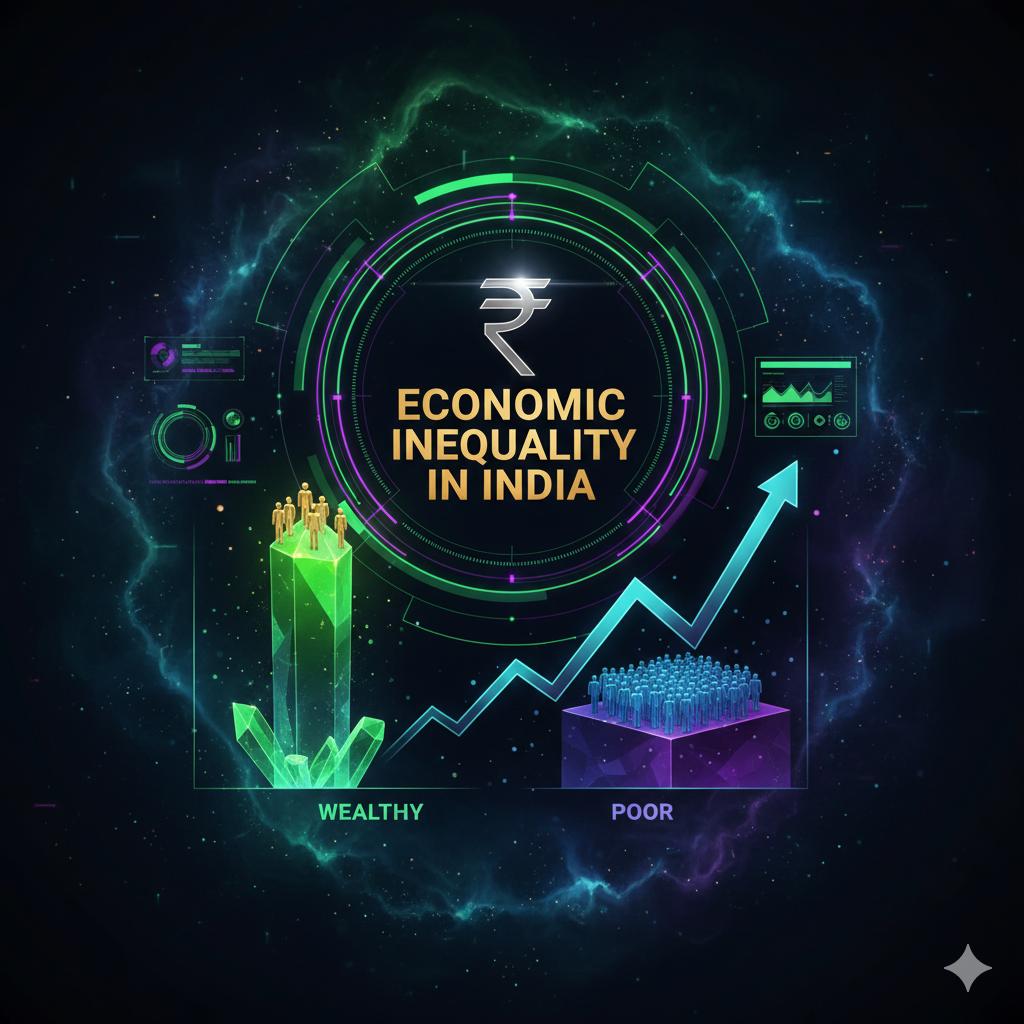
Economic inequality has emerged as one of the most critical challenges facing India in the 21st century. Despite sustained economic growth, technological progress, and rising global integration, the benefits of development have not been distributed evenly across society. Inequality in India is not limited to income differences alone; it spans wealth ownership, access to opportunities, regional development, social identity, gender, and sectoral employment patterns.
Inclusive development aims to ensure that economic growth benefits all sections of society, particularly the marginalized and vulnerable. However, regional and social disparities continue to undermine this objective, creating structural barriers to equitable participation in growth. Understanding the major dimensions of economic inequality and their interaction with inclusive development is essential for designing effective public policy.
Understanding Economic Inequality
Economic inequality refers to the unequal distribution of economic resources, income, assets, and opportunities among individuals and groups. In India, inequality is multidimensional and deeply embedded in historical, social, and institutional structures. It affects not only economic outcomes but also social mobility, political participation, and long-term development sustainability.
Major Dimensions of Economic Inequality in India
1. Income Inequality
Income inequality is one of the most visible dimensions of economic disparity.
- High-income groups, especially professionals, corporate executives, and investors, have experienced rapid income growth.
- A large segment of workers, particularly in agriculture and the informal sector, face low and unstable incomes.
- Wage growth has not kept pace with productivity growth, especially for unskilled and semi-skilled labour.
Income inequality reflects unequal access to skills, capital, and secure employment opportunities.
2. Wealth Inequality
Wealth inequality is more severe and persistent than income inequality.
- Ownership of land, real estate, businesses, and financial assets is highly concentrated.
- Wealth generates further income, reinforcing inequality over generations.
- Intergenerational transfer of assets limits social mobility.
Wealth inequality creates long-term economic dominance for a small elite and weakens equal opportunity.
3. Regional Inequality
India exhibits sharp inter-state and intra-state disparities.
- Southern and western states outperform eastern and central states in income, infrastructure, health, and education.
- Urban and industrialized regions attract more private investment.
- Backward regions struggle with poor connectivity, low human capital, and weak institutions.
Regional inequality results in uneven development and migration pressures.
4. Urban–Rural Inequality
The gap between urban and rural India remains substantial.
- Urban areas benefit from better infrastructure, higher wages, and diversified employment.
- Rural areas rely heavily on agriculture, which suffers from low productivity and climate vulnerability.
- Rural underemployment and disguised unemployment persist.
This divide limits rural participation in economic growth.
5. Sectoral Inequality
Growth in India has been uneven across sectors.
- High-growth sectors such as IT, finance, and digital services employ a small proportion of the workforce.
- Manufacturing has not expanded sufficiently to absorb surplus labour.
- Agriculture employs a large share of the population but contributes a declining share to GDP.
This imbalance creates jobless or low-employment growth.
6. Gender Inequality
Economic inequality in India is deeply gendered.
- Female labour force participation remains low.
- Women earn less than men for comparable work.
- Unpaid care work disproportionately affects women.
- Limited asset ownership reduces women’s economic independence.
Gender inequality reduces household welfare and national productivity.
7. Social and Caste-Based Inequality
Social identity plays a significant role in shaping economic outcomes.
- Marginalized communities face barriers in education, employment, and access to credit.
- Historical discrimination translates into present-day economic disadvantage.
- Informal employment disproportionately affects socially disadvantaged groups.
Social inequality intersects with economic inequality, deepening exclusion.
8. Educational and Skill Inequality
Access to quality education remains uneven.
- Private education advantages affluent families.
- Public education quality varies widely across regions.
- Skill mismatch limits employability among youth.
Educational inequality perpetuates economic inequality across generations.
Regional Disparities and Inclusive Development
Nature of Regional Disparities
Regional disparities arise from differences in:
- Infrastructure availability
- Industrial base
- Human capital
- Governance quality
- Historical investment patterns
Market-driven growth tends to concentrate in already developed regions.
Impact on Inclusive Development
- Unequal Access to Opportunities
People in backward regions lack access to quality education, healthcare, and employment, limiting participation in growth. - Migration Pressures
Regional inequality fuels distress migration, leading to urban overcrowding and informal settlements. - Fiscal Stress
Poorer states have lower revenue capacity but higher development needs, constraining public investment. - Social and Political Tensions
Perceived neglect of certain regions can weaken national cohesion.
Thus, regional disparities directly obstruct inclusive development.
Social Disparities and Inclusive Development
Nature of Social Disparities
Social disparities stem from:
- Caste and community-based exclusion
- Gender norms and discrimination
- Unequal access to social capital
- Informal labour market structures
These disparities limit economic participation.
Impact on Inclusive Development
- Restricted Human Capital Formation
Discrimination limits education and skill acquisition for marginalized groups. - Labour Market Segmentation
Social identity influences job type, wages, and security. - Intergenerational Inequality
Social exclusion perpetuates poverty cycles across generations. - Underutilization of Human Potential
Excluding large sections of society reduces overall productivity.
Inclusive development requires social inclusion alongside economic growth.
Interlinkages Between Regional and Social Inequality
Regional and social disparities reinforce each other.
- Backward regions often have higher concentrations of marginalized communities.
- Poor infrastructure limits access to social mobility.
- Migration can expose socially disadvantaged groups to urban exploitation.
This intersectionality makes inequality more complex and persistent.
Government Efforts Toward Inclusive Development
1. Welfare and Social Protection
- Food security programs
- Employment guarantee schemes
- Direct benefit transfers
These reduce consumption inequality but not structural causes.
2. Education and Skill Development
- Expansion of schooling and higher education
- Skill development initiatives
- Digital learning platforms
Quality and reach remain uneven.
3. Regional Development Initiatives
- Infrastructure investment
- Industrial corridors
- Aspirational region programs
Balanced development remains a challenge.
4. Financial Inclusion
- Banking access
- Digital payments
- Credit programs
Inclusion improves resilience but needs sustainability.
Challenges to Achieving Inclusive Development
- Persistent informal employment
- Weak manufacturing growth
- Skill mismatch
- Governance capacity constraints
- Technological exclusion
- Climate vulnerability affecting poor regions
These challenges limit the effectiveness of inclusive policies.
Way Forward: Strengthening Inclusive Development
1. Promote Labour-Intensive Growth
- Support MSMEs and manufacturing
- Encourage local employment
- Strengthen value chains
2. Improve Quality of Public Services
- Education and health reforms
- Reduce regional disparities in service delivery
3. Address Regional Imbalances
- Targeted investment in backward regions
- Decentralized planning
- Cooperative federalism
4. Reduce Social Barriers
- Enforce anti-discrimination laws
- Promote asset ownership
- Strengthen social mobility mechanisms
5. Gender-Inclusive Policies
- Childcare infrastructure
- Safe workplaces
- Equal pay enforcement
Conclusion
Economic inequality in India is multidimensional, encompassing income, wealth, region, sector, gender, and social identity. Regional and social disparities significantly hinder the process of inclusive development by restricting access to opportunities, limiting human capital formation, and perpetuating intergenerational disadvantage. While economic growth has expanded overall resources, its benefits remain unevenly distributed.
Inclusive development in India requires moving beyond aggregate growth targets to structural transformation that expands opportunities, reduces exclusion, and balances regional development. Only by addressing both economic and social inequalities can India achieve sustainable, equitable, and resilient development.