Introduction
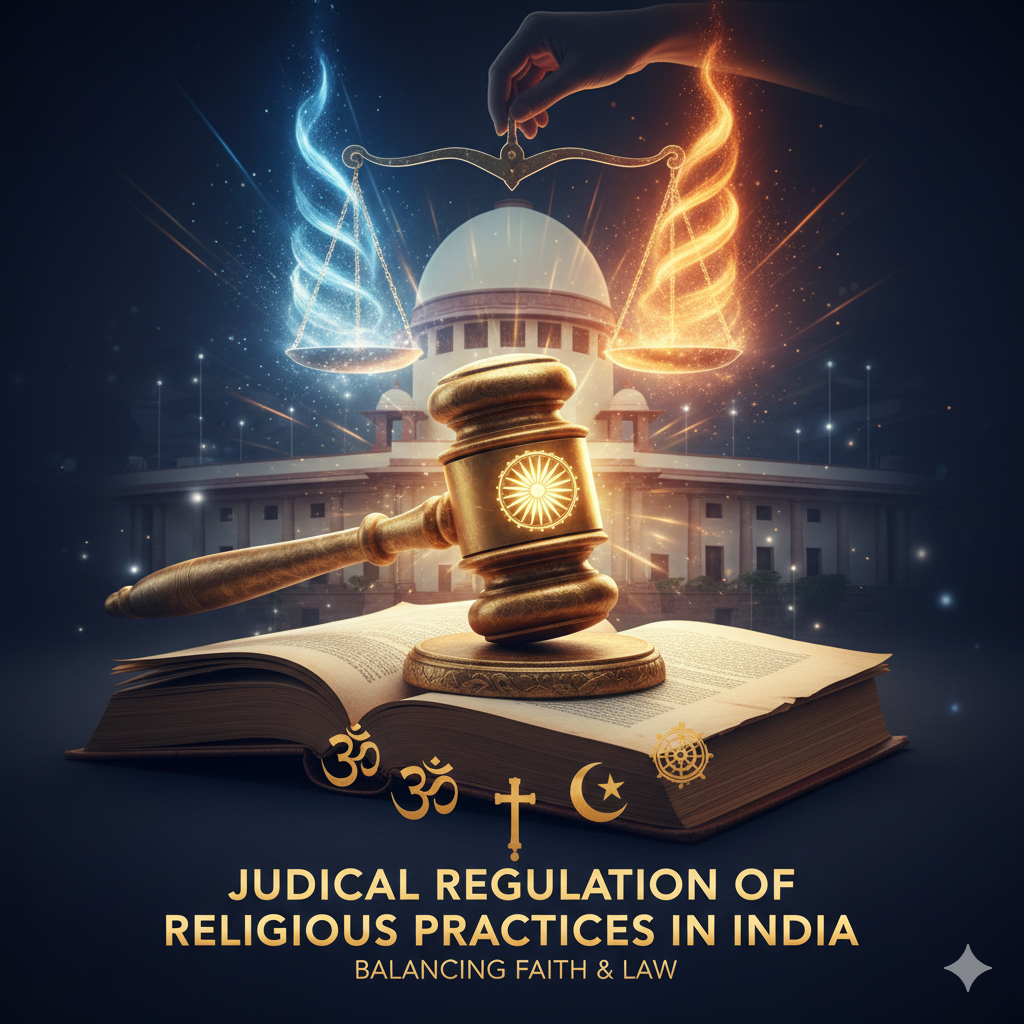
Religious diversity is one of the defining features of India. The Constitution guarantees freedom of religion while simultaneously committing the State to equality, dignity, and secular governance. This dual commitment often brings courts into sensitive disputes involving rituals, temple management, and denominational rights.
Recent judicial observations—particularly from the Madras High Court—have once again highlighted the evolving relationship between faith and constitutional law. These developments revive a longstanding question: how far should courts intervene in religious affairs, and where should autonomy prevail?
Constitutional Framework Governing Religion
India’s constitutional design does not strictly separate religion from public life. Instead, it adopts a model of principled engagement, where religious freedom is protected but regulated by constitutional values.
Key provisions include:
Article 25 – Individual Freedom of Religion
Every person has the right to freely profess, practice, and propagate religion, subject to public order, morality, health, and other fundamental rights.
Article 26 – Rights of Religious Denominations
Religious groups may manage their own affairs, establish institutions, and administer property.
Articles 27 and 28 – Protection from Forced Religious Funding or Instruction
These safeguard citizens from compulsory participation in religious promotion.
Together, these provisions attempt to strike a balance between personal belief, community autonomy, and constitutional discipline.
Why Do Courts Intervene in Religious Matters?
Courts are usually drawn into religious disputes when:
- Competing groups claim ritual authority
- Administrative actions restrict traditional practices
- Individual rights clash with collective customs
- Allegations of discrimination arise
In such cases, judicial oversight becomes necessary to ensure that religious freedom does not override equality, dignity, or public order.
The ultimate responsibility for interpreting these boundaries rests with the Supreme Court of India and the High Courts.
The “Essential Religious Practices” Doctrine
To decide whether a practice deserves constitutional protection, Indian courts developed the Essential Religious Practices (ERP) test.
Under this approach, judges examine whether a particular custom is fundamental to a religion or merely ancillary. If a practice is found non-essential, it may be regulated or restricted by the State.
Over time, this doctrine has shaped landmark rulings involving:
- Temple entry
- Gender-based exclusions
- Divorce customs
- Denominational privileges
However, the ERP test has also attracted criticism for placing judges in the role of religious interpreters.
Recent Judicial Trends (2025–26)
Recent High Court rulings have clarified two important principles:
1. Administrative Convenience Cannot Override Faith
Courts have held that governments cannot prohibit traditional religious observances solely based on speculative law-and-order concerns. Authorities must facilitate peaceful worship rather than pre-emptively restrict it.
This reinforces the idea that constitutional rights cannot be suspended merely due to administrative discomfort.
2. Denominational Rights Remain Protected
In disputes between different sects of the same religion, courts have affirmed that historically established ritual privileges fall under Article 26 protection.
This means:
- Individual worship rights are respected
- But long-recognised denominational practices cannot be arbitrarily altered
Such rulings highlight the judiciary’s effort to preserve institutional religious identity while respecting individual liberties.
Constitutional Morality vs Religious Tradition
A major shift in Indian jurisprudence has been the rise of constitutional morality—the idea that all practices must align with equality, dignity, and liberty.
Even if a custom is religiously significant, it may be struck down if it violates:
- Gender equality
- Human dignity
- Non-discrimination
This principle marked a turning point by placing constitutional values above inherited tradition.
Key Challenges in Judicial Regulation of Religion
Despite its importance, judicial involvement faces several limitations:
1. Theological Complexity
Judges are trained in law, not theology. Determining what is “essential” to a faith often involves interpreting scriptures and traditions beyond legal expertise.
2. Inconsistent Standards
Different benches have sometimes reached conflicting conclusions on similar issues, creating uncertainty.
3. Social Resistance
Even constitutionally sound judgments may face public opposition, limiting effective implementation.
4. Risk of Politicisation
Religious verdicts can be framed through political narratives, potentially undermining judicial neutrality.
Towards a More Balanced Approach
Experts increasingly suggest moving away from rigid theological scrutiny toward a rights-based framework.
Possible improvements include:
Focusing on Harm, Not Doctrine
Instead of asking whether a practice is “essential,” courts could assess whether it causes measurable harm or discrimination.
Strengthening Administrative Sensitivity
Government officials managing religious institutions should be trained in constitutional ethics.
Encouraging Mediation
Community dialogue can sometimes resolve disputes more sustainably than litigation.
Enhancing Civic Awareness
Public education on constitutional values can reduce friction between faith and law.
Broader Democratic Significance
Judicial engagement with religion reflects India’s unique secularism—neither hostile to faith nor submissive to it.
The courts act as guardians of:
- Individual liberty
- Minority rights
- Social equality
At the same time, they recognise the deep cultural role of religion in Indian society.
This delicate balancing act is central to preserving harmony in a plural democracy.
Conclusion
India’s experience shows that religious freedom cannot exist in isolation from constitutional principles. Judicial oversight, though imperfect, remains essential to prevent exclusion, protect dignity, and uphold equality.
Recent rulings reaffirm that faith-based practices must coexist with democratic values. The long-term challenge lies in evolving from doctrinal tests toward a more human-centred constitutional approach—one that respects belief while safeguarding rights.
In doing so, India continues its complex journey of harmonising tradition with modern constitutionalism.