Introduction
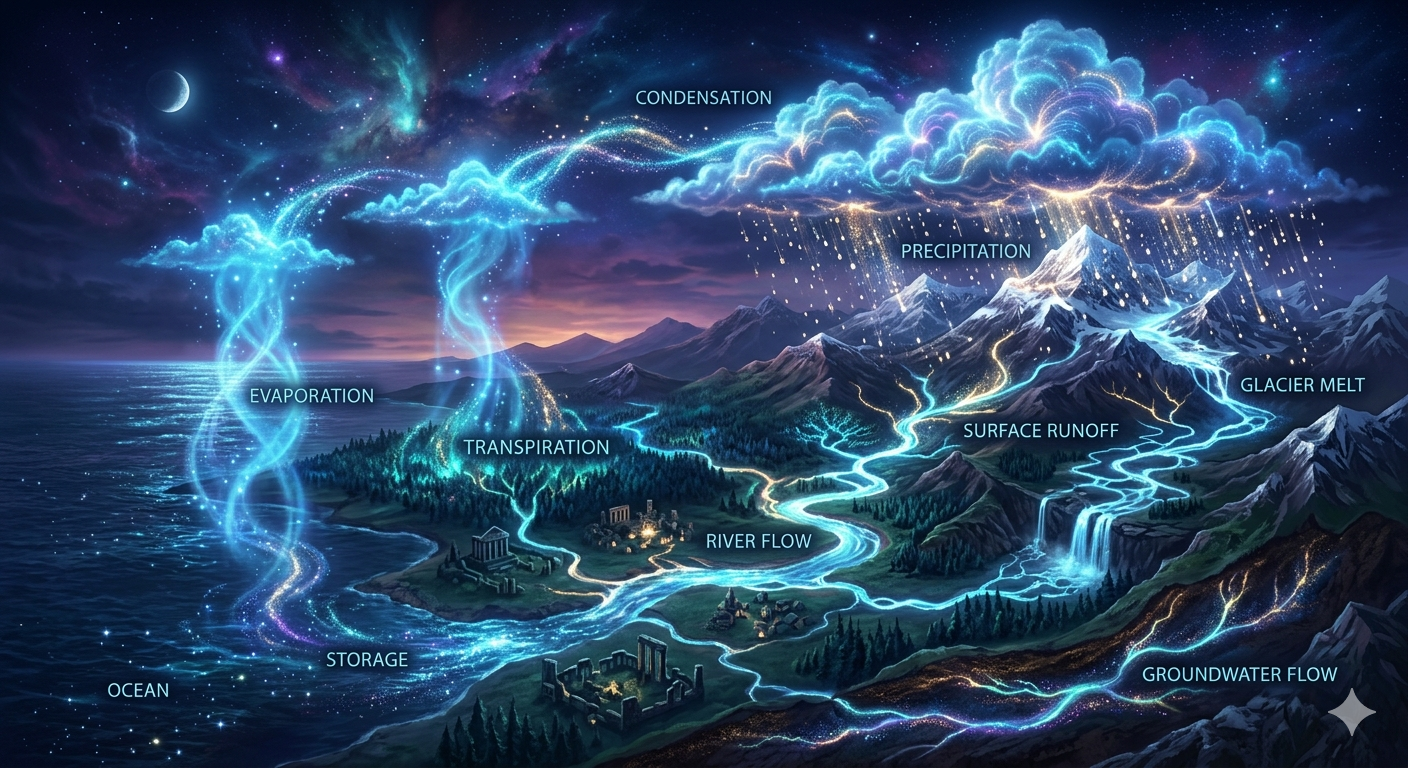
Water is the foundation of life on Earth, and its continuous movement across different spheres of the planet sustains all living organisms. This movement is governed by the hydrological cycle, also known as the water cycle, which ensures the circulation, distribution, and recycling of water in the environment.
The hydrological cycle is not merely a physical process; it is a dynamic, interconnected system linking the atmosphere, lithosphere, hydrosphere, and biosphere. It plays a vital role in regulating climate, supporting ecosystems, and maintaining environmental stability. Without this cycle, the Earth would neither sustain life nor maintain ecological balance.
Concept of the Hydrological Cycle
The hydrological cycle refers to the continuous circulation of water on, above, and below the Earth’s surface. It involves the transformation of water into different states—liquid, solid, and gas—and its movement through various reservoirs such as oceans, rivers, lakes, soil, glaciers, and the atmosphere.
This cycle operates on the principle of energy exchange, primarily driven by solar radiation and gravitational forces. The Sun provides the energy required for evaporation, while gravity ensures the downward movement of water through precipitation and runoff.
The hydrological cycle can be understood as a closed system at the global level, meaning that the total amount of water remains constant, although its distribution and form continuously change.
Major Components of the Hydrological Cycle
1. Evaporation
Process and Mechanism
Evaporation is the process by which water transforms from a liquid state into vapor due to heat energy. It primarily occurs from oceans, seas, lakes, rivers, and soil surfaces.
Solar energy heats water bodies, causing molecules to gain kinetic energy and escape into the atmosphere as water vapor. Oceans contribute the largest share of evaporation, making them the primary source of atmospheric moisture.
Significance
Evaporation plays a crucial role in:
- Initiating the hydrological cycle
- Regulating temperature through heat exchange
- Transferring moisture from the Earth’s surface to the atmosphere
It acts as a cooling mechanism, preventing excessive heating of the Earth’s surface.
2. Transpiration
Process and Mechanism
Transpiration refers to the release of water vapor from plants through microscopic pores called stomata. It is a biological process that links vegetation with the atmosphere.
Plants absorb water from the soil through their roots and release it into the atmosphere during metabolic activities. Together with evaporation, this process is often referred to as evapotranspiration.
Significance
Transpiration contributes to:
- Maintaining atmospheric humidity
- Regulating plant temperature
- Facilitating nutrient transport within plants
It highlights the role of vegetation in sustaining the hydrological cycle.
3. Condensation
Process and Mechanism
Condensation is the transformation of water vapor into liquid droplets when it cools. As warm, moist air rises, it loses heat and forms clouds through condensation.
This process occurs around tiny particles such as dust, salt, or smoke, which act as condensation nuclei.
Significance
Condensation is essential for:
- Cloud formation
- Precipitation processes
- Atmospheric heat balance
It marks the transition of water from the atmosphere back toward the Earth’s surface.
4. Precipitation
Process and Mechanism
Precipitation occurs when condensed water droplets in clouds combine and grow heavy enough to fall to the Earth’s surface. It can take various forms such as rain, snow, sleet, or hail.
The type of precipitation depends on temperature conditions in the atmosphere.
Significance
Precipitation is a key stage that:
- Replenishes freshwater sources
- Supports agriculture and ecosystems
- Maintains river and groundwater systems
It ensures the redistribution of water across regions.
5. Infiltration and Percolation
Process and Mechanism
Infiltration is the process by which water seeps into the soil after reaching the ground. Percolation refers to the downward movement of this water through soil layers into groundwater reservoirs.
The rate of infiltration depends on soil type, vegetation cover, and land use.
Significance
These processes are important for:
- Recharging groundwater
- Maintaining soil moisture
- Supporting vegetation growth
They act as natural filtration systems, improving water quality.
6. Runoff
Process and Mechanism
Runoff occurs when water flows over the land surface into rivers, lakes, and oceans. It happens when the rate of precipitation exceeds the infiltration capacity of the soil.
Runoff can be surface runoff or subsurface flow, depending on how water moves.
Significance
Runoff:
- Connects different components of the hydrological cycle
- Shapes landforms through erosion and deposition
- Maintains river systems
However, excessive runoff can lead to floods and soil erosion.
7. Storage (Reservoirs)
Types of Storage
Water is stored in various reservoirs:
- Oceans (largest storage)
- Glaciers and ice caps
- Groundwater
- Lakes and rivers
- Atmosphere
Significance
Storage ensures:
- Availability of water during dry periods
- Regulation of water flow
- Stability in the hydrological cycle
Different reservoirs act as buffers, balancing water distribution over time.
Integrated Nature of the Hydrological Cycle
The hydrological cycle is not a linear process but a complex, interconnected system. Each component influences others, creating a continuous loop of water movement.
For example:
- Increased evaporation leads to more cloud formation
- Higher precipitation enhances groundwater recharge
- Vegetation influences both transpiration and infiltration
This interdependence ensures the stability and sustainability of Earth’s ecosystems.
Significance of the Hydrological Cycle in Maintaining Ecological Balance
1. Regulation of Climate and Temperature
The hydrological cycle plays a critical role in regulating the Earth’s climate. Through processes like evaporation and condensation, heat is absorbed and released, maintaining temperature balance.
Water vapor also acts as a greenhouse gas, influencing atmospheric conditions. Ocean currents, driven by water movement, further distribute heat across the globe.
2. Sustenance of Ecosystems
All ecosystems depend on water availability. The hydrological cycle ensures that water reaches forests, grasslands, wetlands, and aquatic systems.
- Forests rely on rainfall and soil moisture
- Wetlands depend on groundwater and surface water
- Rivers support diverse aquatic life
Without this cycle, ecosystems would collapse due to water scarcity.
3. Maintenance of Soil Fertility
Water movement helps in:
- Transporting nutrients within the soil
- Supporting microbial activity
- Facilitating plant growth
Infiltration and percolation processes ensure that soils remain fertile and productive.
4. Groundwater Recharge and Water Availability
The hydrological cycle replenishes groundwater, which is a major source of freshwater for drinking, irrigation, and industry.
Sustainable groundwater levels are essential for:
- Agricultural productivity
- Drinking water security
- Drought resilience
5. Biodiversity Conservation
Water availability influences species distribution and survival. Aquatic ecosystems, forests, and wetlands depend on consistent water cycles.
Disruptions in the hydrological cycle can lead to:
- Habitat loss
- Species migration
- Biodiversity decline
6. Purification of Water
Natural processes within the hydrological cycle act as purification mechanisms:
- Evaporation removes impurities
- Soil filtration cleans water during infiltration
- Wetlands filter pollutants
This natural purification is essential for maintaining water quality.
7. Prevention of Environmental Extremes
A balanced hydrological cycle helps in preventing extremes such as:
- Droughts (due to lack of precipitation)
- Floods (due to excessive runoff)
Vegetation and soil play a crucial role in moderating these extremes.
8. Support to Human Activities
Human civilization is deeply dependent on the hydrological cycle:
- Agriculture depends on rainfall and irrigation
- Industries rely on water resources
- Urban systems require water supply and drainage
Thus, the cycle supports economic and social development.
Human Impact on the Hydrological Cycle
1. Deforestation
Removal of vegetation reduces transpiration and infiltration, leading to:
- Reduced rainfall
- Increased runoff and floods
2. Urbanization
Urban surfaces like concrete prevent infiltration, causing:
- Waterlogging
- Reduced groundwater recharge
3. Climate Change
Global warming alters precipitation patterns, leading to:
- Extreme weather events
- Glacial melting
- Sea-level rise
4. Overexploitation of Water Resources
Excessive groundwater extraction disrupts the natural balance, resulting in:
- Declining water tables
- Land subsidence
Need for Sustainable Management
To maintain ecological balance, it is essential to:
- Promote water conservation practices
- Protect forests and wetlands
- Implement rainwater harvesting
- Encourage sustainable urban planning
Such measures ensure that the hydrological cycle remains stable and functional.
Conclusion
The hydrological cycle is a fundamental natural system that sustains life and maintains ecological balance on Earth. Its components—evaporation, condensation, precipitation, infiltration, runoff, and storage—work together in a continuous and interconnected process.
Beyond its physical aspects, the cycle plays a crucial role in regulating climate, supporting ecosystems, conserving biodiversity, and ensuring water availability. However, human activities and environmental changes are increasingly disrupting this delicate balance.
Ensuring the sustainability of the hydrological cycle requires conscious efforts to protect natural resources and adopt environmentally responsible practices. By maintaining this cycle, humanity not only secures its own future but also preserves the intricate web of life that depends on water.