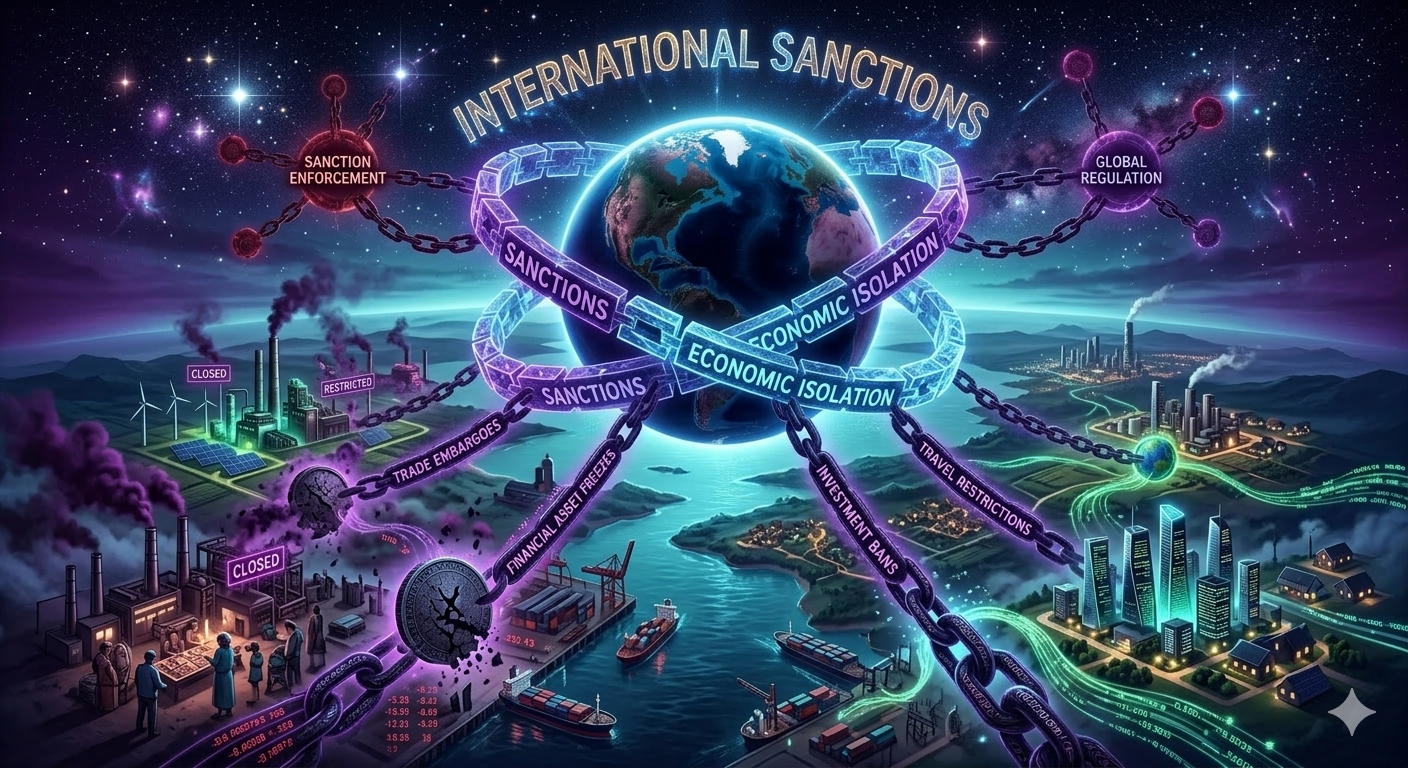
International sanctions are among the most commonly used instruments of foreign policy and economic diplomacy in the contemporary global order. Countries and international organizations impose sanctions to influence the political behavior of a state without resorting to military force. These measures may include trade restrictions, financial prohibitions, travel bans, asset freezes, and limitations on technological cooperation.
Sanctions are usually imposed to discourage actions such as violations of international law, territorial aggression, nuclear proliferation, human rights abuses, or threats to global peace. Institutions such as the United Nations, the European Union, and powerful nations like the United States frequently employ sanctions as a diplomatic tool.
While sanctions are intended to pressure governments to change policies, they often have significant economic consequences for the targeted country. These consequences affect trade, financial markets, currency stability, industrial production, employment, and overall economic growth. In some cases, sanctions can also create humanitarian and social challenges for the population.
This discussion examines the economic impact of international sanctions on national economies, explaining how sanctions operate and analyzing their effects with examples from recent global events.
Understanding International Sanctions
Meaning and Concept of Sanctions
International sanctions are economic or political penalties imposed by one or more countries against a targeted state, organization, or individual. These penalties are designed to limit economic interactions and restrict access to global markets in order to compel behavioral change.
Sanctions can be imposed unilaterally by individual countries or multilaterally through international organizations. For instance, sanctions authorized by the United Nations Security Council carry global legitimacy because they involve collective international agreement.
Objectives of International Sanctions
Sanctions are used for several strategic objectives:
- Maintaining International Peace and Security
Sanctions aim to prevent aggression and military conflicts by pressuring states to comply with international norms. - Preventing Nuclear Proliferation
Many sanctions target countries suspected of developing nuclear weapons. - Protecting Human Rights
Governments accused of human rights violations may face economic penalties. - Influencing Political Behavior
Sanctions seek to force policy changes without direct military intervention. - Demonstrating International Disapproval
Sanctions symbolically express global condemnation of a country’s actions.
While these objectives focus on political outcomes, sanctions inevitably produce significant economic impacts.
Types of International Sanctions
Economic and Trade Sanctions
Trade sanctions restrict the import and export of goods and services between countries. These sanctions can affect specific sectors such as oil, technology, and defense industries.
Financial Sanctions
Financial sanctions limit a country’s access to international banking systems, foreign investments, and international financial institutions. Such measures often include asset freezes and restrictions on international payment systems.
Diplomatic Sanctions
Diplomatic sanctions involve the reduction or suspension of diplomatic relations, expulsion of diplomats, or exclusion from international organizations.
Targeted or Smart Sanctions
These sanctions are directed at specific individuals, companies, or political leaders rather than the entire population. They include travel bans and asset freezes.
Economic Impact of Sanctions on a Country
1. Decline in International Trade
One of the most immediate effects of sanctions is a sharp decline in international trade. When sanctions restrict exports and imports, industries lose access to foreign markets and essential resources.
Export-oriented sectors suffer revenue losses, while domestic industries struggle to obtain raw materials, machinery, and technological components. Over time, reduced trade activity can weaken economic growth and industrial productivity.
2. Currency Depreciation and Financial Instability
Sanctions often trigger instability in the financial system of the targeted country. Restrictions on international banking transactions reduce foreign currency inflows, leading to depreciation of the national currency.
Currency depreciation increases the cost of imports, fuels inflation, and reduces purchasing power among citizens. Financial markets may also experience capital flight as investors withdraw funds due to uncertainty.
3. Reduction in Foreign Investment
Foreign direct investment (FDI) is crucial for economic growth, technological transfer, and industrial development. However, sanctions discourage investors from entering sanctioned economies.
Investors fear legal penalties, reputational risks, and economic instability associated with sanctioned countries. As a result, major infrastructure projects, industrial ventures, and technological collaborations may come to a halt.
4. Disruption of Industrial Production
Sanctions can disrupt industrial production by restricting access to essential raw materials, machinery, and advanced technologies. Industries such as energy, aviation, automobile manufacturing, and telecommunications often depend on international supply chains.
When these supply chains are interrupted, production capacity declines, resulting in reduced output, layoffs, and declining industrial competitiveness.
5. Inflation and Rising Cost of Living
Limited imports and currency depreciation often lead to inflation. The prices of essential goods such as food, medicine, fuel, and consumer products rise sharply.
Inflation reduces real incomes and increases economic hardship for ordinary citizens. In extreme cases, shortages of essential goods may occur.
6. Impact on Employment and Labor Markets
Economic sanctions can lead to widespread job losses, especially in sectors heavily dependent on international trade and investment. Export industries, manufacturing sectors, and service industries connected to global markets may experience layoffs.
High unemployment can create social unrest and political instability, further complicating economic recovery.
7. Technological Isolation
Modern economies rely heavily on technological cooperation and knowledge transfer. Sanctions often restrict access to advanced technologies, software, research collaborations, and industrial innovations.
Technological isolation slows economic modernization and weakens long-term productivity growth.
Case Studies from Recent Global Events
Sanctions on Russia after the Ukraine Conflict
One of the most prominent examples of economic sanctions in recent years is the international response to the Russian invasion of Ukraine. Following the invasion, multiple countries including the European Union and the United States imposed extensive sanctions on Russia.
Key economic impacts included:
- Restrictions on Russian banks from accessing the global financial messaging system SWIFT
- Freezing of foreign exchange reserves
- Bans on technology exports
- Limits on energy trade
These measures caused significant volatility in Russia’s financial markets and disrupted several industrial sectors. However, Russia also adapted by increasing trade with countries such as China and India, demonstrating that sanctions may not completely isolate a large economy.
Sanctions on Iran
Another significant example involves sanctions imposed on Iran due to concerns about its nuclear program. These sanctions intensified after the withdrawal of the United States from the Joint Comprehensive Plan of Action.
Economic consequences included:
- Severe restrictions on oil exports
- Loss of foreign investment
- High inflation and currency depreciation
- Economic recession
Iran’s economy experienced significant challenges, although it attempted to mitigate sanctions by expanding regional trade and domestic production.
Sanctions on North Korea
North Korea has faced some of the strictest international sanctions due to its nuclear weapons program. The United Nations Security Council has imposed sanctions limiting exports of coal, textiles, and other resources.
These sanctions have significantly constrained North Korea’s economic development and access to international markets.
Secondary Effects of Sanctions
Global Supply Chain Disruptions
Sanctions imposed on major economies can disrupt global supply chains. For example, restrictions on energy exports from certain countries may increase global fuel prices and affect manufacturing industries worldwide.
Impact on Global Energy Markets
Sanctions targeting energy-exporting countries influence global oil and gas markets. Reduced supply can cause price volatility and increase energy costs for importing nations.
Development of Alternative Economic Alliances
Sanctioned countries often seek new trade partners and economic alliances to reduce dependence on sanctioning nations. This may lead to the creation of alternative financial systems and regional economic blocs.
Limitations and Criticism of Sanctions
Humanitarian Consequences
Critics argue that sanctions often hurt ordinary citizens more than political leaders. Economic hardship, shortages of essential goods, and declining public services can affect vulnerable populations.
Limited Political Effectiveness
In some cases, sanctions fail to achieve their intended political objectives. Governments may resist external pressure or shift economic strategies to circumvent sanctions.
Emergence of Informal Economic Networks
Sanctions may encourage black markets, smuggling, and informal trade networks, which undermine economic transparency and governance.
Strategies for Mitigating the Impact of Sanctions
Countries facing sanctions often adopt several strategies to reduce economic damage:
- Diversifying trade partners and export markets
- Promoting domestic production and self-reliance
- Developing alternative payment systems
- Strengthening regional economic cooperation
- Investing in technological independence
Such strategies help countries adapt to economic restrictions and maintain economic stability.
Conclusion
International sanctions play a significant role in global diplomacy by providing a non-military method for influencing state behavior. However, their economic consequences are far-reaching and complex. Sanctions can reduce trade, restrict financial flows, discourage investment, disrupt industrial production, and cause inflation and unemployment in targeted economies.
Recent global events involving countries such as Russia, Iran, and North Korea demonstrate how sanctions can reshape economic structures and international trade relations.
While sanctions may succeed in exerting economic pressure, their effectiveness in achieving political objectives remains debated. Moreover, the humanitarian and social consequences of sanctions raise important ethical and policy questions.
In an increasingly interconnected world, the economic impact of sanctions extends beyond the targeted country and influences global markets, supply chains, and geopolitical dynamics. Therefore, policymakers must carefully evaluate both the intended outcomes and unintended consequences of sanctions when designing international economic policies.