Introduction
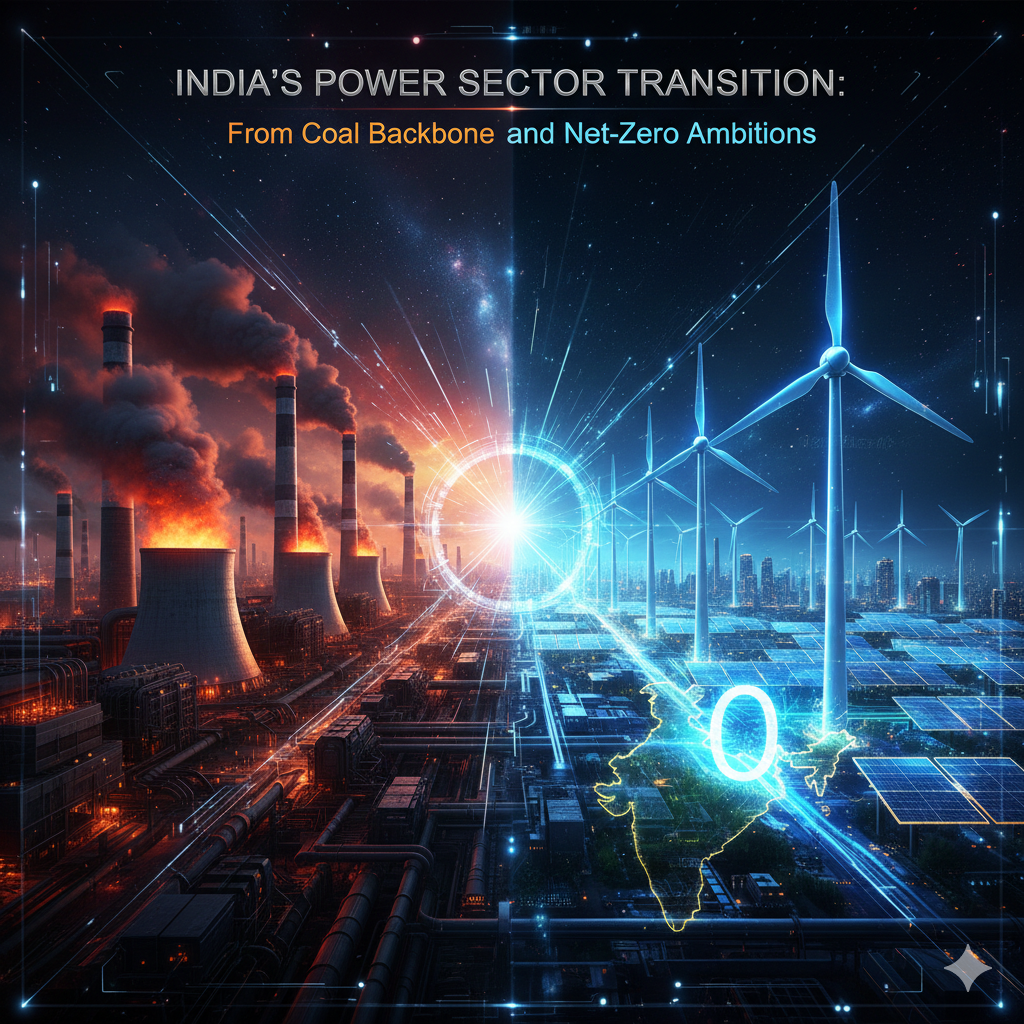
The evolution of India’s electricity sector reflects the broader story of its economic development. For decades, coal-powered generation formed the backbone of industrial expansion, urbanisation, and household electrification. Today, however, India is entering a decisive phase of energy transition, driven by climate commitments, technological progress, and changing economics of power generation.
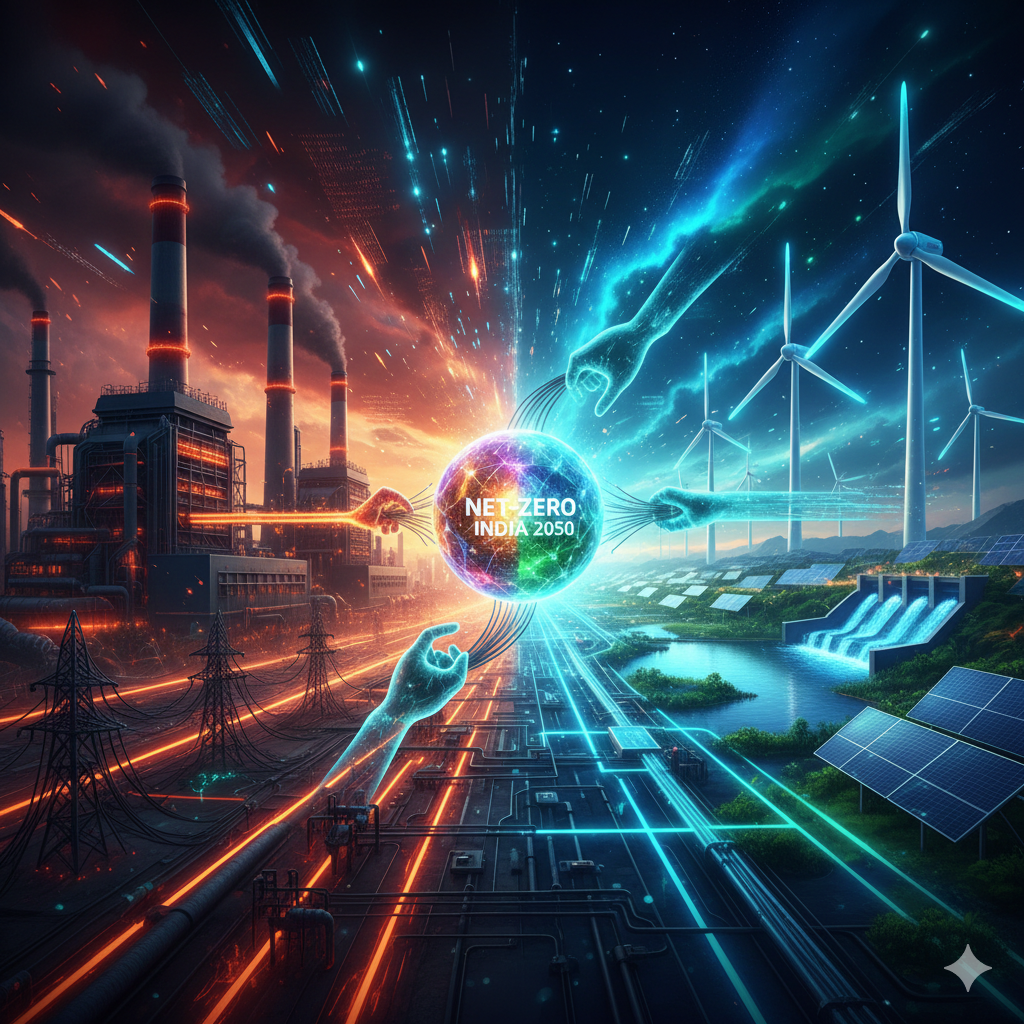
As the world’s fastest-growing major economy, India faces a dual challenge: meeting rapidly rising electricity demand while simultaneously reducing carbon emissions. The country has committed to achieving net-zero emissions by 2070 under the framework of the Paris Agreement. This commitment has accelerated efforts to shift from coal-heavy power generation toward renewable energy dominance.
Rather than an abrupt replacement, India’s transition represents a carefully calibrated shift—where coal continues to play a stabilising role in the short term, while renewable energy steadily becomes the primary driver of future capacity growth.
Historical Dependence on Coal
Coal as the Foundation of Electrification
Coal emerged as India’s principal energy source due to three key factors:
- Abundant domestic reserves, reducing reliance on costly imports
- Ability to provide continuous baseload power, crucial for heavy industry
- Established infrastructure, including mining, rail transport, and thermal plants
From the early Five-Year Plans to large-scale industrialisation in the post-liberalisation era, coal-fired power stations supplied most of the electricity required for manufacturing, irrigation, and urban consumption.
Even today, coal accounts for a large share of actual electricity generation, highlighting how deeply embedded thermal power remains in India’s energy architecture.
Why India Is Pivoting Toward Renewables
India’s power sector transformation is not driven by ideology alone—it is the result of converging economic, environmental, and strategic realities.
1. Climate Commitments and Net-Zero Vision
India’s announcement of a 2070 net-zero target marked a turning point in national energy planning. Long-term modelling exercises conducted by NITI Aayog indicate that achieving this goal will require:
- Massive expansion of solar and wind capacity
- Sharp reduction in coal’s share of electricity generation over coming decades
- Integration of nuclear power and green hydrogen
- Electrification of transport and industry
Electricity lies at the heart of decarbonisation because clean power enables emission reductions across multiple sectors—from mobility to manufacturing.
2. Falling Cost of Renewable Technologies
One of the strongest drivers of transition is economics.
Over the past decade:
- Solar photovoltaic costs have declined dramatically
- Wind energy tariffs have become increasingly competitive
- Renewable projects are often cheaper than building new coal plants
These price trends have transformed renewables from an “environmental choice” into a financially attractive option. For power distribution companies, procuring renewable electricity increasingly makes commercial sense.
3. Energy Security Considerations
While India possesses coal reserves, high-quality coal imports still play a role in power generation. Renewables, by contrast, rely on domestic resources such as sunlight and wind.
Scaling clean energy therefore strengthens energy independence by reducing exposure to volatile international fuel markets.
4. Employment and Industrial Opportunities
Renewable energy expansion has created new economic possibilities:
- Manufacturing of solar modules and wind components
- Construction and maintenance jobs
- Emerging industries like battery storage and green hydrogen
With appropriate skill development, the clean energy sector can become a major employment generator.
Current Status of India’s Energy Transition
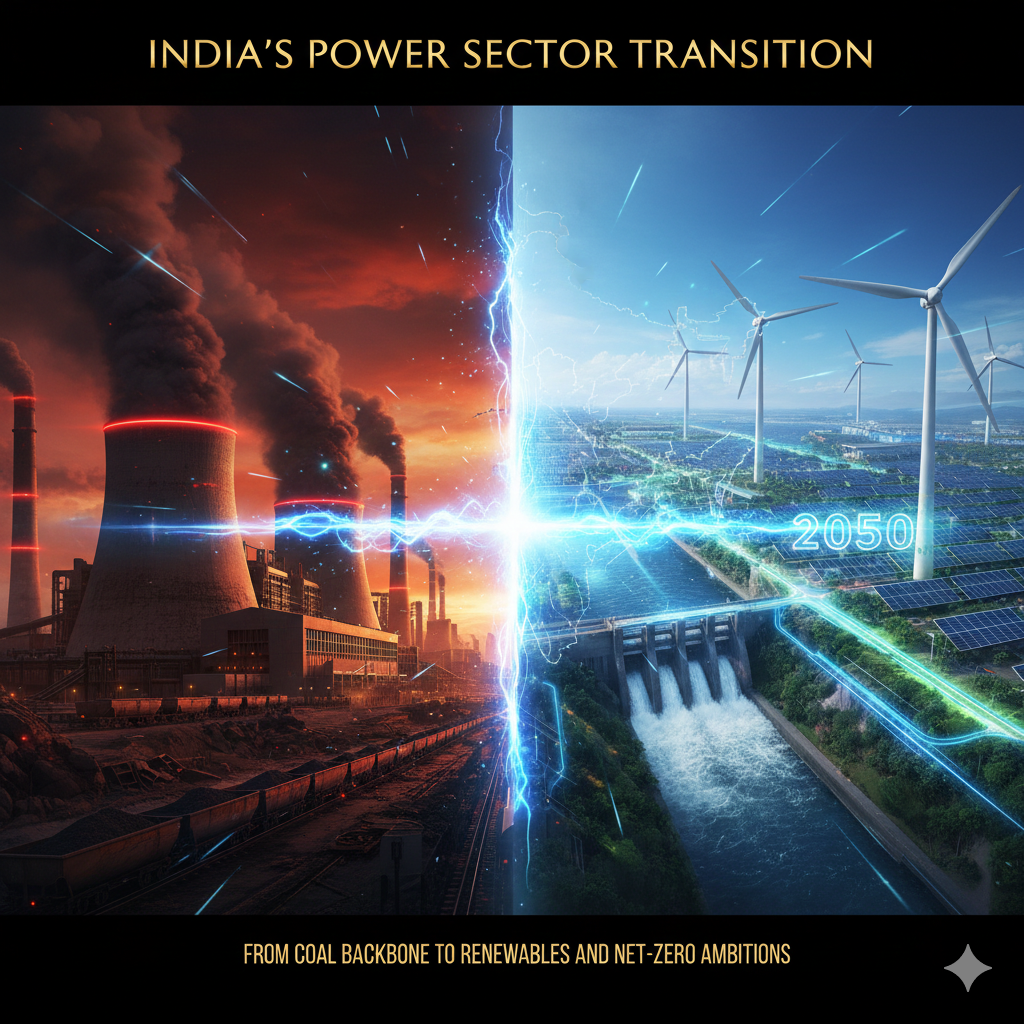
India has made remarkable progress in expanding renewable capacity.
Rapid Growth in Installed Capacity
Solar and wind now account for a significant portion of total installed power capacity. Large solar parks, hybrid renewable projects, and rooftop installations are becoming common across states.
Importantly, non-fossil fuel sources now represent nearly half of India’s total installed electricity capacity—an achievement reached well ahead of earlier targets.
However, there remains a gap between installed capacity and actual electricity generation. Coal continues to dominate output because renewables depend on weather conditions and daylight hours.
This highlights a key reality: capacity expansion alone is insufficient. Storage systems and grid flexibility are essential for renewables to fully replace thermal power.
The Continuing Role of Coal During Transition
India’s approach is pragmatic rather than abrupt.
Coal as a Transitional Stabiliser
Coal plants currently provide:
- Grid stability
- Backup power during low renewable generation
- Support during peak demand periods
Given growing electricity needs from urbanisation, digitalisation, and electric mobility, coal will remain part of the mix in the medium term.
However, the strategic shift is clear:
- Few new coal plants are being planned
- Existing plants are expected to operate more flexibly
- Long-term investment is increasingly flowing toward renewables and storage
Coal is gradually moving from “primary growth driver” to “supporting role”.
Structural Challenges in the Renewable Transition
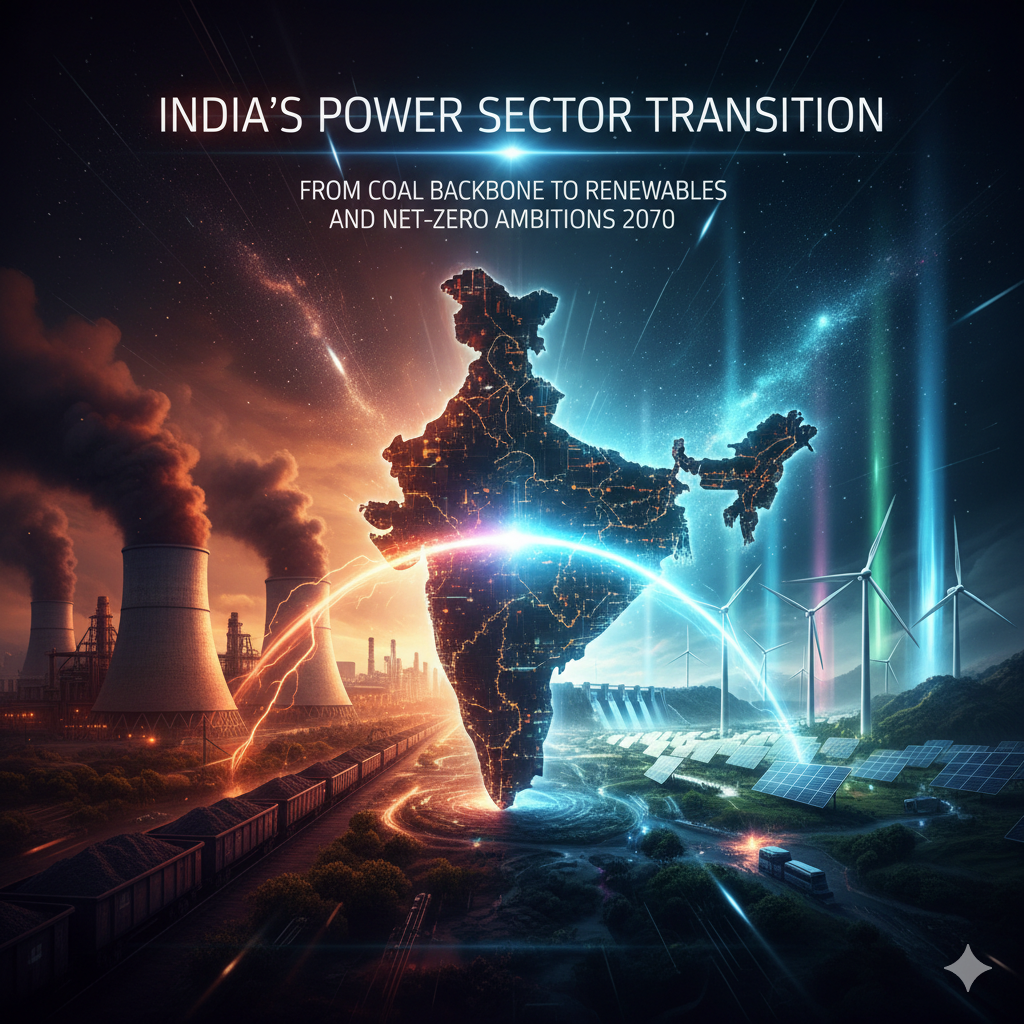
Despite impressive progress, India faces several obstacles in achieving renewable dominance.
1. Grid Integration and Stability
Solar and wind power are inherently variable. Managing large volumes of such electricity requires:
- Advanced forecasting systems
- Strong interstate transmission networks
- Smart grids capable of balancing supply and demand in real time
Without these upgrades, renewable-heavy systems risk frequency fluctuations and outages.
2. Energy Storage Deficit
Storage is the missing link in India’s clean energy puzzle.
Large-scale batteries and pumped hydro storage are still limited. Until storage becomes affordable and widespread, coal will remain necessary to cover night-time demand and seasonal shortfalls.
3. Financial Stress of Distribution Companies
State power distribution companies often struggle with losses, delayed payments, and tariff distortions. These financial weaknesses reduce their ability to sign long-term renewable contracts or invest in grid modernisation.
4. Social Impact of Coal Phase-Down
Millions of livelihoods depend directly or indirectly on coal mining and thermal power.
A rapid exit from coal without alternative employment pathways could deepen regional inequality, particularly in mineral-rich states. A “just transition” strategy is therefore essential—combining reskilling, industrial diversification, and social protection.
Complementary Clean Energy Pillars
India’s energy transition extends beyond solar and wind.
Nuclear Power
Nuclear energy offers reliable, carbon-free baseload electricity. While its expansion is gradual, nuclear is expected to play a stabilising role in a future renewable-heavy grid.
Green Hydrogen
Hydrogen produced using renewable electricity has potential applications in steelmaking, fertilisers, and long-duration energy storage. India’s green hydrogen initiatives aim to position the country as both a producer and exporter of this emerging fuel.
Energy Efficiency
Reducing demand growth through efficient appliances, buildings, and industrial processes is as important as increasing clean supply. Energy efficiency lowers overall system costs and eases pressure on generation capacity.
Implications for India’s Economy and Society
Economic Transformation
A renewable-led power system supports:
- Cleaner cities
- Reduced healthcare costs from air pollution
- Greater resilience to fossil fuel price shocks
It also attracts international climate finance and green investment.
Strategic Leadership
India’s clean energy scale-up demonstrates that large developing economies can pursue growth while addressing climate change. This strengthens India’s position in global climate negotiations and South-South cooperation.
Relevance for UPSC Examination
Prelims Focus
- Net-zero target (2070)
- Renewable energy capacity
- Energy storage technologies
- Role of NITI Aayog
Mains GS Paper III
- Energy security
- Climate change mitigation
- Infrastructure development
- Just transition for coal regions
Essay Themes
- Sustainable development in emerging economies
- Balancing growth with environmental responsibility
Way Forward
To accelerate the shift from coal to renewables, India must prioritise:
- Massive investment in transmission and storage infrastructure
- Financial reform of power distribution companies
- Clear long-term policy signals for clean energy investors
- Workforce reskilling in coal-dependent regions
- Integration of digital tools for grid management
Equally important is public awareness—citizens must see the energy transition not as a sacrifice, but as a pathway to cleaner air, better jobs, and long-term prosperity.
Conclusion
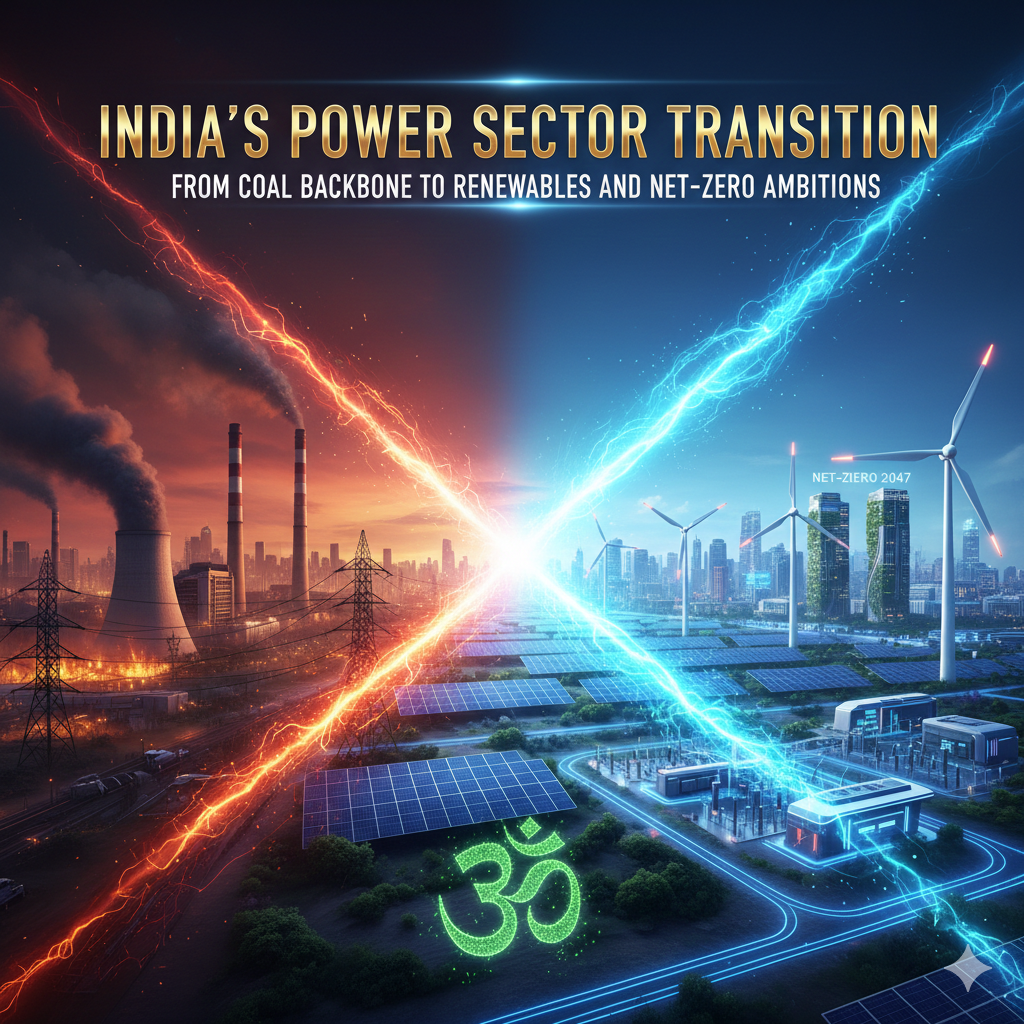
India’s power sector stands at a historic crossroads. Coal, once the undisputed backbone of electricity generation, is gradually giving way to renewables as the engine of future growth. This transformation is driven by climate responsibility, economic logic, and technological progress.
The journey toward a renewable-dominated power system will not be linear. Coal will continue to provide stability in the near term, while storage, nuclear energy, and green hydrogen mature. Yet the direction is unmistakable.
By carefully managing this transition, India has the opportunity to build an energy system that is cleaner, more resilient, and more inclusive—setting a powerful example for other developing nations navigating the same path toward net zero.