Introduction
The Mughal Empire, once one of the most powerful and prosperous empires in the world, witnessed a gradual decline after the reign of Aurangzeb (1658–1707). While earlier rulers like Akbar had built a strong administrative and political foundation, the empire began to weaken due to a combination of internal weaknesses and external pressures.
The decline was not sudden but a slow and multi-dimensional process, involving political instability, economic crisis, military failures, and social fragmentation.
Political Causes of Decline
Weak Successors after Aurangzeb
One of the primary reasons for the decline was the lack of capable rulers after Aurangzeb.
Key Issues
- Frequent succession wars
- Short reigns of emperors
- Lack of administrative ability
The absence of strong leadership led to instability at the center and weakened imperial authority.
War of Succession and Instability
Unlike a fixed law of succession, Mughal tradition allowed any prince to claim the throne.
Consequences
- Civil wars among princes
- Weakening of military strength
- Political chaos
These conflicts drained resources and disrupted governance.
Decline of Central Authority
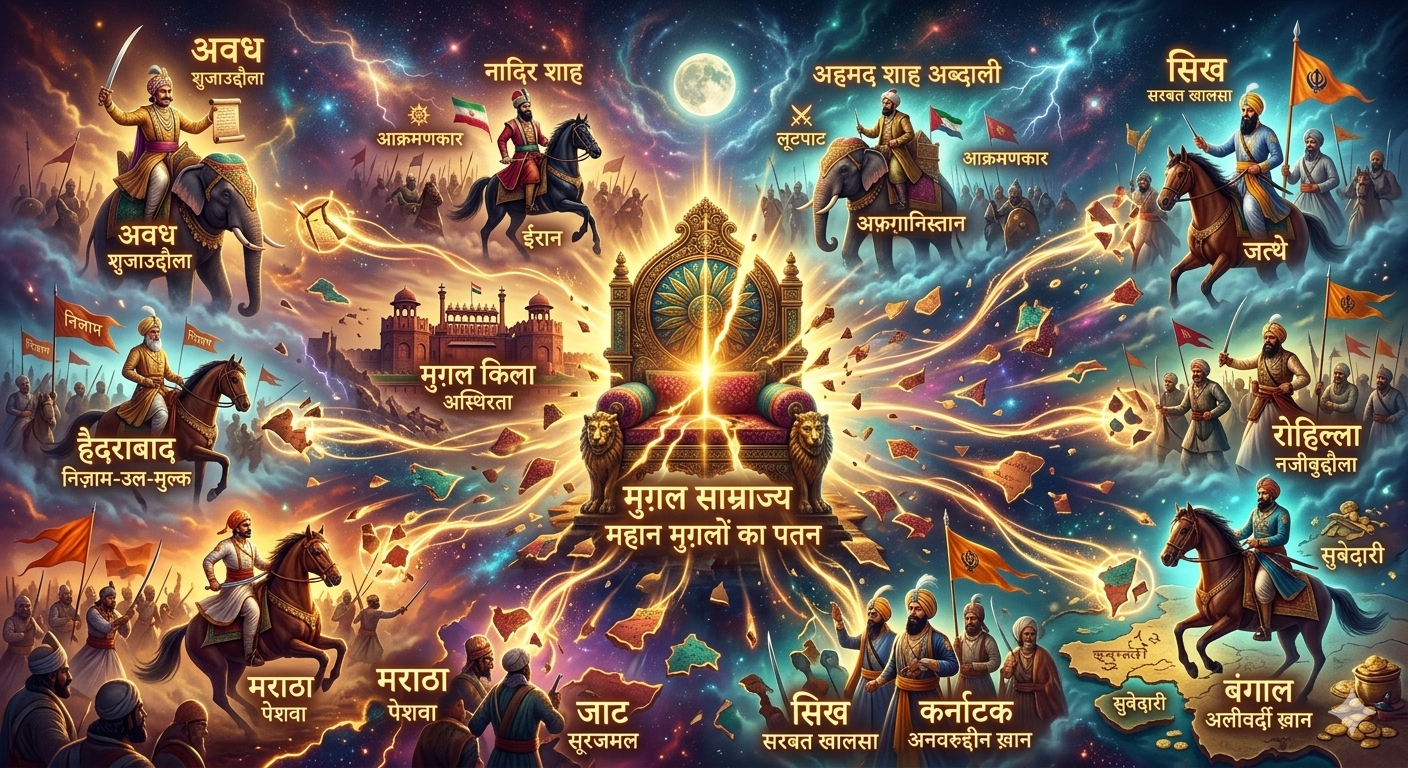
- Provincial governors became increasingly independent
- Rise of autonomous states like Hyderabad, Awadh, and Bengal
- Weak control over distant regions
This fragmentation reduced the empire’s unity and effectiveness.
Administrative Causes
Breakdown of Mansabdari System
The Mansabdari system, which was once the backbone of Mughal administration, began to deteriorate.
Problems
- Corruption among officials
- Fake reporting of troops (Dagh and Chehra system weakened)
- Irregular payment of salaries
This led to inefficiency in administration and military organization.
Jagirdari Crisis
The Jagirdari system faced serious challenges:
- Shortage of jagirs (land assignments)
- Excessive pressure on peasants
- Conflict between jagirdars and central authority
This crisis weakened revenue collection and administrative stability.
Corruption and Inefficiency
- Officials became self-serving
- Lack of accountability
- Decline in administrative discipline
These factors reduced the effectiveness of governance.
Economic Causes
Agrarian Crisis
The Mughal economy was primarily agrarian, and it faced severe challenges:
Key Issues
- Heavy taxation on peasants
- Decline in agricultural productivity
- Peasant revolts
This weakened the economic base of the empire.
Depletion of Treasury
Continuous wars, especially during the Deccan campaigns of Aurangzeb, drained the state treasury.
- High military expenditure
- Decline in revenue
- Financial instability
Decline in Trade and Commerce
- Disruption of trade routes
- Rise of European trading companies like British East India Company
- Loss of control over maritime trade
This affected economic growth and revenue.
Military Causes
Overextension of Empire
The empire expanded beyond manageable limits, especially in the Deccan.
Consequences
- Difficulty in administration
- Increased military burden
- Weak control over distant territories
Weakening of Army
- Decline in discipline and efficiency
- Outdated military techniques
- Lack of modernization
The Mughal army failed to compete with emerging powers.
Continuous Wars
- Long Deccan wars
- Conflicts with regional powers
These wars exhausted resources and weakened the empire.
Religious and Social Causes
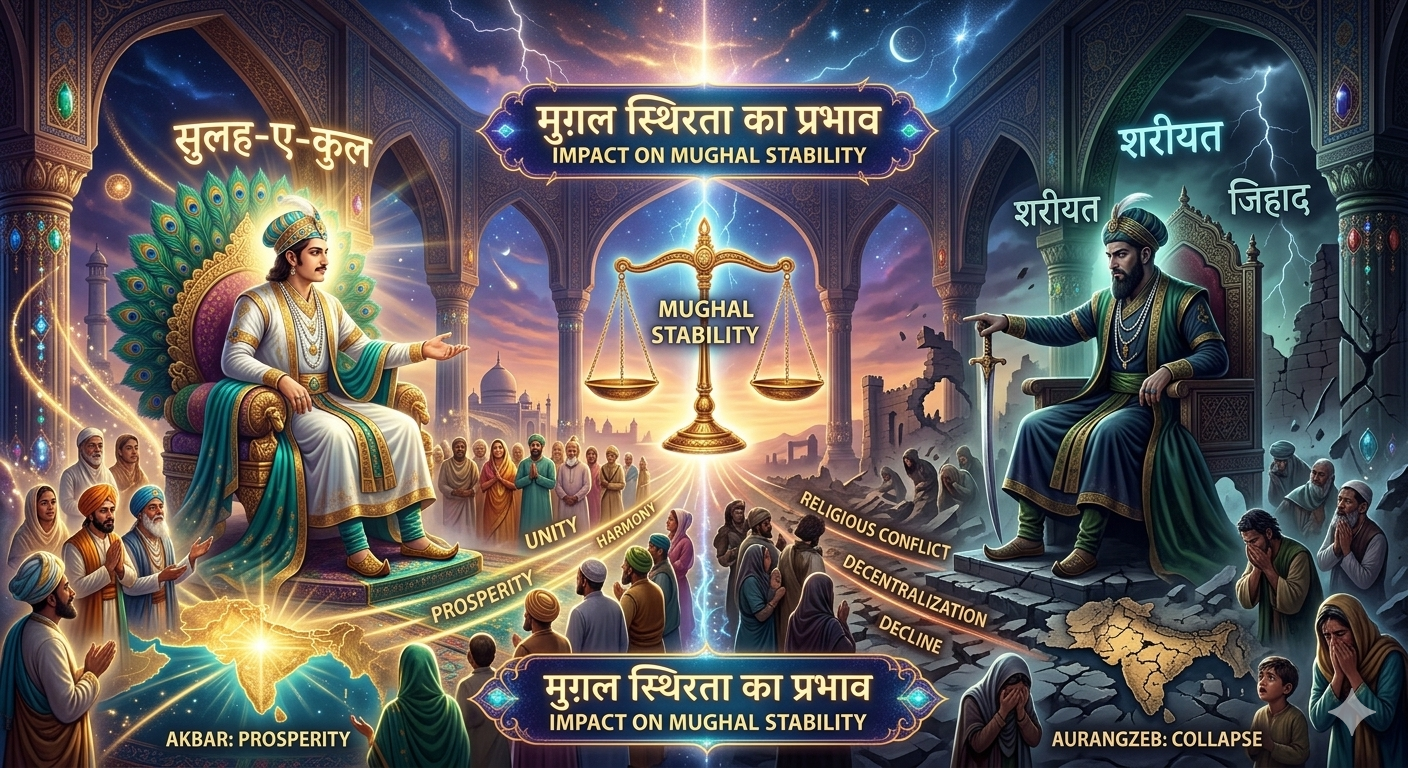
Religious Policies of Aurangzeb
The policies of Aurangzeb created divisions:
- Reimposition of Jizya
- Temple destructions in some regions
- Alienation of non-Muslims
This reduced the loyalty of large sections of the population.
Loss of Rajput Support
Earlier Mughal rulers maintained strong alliances with Rajputs.
- Aurangzeb’s policies strained these relations
- Rajputs became less supportive
This weakened the political foundation of the empire.
Rise of Regional Identities
- Growth of regional consciousness
- Emergence of local powers
- Decline of imperial unity
Rise of Regional Powers
Marathas
The rise of the Marathas under Shivaji posed a major challenge.
Impact
- Guerrilla warfare weakened Mughal control
- Loss of territories in the Deccan
Sikhs and Jats
- Sikh resistance in Punjab
- Jat uprisings in North India
These movements further weakened Mughal authority.
Emergence of Independent States
- Hyderabad, Awadh, Bengal became autonomous
- Decline of centralized power
Foreign Invasions
Invasion of Nadir Shah (1739)
The invasion by Nadir Shah was a turning point.
Consequences
- Looting of Delhi
- Massive loss of wealth
- Weakening of Mughal prestige
Invasions of Ahmad Shah Abdali
Ahmad Shah Abdali launched repeated invasions:
- Further destruction and instability
- Weakening of northern India
Role of European Powers
Rise of Colonial Influence
European companies gradually gained power:
- British East India Company expanded influence
- Established political control through trade
Economic Exploitation
- Drain of wealth
- Control over trade routes
- Weakening of indigenous economy
Cultural and Moral Decline
Luxury and Degeneration of Nobility
- Nobles became indulgent and corrupt
- Lack of discipline and responsibility
Loss of Public Support
- Decline in trust towards rulers
- Increasing dissatisfaction among people
Critical Evaluation
Internal vs External Causes
While external invasions and European intervention played a role, the primary reasons for decline were internal weaknesses:
- Administrative inefficiency
- Economic crisis
- Political instability
Role of Leadership
Strong rulers like Akbar ensured stability, while weak successors accelerated decline.
Structural Weaknesses
- Over-centralization
- Lack of institutional strength
- Dependence on individual rulers
Historical Significance
The decline of the Mughal Empire marked a turning point in Indian history:
- End of centralized imperial rule
- Rise of regional powers
- Beginning of colonial dominance
Conclusion
The decline of the Mughal Empire was the result of a complex interplay of political, administrative, economic, military, and social factors. Internal weaknesses such as weak leadership, administrative breakdown, and economic crisis played a decisive role, while external invasions and the rise of European powers accelerated the process.
Thus, the fall of the Mughal Empire was not due to a single cause but a combination of multiple interconnected factors, making it a gradual and inevitable process in the course of history.