1. Introduction
Climate change has become one of the most serious environmental challenges facing humanity in the modern era. Rapid industrialization, increasing use of fossil fuels, deforestation, and unsustainable patterns of consumption have significantly increased the concentration of greenhouse gases in the Earth’s atmosphere. As a result, the planet is experiencing rising global temperatures, changing weather patterns, melting glaciers, rising sea levels, and increasing frequency of extreme climatic events.
Because climate change is a global issue that transcends national boundaries, it requires coordinated international efforts. No single country can solve the problem alone, as greenhouse gas emissions released in one region can affect the climate system worldwide. Therefore, nations across the globe have come together through international negotiations to create agreements aimed at controlling emissions and promoting sustainable development.
International climate agreements serve several purposes. They establish frameworks for cooperation, set emission reduction targets, provide financial assistance for developing countries, and promote the transfer of environmentally friendly technologies. These agreements also encourage nations to adopt policies that protect the environment while maintaining economic development.
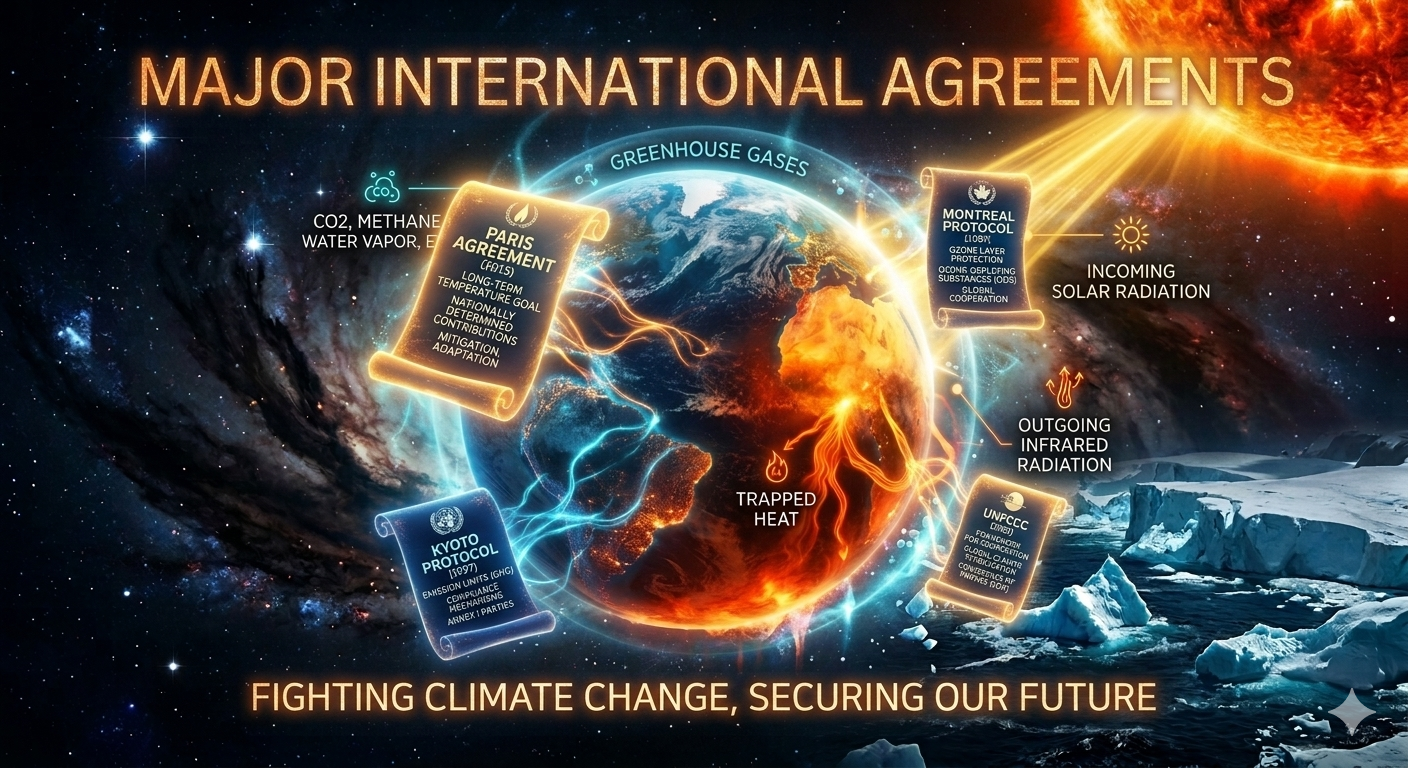
Over the past few decades, the international community has adopted several important treaties and agreements designed to address climate change. Among the most significant are the United Nations Framework Convention on Climate Change (UNFCCC), the Kyoto Protocol, and the Paris Agreement. These agreements represent milestones in the global effort to mitigate climate change and promote environmental sustainability.
Understanding these international agreements is essential for appreciating how global environmental governance operates and how countries are working together to protect the planet for future generations.
2. United Nations Framework Convention on Climate Change (UNFCCC)
Overview
The United Nations Framework Convention on Climate Change (UNFCCC) is the foundational international treaty addressing climate change. It was adopted in 1992 during the Earth Summit held in Rio de Janeiro, Brazil. The convention came into force in 1994 and currently has near-universal membership, with almost all countries in the world participating.
The primary objective of the UNFCCC is to stabilize greenhouse gas concentrations in the atmosphere at a level that would prevent dangerous human interference with the climate system. The convention recognizes that climate change is a global issue requiring collective action and international cooperation.
Objectives of the UNFCCC
The convention focuses on several important goals aimed at addressing climate change effectively.
First, it seeks to reduce the concentration of greenhouse gases in the atmosphere. This is essential to prevent severe environmental impacts such as global warming, extreme weather conditions, and ecological imbalance.
Second, the UNFCCC promotes sustainable development by encouraging countries to adopt environmentally friendly policies while continuing economic growth.
Third, the convention emphasizes scientific research and monitoring of climate systems. Reliable scientific information is necessary to understand climate trends and design effective policy responses.
Finally, the convention encourages cooperation between developed and developing countries. Developed nations are expected to provide financial and technological assistance to help developing countries address climate challenges.
Principles Guiding the UNFCCC
The UNFCCC is based on several guiding principles that shape international climate negotiations.
One important principle is Common but Differentiated Responsibilities (CBDR). This principle recognizes that all countries share responsibility for protecting the climate system, but developed countries should take greater responsibility because they historically contributed more to greenhouse gas emissions.
Another principle is the Precautionary Principle, which encourages countries to take preventive action against climate change even if scientific certainty is not complete.
The convention also emphasizes the Right to Sustainable Development, allowing developing countries to pursue economic progress while implementing environmentally responsible policies.
Conference of the Parties (COP)
The UNFCCC established an annual meeting known as the Conference of the Parties (COP). During these meetings, representatives from member countries review progress, negotiate new agreements, and discuss strategies to strengthen global climate action.
These conferences have played a crucial role in shaping international climate policy and have led to the development of major agreements such as the Kyoto Protocol and the Paris Agreement.
3. Kyoto Protocol
Introduction
The Kyoto Protocol is one of the most significant international treaties aimed at reducing greenhouse gas emissions. It was adopted in 1997 in Kyoto, Japan, and entered into force in 2005.
The protocol was created under the framework of the UNFCCC and represents the first international agreement that imposed legally binding emission reduction targets on developed countries.
Objectives of the Kyoto Protocol
The primary objective of the Kyoto Protocol was to reduce greenhouse gas emissions and slow down the process of global warming. The agreement required industrialized nations to reduce their overall emissions by approximately 5 percent below 1990 levels during the first commitment period from 2008 to 2012.
This reduction was intended to limit the environmental damage caused by excessive greenhouse gas emissions.
Key Features of the Kyoto Protocol
One of the most important features of the Kyoto Protocol was the establishment of legally binding emission reduction commitments for developed countries. This meant that participating nations had to meet specific targets or face potential consequences.
Another significant feature was the introduction of market-based mechanisms that allowed countries to achieve emission reductions in a cost-effective manner.
Flexible Mechanisms
The Kyoto Protocol introduced three major flexible mechanisms to help countries meet their emission targets.
The first mechanism is Emission Trading. This system allows countries with excess emission allowances to sell them to countries that exceed their limits. It creates a global carbon market and encourages efficient emission reductions.
The second mechanism is the Clean Development Mechanism (CDM). Under this mechanism, developed countries can invest in emission reduction projects in developing countries and receive carbon credits in return.
The third mechanism is Joint Implementation (JI). This mechanism allows developed countries to collaborate on emission reduction projects and share the resulting credits.
Achievements and Limitations
The Kyoto Protocol played a crucial role in promoting international cooperation on climate change. It introduced the concept of legally binding emission targets and created innovative mechanisms for reducing emissions.
However, the agreement also faced several limitations. Some major emitting countries did not fully participate, and developing countries were not required to reduce emissions. These factors limited the overall effectiveness of the protocol.
Despite these challenges, the Kyoto Protocol laid the groundwork for future international climate agreements.
4. Paris Agreement
Introduction
The Paris Agreement is one of the most comprehensive international agreements designed to combat climate change. It was adopted in 2015 during the twenty-first Conference of the Parties (COP21) held in Paris, France.
The agreement represents a global commitment by countries to limit global warming and reduce greenhouse gas emissions.
Main Goal of the Paris Agreement
The central objective of the Paris Agreement is to limit the increase in global average temperature to well below 2°C above pre-industrial levels. Additionally, the agreement encourages efforts to limit temperature rise to 1.5°C, which scientists consider crucial to preventing severe climate impacts.
Nationally Determined Contributions (NDCs)
One of the most innovative aspects of the Paris Agreement is the concept of Nationally Determined Contributions (NDCs). Instead of imposing fixed emission targets, the agreement allows each country to determine its own climate action plans.
Countries are required to submit their emission reduction strategies and update them every five years. This system encourages continuous improvement in climate policies.
Climate Finance
The Paris Agreement also recognizes the financial challenges faced by developing countries in addressing climate change. Therefore, it encourages developed nations to provide financial assistance to support climate mitigation and adaptation projects.
Climate finance helps developing countries invest in renewable energy, sustainable infrastructure, and climate-resilient development.
Transparency and Accountability
To ensure progress, the Paris Agreement includes a transparency framework that requires countries to report their greenhouse gas emissions and climate policies regularly. This monitoring system promotes accountability and encourages nations to fulfill their commitments.
Significance of the Paris Agreement
The Paris Agreement is widely regarded as a historic milestone in international climate diplomacy. Almost every country in the world has joined the agreement, demonstrating global recognition of the urgency of climate action.
5. Montreal Protocol and Climate Change
Overview
The Montreal Protocol, adopted in 1987, was originally designed to protect the ozone layer by phasing out ozone-depleting substances such as chlorofluorocarbons (CFCs).
Although its primary purpose was ozone protection, the agreement has also contributed significantly to climate change mitigation. Many ozone-depleting substances are powerful greenhouse gases, and their reduction has helped limit global warming.
Success of the Montreal Protocol
The Montreal Protocol is considered one of the most successful international environmental agreements. It demonstrates that global cooperation can effectively address environmental challenges when countries commit to collective action.
6. Glasgow Climate Pact
Introduction
The Glasgow Climate Pact was adopted during the 2021 climate conference held in Glasgow, Scotland. This agreement strengthened global commitments to reducing greenhouse gas emissions and accelerating climate action.
Key Provisions
The pact encourages countries to increase their emission reduction targets and accelerate the transition to clean energy sources.
It also calls for the gradual reduction of coal power and the elimination of inefficient fossil fuel subsidies.
Additionally, the agreement highlights the importance of increasing financial support for developing countries facing climate impacts.
7. Challenges in Implementing Climate Agreements
Political Challenges
International climate negotiations often involve complex political discussions. Countries have different economic priorities and development goals, which can make it difficult to reach consensus.
Economic Concerns
Many nations worry that strict emission reduction policies could affect economic growth and industrial development.
Responsibility and Equity Issues
Developing countries frequently argue that developed nations should bear greater responsibility for reducing emissions because they historically contributed more to climate change.
8. Importance of Global Cooperation
International climate agreements demonstrate the importance of cooperation in addressing global environmental challenges. Through shared commitments, financial support, and technological collaboration, countries can work together to reduce emissions and protect ecosystems.
Collective action is essential because the climate system is interconnected, and environmental problems in one region can affect the entire planet.
9. Conclusion
Climate change represents one of the greatest challenges facing humanity. To address this issue, countries around the world have developed international agreements that promote cooperation, emission reduction, and sustainable development.
The UNFCCC established the framework for global climate action, the Kyoto Protocol introduced legally binding emission reduction targets, and the Paris Agreement created a flexible system encouraging all countries to participate in climate mitigation efforts.
Although challenges remain, these agreements represent important steps toward protecting the environment and ensuring a sustainable future for coming generations.
Continued commitment, stronger policies, and increased international collaboration will be essential to effectively combat climate change and preserve the Earth’s ecological balance.