Introduction
Tropical cyclones are among the most destructive natural hazards, capable of causing massive loss of life, property damage, and economic disruption. Across the globe, these storms are known by different regional names such as hurricanes in the Atlantic and eastern Pacific, typhoons in the western Pacific, and cyclones in the Indian Ocean and South Pacific.
Naming cyclones helps in effective communication, disaster preparedness, and public awareness. Without distinct names, confusion could arise when multiple storms occur simultaneously in the same region. The recent East Coast cyclone “Phailin” in India highlighted the importance of naming conventions in raising early warnings and coordinating disaster response.
The system of naming tropical cyclones varies across regions, governed by meteorological agencies and international committees, with names chosen based on cultural relevance, ease of communication, and pre-approved lists. Understanding how cyclones are named provides insights into meteorology, international cooperation, and disaster management practices.
Significance of Naming Tropical Cyclones
- Communication and Public Awareness
- Names make it easier for the media, authorities, and public to track and communicate information about a storm.
- For example, warnings about Cyclone Phailin in 2013 helped in efficient evacuation along Odisha’s coast.
- Avoiding Confusion
- In regions where multiple cyclones can occur simultaneously, names prevent miscommunication compared to using dates or technical codes.
- International Coordination
- Named cyclones allow cross-border coordination when storms affect multiple countries.
- This is particularly relevant in regions like the western Pacific or the Bay of Bengal, where cyclones often impact several nations.
- Cultural Relevance and Memorability
- Names are often selected to reflect local languages and cultures, making them easier for residents to remember and respond to.
The Global System of Naming Tropical Cyclones
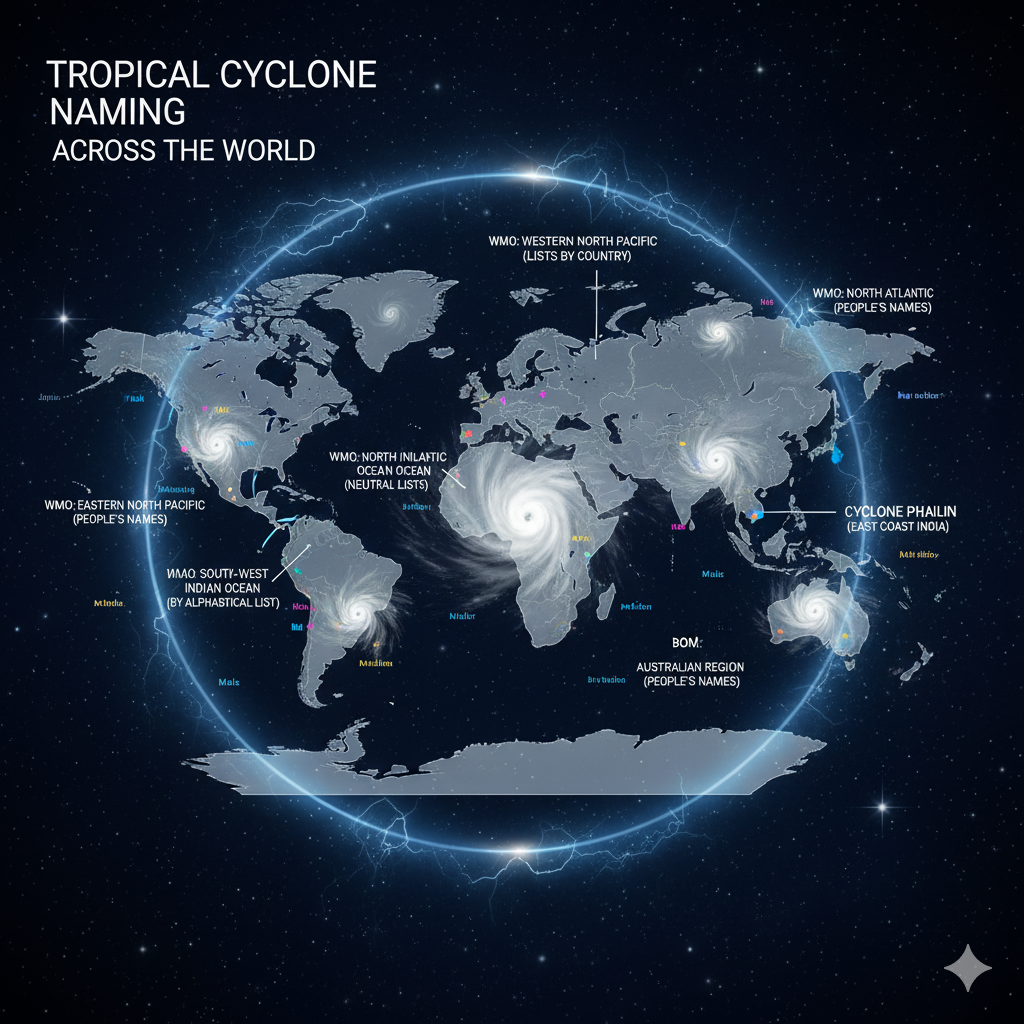
The practice of naming tropical cyclones is region-specific, coordinated under the oversight of the World Meteorological Organization (WMO) and regional meteorological centers.
1. Atlantic and Eastern Pacific (Hurricanes)
- The National Hurricane Center (NHC) in the United States oversees naming for the Atlantic Ocean and eastern Pacific.
- Names are pre-determined in alphabetical order and alternate between male and female names.
- There are six rotating lists, each reused every six years.
- Example: Hurricane Katrina (2005), Hurricane Sandy (2012).
- Names of particularly destructive storms are retired to avoid confusion and maintain sensitivity.
2. Western Pacific (Typhoons)
- The Japan Meteorological Agency (JMA) and the Typhoon Committee (14 member countries) manage naming.
- Names are contributed by member nations, reflecting flora, fauna, cultural elements, or local words.
- Examples: Typhoon Hagibis (Japan), Typhoon Mangkhut (Philippines contribution).
- Names are not alphabetical; they are drawn from a list of 140 pre-approved names.
3. Indian Ocean (Cyclones)
- The India Meteorological Department (IMD) coordinates cyclone naming for the North Indian Ocean, covering the Bay of Bengal and Arabian Sea.
- In 2004, the WMO/ESCAP Panel introduced a naming system for the region.
- Member countries (Bangladesh, India, Maldives, Myanmar, Oman, Pakistan, Sri Lanka, Thailand) submit names.
- Names are used sequentially, without retiring unless exceptionally destructive.
- Example: Cyclone Phailin (India), Cyclone Fani (Bangladesh/India), Cyclone Amphan (India/Bangladesh).
4. South-West Indian Ocean
- Managed by the Regional Specialized Meteorological Center (RSMC) in La Réunion, France.
- Names are contributed by countries in the region such as Madagascar, Mauritius, Seychelles.
5. Australian Region
- The Australian Bureau of Meteorology names cyclones affecting the Australian coast.
- Names are pre-approved lists, often of Aboriginal origin or English common names.
6. South Pacific
- Cyclones in the South Pacific are named by RSMC Nadi (Fiji) and Wellington (New Zealand).
- Names reflect local languages and cultural relevance.
Process of Naming a Cyclone
- Identification of Tropical Storm
- When a low-pressure system reaches tropical storm strength (wind speeds above 34 knots or 63 km/h), it is eligible for naming.
- Selection from Pre-Approved List
- The responsible meteorological agency assigns the next name in sequence from the pre-approved list for the region.
- Dissemination of Name
- Once named, the cyclone’s name is used in weather bulletins, news media, and international reports.
- Retirement of Names
- Names of exceptionally destructive cyclones are retired from lists to avoid public sensitivity and confusion.
- Examples: Katrina (2005, USA), Nargis (2008, Myanmar), Phailin (India, 2013).
Case Study: Cyclone Phailin
- Cyclone Phailin struck Odisha, India, in October 2013.
- The name “Phailin” was submitted by Thailand, meaning sapphire.
- Its naming facilitated early evacuation of over one million people, significantly reducing casualties compared to past cyclones of similar intensity.
- Phailin illustrates the practical importance of cyclone naming in disaster risk reduction.
Cultural and Linguistic Considerations
- Names are chosen to ensure easy pronunciation and memorability.
- Local contributions reflect regional identity, increasing public attention to warnings.
- Example:
- Bay of Bengal: Cyclone Fani (2019, submitted by Bangladesh).
- Western Pacific: Typhoon Hato (2017, Macau/China contribution).
Evolution of Cyclone Naming
- Early Practices
- Cyclones were initially identified by latitude/longitude coordinates, which were cumbersome.
- In the early 20th century, the Australian meteorologist Clement Wragge introduced personal names for storms.
- World War II Influence
- US meteorologists started using female names for storms in the Pacific during WWII, simplifying military communication.
- Modern Gender-Neutral Approach
- Lists now alternate male and female names in most regions.
- Names reflect cultural diversity and global cooperation.
Benefits of Standardized Naming
- Disaster Preparedness
- Names help authorities issue timely warnings and organize evacuations.
- Example: Cyclone Amphan (2020) warnings saved thousands of lives in India and Bangladesh.
- Media Communication
- Names allow for quick reporting, avoiding confusion with multiple storms.
- International Coordination
- Names enable sharing of meteorological data across nations for monitoring, forecasting, and response planning.
Challenges and Controversies
- Pronunciation Issues
- Some names are difficult for international media or residents to pronounce, reducing clarity.
- Cultural Sensitivity
- Names must avoid offending local customs or religious sentiments.
- Retirement and Replacement
- Determining which names to retire can sometimes cause delays in updating lists.
- Climate Change and Increasing Cyclone Frequency
- As cyclone frequency increases, naming lists may be exhausted faster, necessitating additional planning.
Global Cooperation and the Role of WMO
- The World Meteorological Organization (WMO) coordinates naming conventions through regional committees.
- Collaboration ensures consistency, data sharing, and effective disaster communication.
- The WMO also maintains guidelines for name selection, retirement, and public dissemination.
Conclusion
The naming of tropical cyclones is a crucial component of modern meteorology and disaster management. From Phailin on the East Coast of India to hurricanes in the Atlantic, cyclone names improve public awareness, communication efficiency, and international coordination.
Global practices reflect a blend of scientific, cultural, and linguistic considerations, ensuring that names are easily recognizable, memorable, and regionally relevant. The evolution of cyclone naming—from coordinates to culturally appropriate names—demonstrates the integration of science, communication, and disaster risk reduction.
As climate change increases the frequency and intensity of tropical cyclones, standardized naming and international coordination will remain essential tools for mitigating disaster impacts and saving lives worldwide.