Introduction
The unification of Germany in the nineteenth century stands as one of the most significant political transformations in European history. Before unification, the German-speaking region was fragmented into numerous independent states, principalities, and kingdoms that lacked political unity. Although cultural and linguistic bonds existed among the German people, political division prevented the emergence of a strong national state.
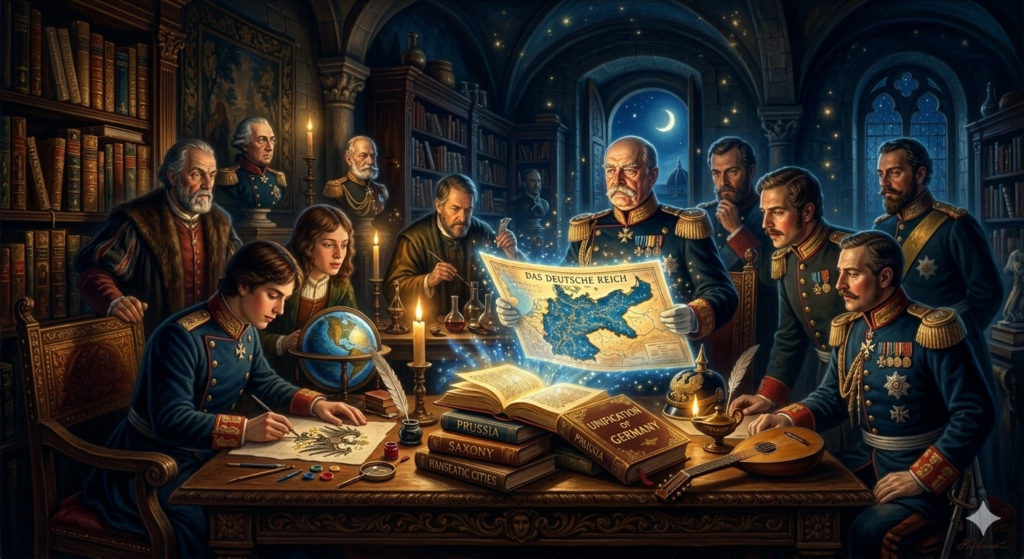
The process of unification reached its culmination in 1871 with the creation of the German Empire under the leadership of Prussia. A central figure in this historic development was Otto von Bismarck, who served as the Prime Minister of Prussia and later the first Chancellor of the German Empire. Through a combination of diplomatic skill, military strategy, and political realism, Bismarck engineered the unification of Germany under Prussian dominance.
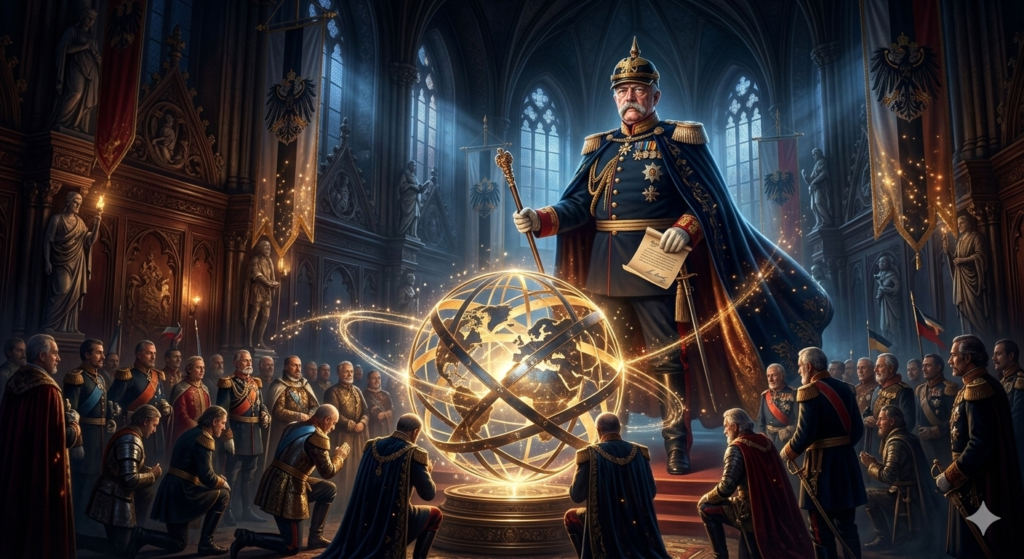
Bismarck’s approach to politics, often described as Realpolitik, emphasized practical goals and power politics rather than ideological principles. His famous declaration that the great questions of the time would be decided by “blood and iron” symbolized his belief that military strength and political strategy were necessary to achieve national unity.
This essay assesses the role of Bismarck in the unification of Germany by examining the historical background, his diplomatic and military strategies, the wars that led to unification, and the broader significance of his leadership.
Historical Background of German Disunity
Fragmentation of the German States
Prior to the nineteenth century, the German lands were politically fragmented. After the collapse of the Holy Roman Empire in 1806, the region remained divided into dozens of independent states.
Key Features of German Fragmentation
- Around 39 German states existed within the German Confederation created after the Congress of Vienna.
- These states varied in size and power, ranging from large kingdoms such as Prussia and Austria to numerous small duchies and principalities.
- Rivalry between Austria and Prussia dominated German politics.
Impact
This fragmentation created political instability and hindered economic and military development. However, it also created conditions in which a strong leader could unite the German states under one power.
Rise of Nationalism in Germany
Growth of German National Consciousness
The nineteenth century witnessed the growth of nationalism throughout Europe, and German-speaking peoples also developed a strong sense of shared identity.
Factors Promoting Nationalism
- Common language and cultural traditions
- Influence of Romantic nationalism
- Opposition to foreign domination
Influence of Economic Integration
The creation of the Zollverein in 1834 played a crucial role in promoting economic unity among German states.
Significance of the Zollverein
- Eliminated internal trade barriers.
- Strengthened economic ties between German states.
- Increased the influence of Prussia in German affairs.
Economic cooperation helped prepare the ground for political unification.
Early Attempts at German Unification
Liberal Efforts and Their Failure
Before Bismarck’s rise, attempts were made to unify Germany through liberal and democratic means.
The Revolutions of 1848
The Revolutions of 1848 led to the formation of the Frankfurt Parliament, which attempted to create a unified German state.
Reasons for Failure
- Internal divisions among liberals.
- Lack of military power.
- Refusal of Frederick William IV to accept the German crown offered by the parliament.
The failure of liberal nationalism created an opportunity for a conservative leader like Bismarck to achieve unification through different means.
Rise of Otto von Bismarck
Political Career
Otto von Bismarck became Prime Minister of Prussia in 1862. He was a conservative aristocrat who believed in strong monarchy and state power.
Key Ideas of Bismarck
- Support for monarchy and aristocracy.
- Opposition to liberal parliamentary control.
- Belief in practical politics and power diplomacy.
“Blood and Iron” Policy
In a famous speech, Bismarck argued that major political questions would not be resolved through speeches and parliamentary debates but through “blood and iron,” meaning military strength and strategic power.
This philosophy guided his approach to German unification.
Bismarck’s Strategy for German Unification
Bismarck pursued a carefully planned strategy to unite Germany under Prussian leadership.
Key Elements of His Strategy
- Isolation of Austria from German affairs.
- Strengthening Prussia’s military power.
- Using wars strategically to unite German states.
- Manipulating diplomacy to avoid international opposition.
His approach combined diplomacy, political calculation, and military action.
The Danish War (1864)
The first step in Bismarck’s unification plan involved conflict with Denmark.
Background
The dispute centered on the duchies of Schleswig and Holstein, which had mixed German and Danish populations.
War Against Denmark
In 1864, Prussia allied with Austria to defeat Denmark in the Second Schleswig War.
Results
- Denmark was defeated.
- Schleswig came under Prussian administration.
- Holstein was governed by Austria.
Importance
This war increased Prussia’s prestige and created tensions with Austria, which Bismarck later used to provoke another conflict.
The Austro-Prussian War (1866)
The next stage of unification involved removing Austrian influence from German politics.
Causes of the War
Disputes over the administration of Schleswig and Holstein led to conflict between Prussia and Austria.
The war is known as the Austro-Prussian War.
Key Developments
Prussia’s modern army, supported by superior military organization and railways, defeated Austria in a short conflict.
The decisive battle took place at the Battle of Königgrätz.
Results
- Austria was excluded from German politics.
- The German Confederation was dissolved.
- Prussia formed the North German Confederation.
Importance
This war was a major step toward unification because it established Prussia as the dominant power among German states.
The Franco-Prussian War (1870–1871)
The final stage of German unification came through conflict with France.
Background
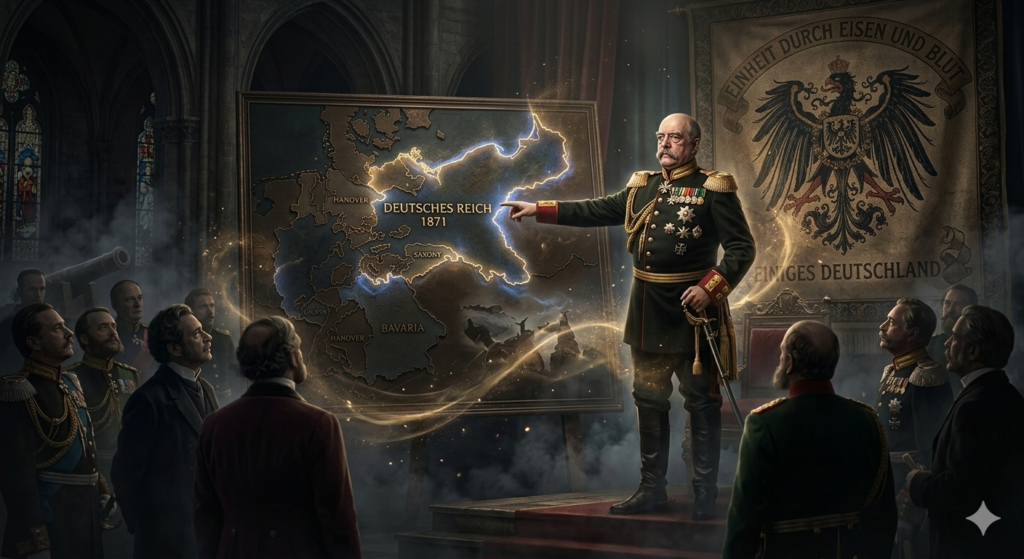
Bismarck believed that a war with France would unite the southern German states with Prussia against a common enemy.
The conflict began after the diplomatic controversy known as the Ems Dispatch, which increased tensions between Prussia and France.
War with France
The resulting war is known as the Franco-Prussian War.
Key Events
- German armies defeated France decisively.
- Napoleon III was captured at the Battle of Sedan.
Outcome
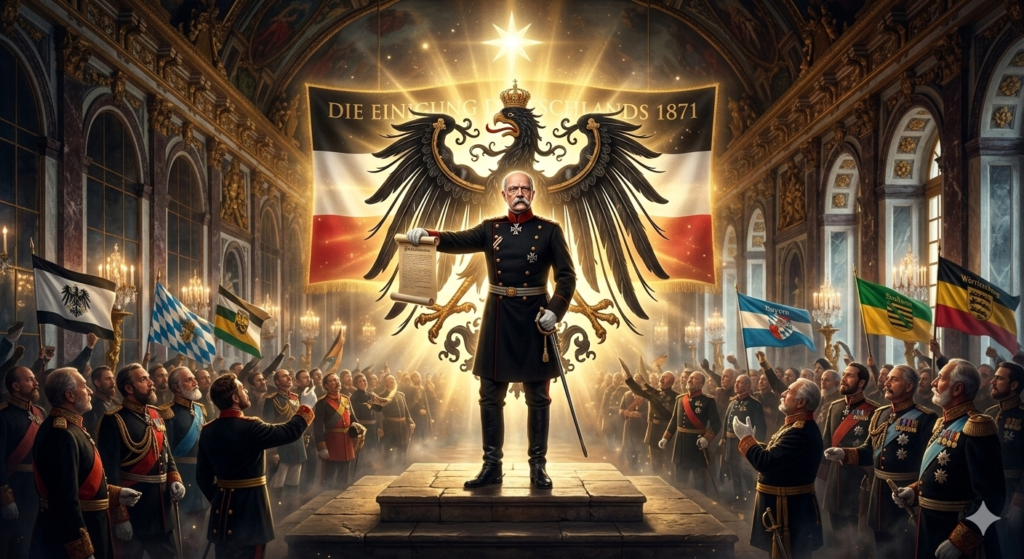
In 1871, the German states united to form the German Empire.
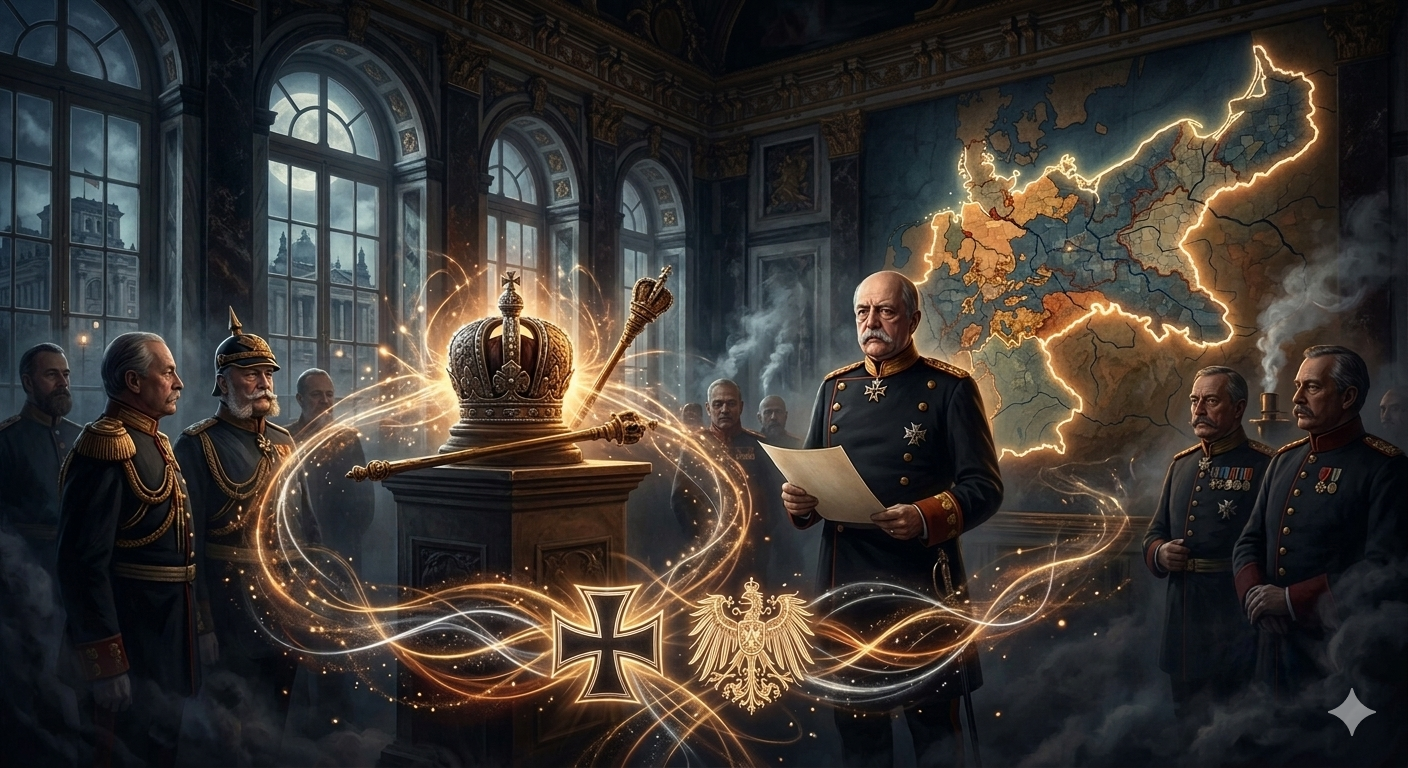
The empire was proclaimed in the Palace of Versailles, symbolizing German victory over France.
Proclamation of the German Empire
In January 1871, Wilhelm I was declared the German Emperor.
Features of the New Empire
- Prussia became the dominant state.
- Bismarck became the first Chancellor.
- Germany emerged as a major European power.
This event marked the completion of German unification.
Assessment of Bismarck’s Role
Positive Contributions
1. Master of Diplomacy
Bismarck skillfully managed diplomatic relations to prevent other European powers from interfering in German unification.
2. Strategic Use of War
He fought limited and carefully planned wars that achieved political objectives without creating large-scale European conflicts.
3. Political Realism
Bismarck’s Realpolitik allowed him to adapt policies according to circumstances rather than ideological commitments.
4. Leadership and Vision
His leadership provided direction and determination in the complex process of unification.
Limitations and Criticism
Despite his achievements, Bismarck’s methods also faced criticism.
1. Militaristic Approach
Unification through war strengthened militarism in German politics.
2. Authoritarian System
The new German Empire maintained strong monarchical power and limited democratic participation.
3. Exclusion of Austria
The unification created a “Lesser Germany” that excluded Austria, leaving unresolved tensions in Central Europe.
Historical Significance of German Unification
The unification of Germany had far-reaching consequences.
Major Impacts
- Emergence of Germany as a major European power.
- Shift in the balance of power in Europe.
- Strengthening of nationalism across the continent.
The rise of Germany eventually influenced the political developments that shaped twentieth-century European history.
Conclusion
The unification of Germany was the result of complex historical forces including nationalism, economic integration, and political rivalry. However, the decisive role was played by Otto von Bismarck, whose leadership, diplomacy, and strategic planning transformed the political landscape of Europe.
Through his policy of Realpolitik and the calculated use of three wars—against Denmark, Austria, and France—Bismarck successfully united the German states under Prussian leadership. His actions reshaped European politics and created a powerful German Empire that would play a central role in international affairs.
Therefore, while German nationalism and economic developments provided the background for unification, it was Bismarck’s political skill and determination that ultimately made German unity a reality.