Introduction
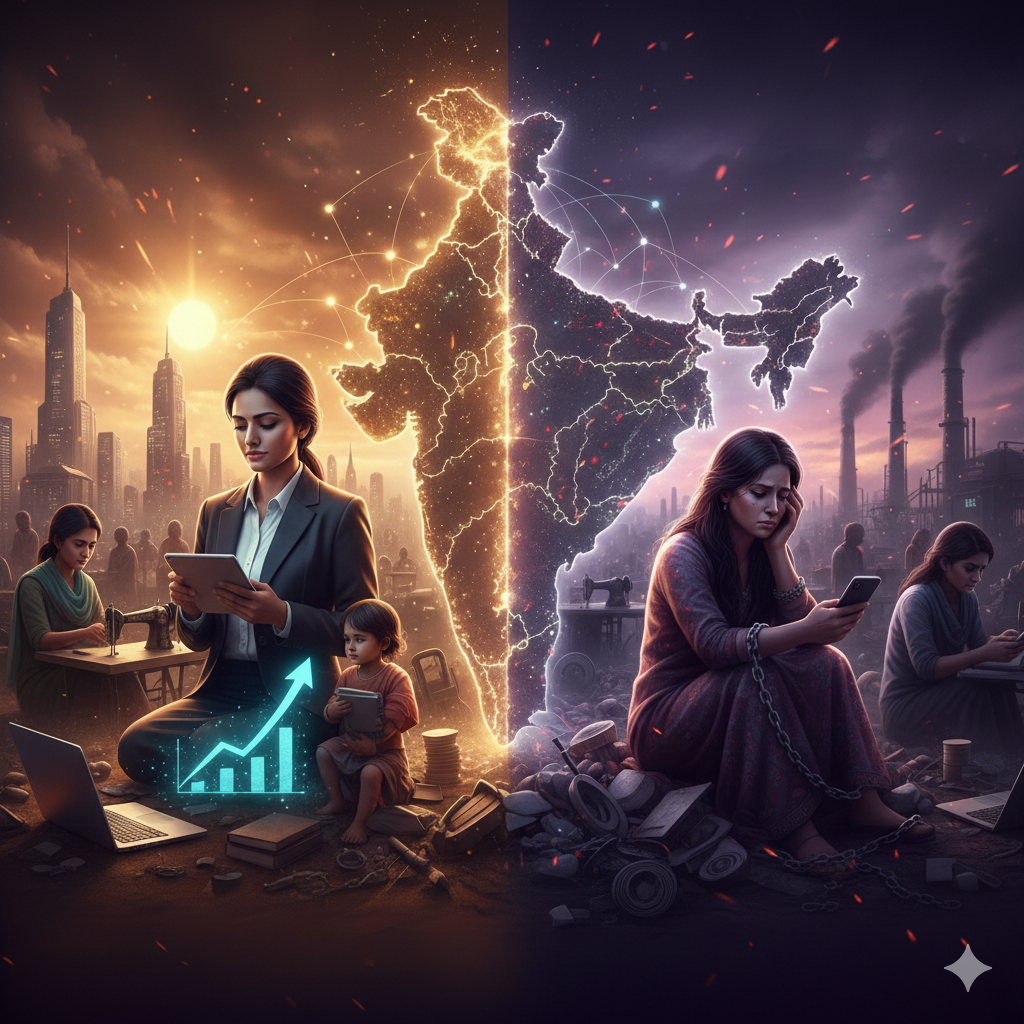
Globalization refers to the increasing integration of economies, societies, cultures, and technologies across national boundaries. Since India adopted economic liberalization policies in 1991, globalization has significantly reshaped its social and economic landscape. Among the most profound impacts has been its influence on women’s lives. Globalization has opened new avenues of employment, education, and social mobility for Indian women, while simultaneously generating fresh vulnerabilities in the form of labor exploitation, cultural commodification, and widening inequalities. The experience of Indian women under globalization is therefore complex, uneven, and deeply shaped by class, caste, region, and education.
Changing Position of Women in the Globalized Indian Economy
Before globalization, women’s participation in the formal economy was limited and largely confined to agriculture, household industries, and low-paid service work. The post-1991 period witnessed a structural transformation in India’s economy, with rapid growth in information technology, services, manufacturing, and export-oriented industries. This shift created new employment spaces for women, especially in urban centers. Women increasingly entered call centers, software services, retail, healthcare, education, and textile exports. Simultaneously, globalization intensified informalization, meaning a large number of women were absorbed into insecure and unregulated forms of work. Thus, while globalization expanded opportunities, it also reinforced precarious employment patterns.
Positive Effects of Globalization on Women in India
One of the most visible positive outcomes of globalization has been increased employment opportunities for women. The expansion of service sectors such as IT, hospitality, healthcare, and education has enabled many urban and semi-urban women to access paid work, financial independence, and professional identities. Export-oriented industries like garments, handicrafts, and food processing have created jobs for millions of women, particularly in states such as Tamil Nadu, Karnataka, Gujarat, and West Bengal. Economic participation has enhanced women’s bargaining power within households and encouraged delayed marriage, smaller families, and greater investment in girls’ education.
Globalization has also contributed to rising educational aspirations among women. Greater exposure to global ideas and labor markets has increased demand for higher education and skill development. Women’s enrollment in universities and professional courses has grown steadily, particularly in fields such as management, medicine, engineering, and information technology. Access to digital technologies and online learning platforms has further expanded educational possibilities, especially for middle-class women.
Another significant benefit has been increased visibility of women in public life. Global media, international norms, and transnational feminist movements have strengthened awareness of gender rights, workplace equality, and legal protections. Issues such as sexual harassment, domestic violence, and reproductive rights have gained greater attention, leading to legislative reforms like the Sexual Harassment of Women at Workplace Act and expanded maternity benefits. Corporate diversity policies and global reporting standards have also encouraged organizations to adopt gender-sensitive practices.
Globalization has promoted entrepreneurship among women through access to microfinance, self-help groups, and e-commerce platforms. Many women have established small businesses in handicrafts, food services, fashion, and digital services, reaching national and international markets. Government programs aligned with global development frameworks have supported women’s self-employment, contributing to grassroots economic empowerment.
Cultural exchange under globalization has broadened women’s exposure to alternative lifestyles and role models. The visibility of successful women leaders, professionals, and entrepreneurs has challenged traditional gender stereotypes and inspired younger generations. Urban women, in particular, have experienced greater freedom in career choices, mobility, and personal expression.
Negative Effects of Globalization on Women in India
Despite these gains, globalization has also produced serious challenges for women, especially those from marginalized backgrounds. One of the most critical issues is the feminization of informal labor. While women’s workforce participation has increased in certain sectors, most jobs created are insecure, low-paid, and lacking social protection. Women dominate casual labor, home-based work, and subcontracted production, particularly in textiles, construction, domestic work, and agriculture. These jobs often involve long hours, unsafe conditions, and absence of maternity or health benefits.
Globalization has intensified economic inequality among women themselves. Educated urban women have benefited disproportionately from new opportunities, while rural and unskilled women face declining livelihoods due to mechanization, land dispossession, and reduced public sector employment. Small-scale women farmers and artisans struggle to compete with global agribusiness and mass-produced goods, leading to income instability and distress migration.
Another negative impact is the commercialization of women’s bodies and identities. Global media and consumer culture increasingly portray women as objects of beauty and consumption, reinforcing unrealistic standards and commodification. The spread of advertising and entertainment industries has contributed to body image issues and cultural homogenization, weakening indigenous values and diverse expressions of femininity.
Workplace exploitation remains widespread. Women employed in export industries and domestic work frequently experience wage discrimination, job insecurity, and harassment. Migrant women workers are particularly vulnerable due to lack of legal awareness and social support. The pressure to remain competitive in global markets often leads employers to suppress wages and ignore labor rights, affecting women more severely than men.
Globalization has also added to women’s unpaid care burden. Even when women enter paid employment, they continue to shoulder primary responsibility for household work and caregiving. The retreat of the state from welfare provision under neoliberal policies has increased reliance on family-based care, intensifying women’s time poverty and emotional stress.
Cultural backlash is another concern. Rapid social change has sometimes triggered conservative reactions, reinforcing patriarchal norms in certain communities. Increased visibility of women in public spaces has, paradoxically, coincided with rising incidents of gender-based violence and moral policing. Digital globalization has further exposed women to online harassment and cyber abuse.
Health impacts cannot be overlooked. Women working in factories, plantations, and informal sectors often face occupational hazards without adequate healthcare. Urban working women experience lifestyle-related stress, while rural women confront nutritional insecurity due to changing food systems and declining agricultural diversity.
Globalization, Migration, and Women
Globalization has reshaped migration patterns, with growing numbers of women migrating internally and internationally for work. Female migration for domestic service, nursing, and care work has expanded significantly. While migration offers income opportunities, it also exposes women to exploitation, trafficking, and isolation. Remittances improve household welfare, yet migrant women frequently endure poor working conditions and limited legal protection, especially in Gulf countries and urban domestic labor markets.
Impact on Gender Relations and Family Structures
Economic participation has altered traditional gender relations in many households. Women’s earnings contribute to greater decision-making power and aspirations for children’s education. However, these changes are uneven and often resisted. In some cases, women’s income leads to increased domestic conflict rather than empowerment, highlighting the need for broader social transformation alongside economic change.
Family structures are also evolving. Nuclear families, delayed marriages, and dual-earner households are becoming more common in urban India. While this offers greater autonomy to women, it also reduces traditional support systems, increasing childcare pressures and emotional responsibilities.
Role of State and Policy Interventions
The outcomes of globalization for women depend heavily on state policies. Where governments invest in education, healthcare, skill development, and social security, women benefit more equitably. India has introduced several gender-focused initiatives, including Beti Bachao Beti Padhao, Stand-Up India, and maternity benefit schemes. However, gaps remain in labor regulation, childcare infrastructure, and enforcement of workplace rights. Without inclusive policies, globalization risks deepening gender disparities.

Way Forward
To make globalization more gender-just, India must prioritize decent work conditions, equal wages, and universal social protection. Investment in girls’ education, digital literacy, and vocational training is essential. Strengthening labor laws, expanding childcare facilities, and supporting women entrepreneurs can enhance economic participation. Equally important is challenging patriarchal norms through awareness campaigns and community engagement. Globalization should be harnessed as a tool for inclusive development rather than allowed to reinforce existing inequalities.
Conclusion
Globalization has transformed Indian women’s lives in profound and contradictory ways. It has created new opportunities for education, employment, and empowerment, particularly for urban and educated women. At the same time, it has intensified insecurity, exploitation, and inequality for millions of rural and informal-sector women. The impact of globalization is therefore not uniformly positive or negative but deeply stratified. For globalization to become a force for genuine gender equality, economic reforms must be accompanied by strong social policies, legal safeguards, and cultural change. Only then can Indian women fully realize their potential in an interconnected world.