Introduction
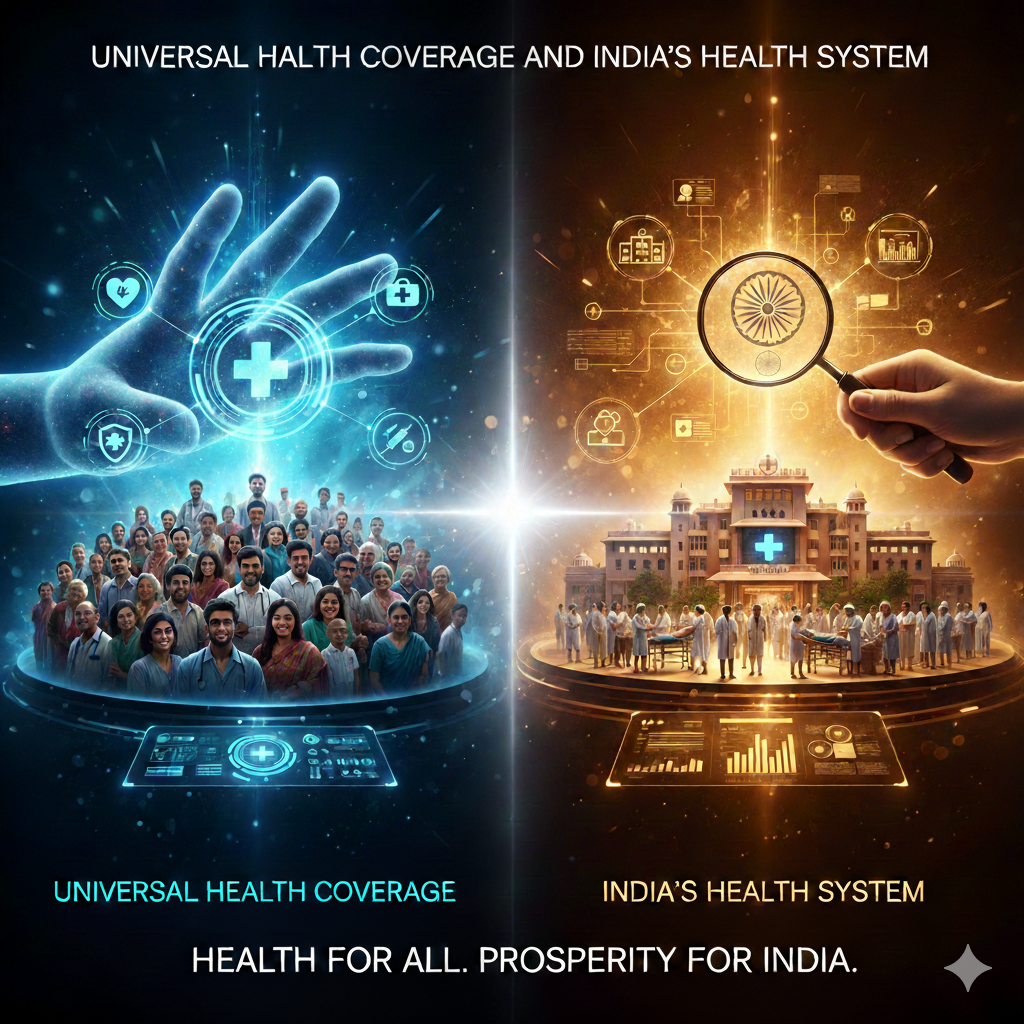
Universal Health Coverage (UHC), defined as ensuring that all individuals receive quality health services without financial hardship, is a core objective of India’s public policy framework. Despite constitutional commitments under the Directive Principles of State Policy and repeated health sector reforms, India’s public health system continues to face structural and operational limitations. These gaps have led to high out-of-pocket expenditure and uneven access to healthcare services. In this context, the private sector has emerged as a significant stakeholder in healthcare delivery. The debate today is not whether the private sector should be involved, but how its participation can be aligned with public goals while safeguarding equity, affordability, and quality. Alongside private participation, several alternative and complementary strategies are also necessary to achieve universal health coverage in India.
Limitations of the Public Health System in Achieving Universal Health Coverage
India’s public health system suffers from chronic underinvestment. Public health expenditure has remained around 1–1.5 percent of GDP for decades, far below global and WHO recommendations. This has resulted in inadequate infrastructure, shortage of medical professionals, poor maintenance of facilities, and limited availability of essential medicines, especially in rural and remote areas.
Human resource constraints further weaken the system. Vacancies of doctors, nurses, and specialists at Primary Health Centres (PHCs), Community Health Centres (CHCs), and district hospitals reduce service delivery capacity. The uneven distribution of healthcare facilities across regions exacerbates regional inequalities, leaving tribal, hilly, and aspirational districts underserved.
Quality of care remains another challenge. Overcrowding, long waiting times, lack of diagnostic facilities, and weak referral mechanisms reduce public trust in government hospitals. As a result, even low-income households often turn to private providers, increasing out-of-pocket expenditure and pushing many into poverty.
Role of the Private Sector in Bridging Healthcare Gaps
The private healthcare sector already plays a dominant role in India, accounting for a majority of outpatient and inpatient services. Its extensive presence, especially in urban and semi-urban areas, makes it a potential partner in expanding healthcare access.
Private hospitals and clinics offer better infrastructure, shorter waiting times, and wider availability of specialists. Their involvement can help address capacity shortages in diagnostics, tertiary care, and specialized treatments. Public-Private Partnerships (PPPs) have demonstrated success in areas such as dialysis services, diagnostic labs, emergency transport, and hospital management.
Government schemes like Ayushman Bharat – Pradhan Mantri Jan Arogya Yojana (PM-JAY) rely heavily on empanelled private hospitals to provide secondary and tertiary care. This has expanded access to cashless treatment for millions of vulnerable families and reduced catastrophic health expenditure in many cases.
The private sector also contributes to innovation, adoption of new technologies, telemedicine, and digital health solutions, which can enhance efficiency and reach, particularly in remote areas.
Challenges of Relying on the Private Sector
Despite its potential, excessive reliance on the private sector raises serious concerns. Profit orientation often leads to cost escalation, unnecessary diagnostics, and over-medicalization, which undermines affordability. Weak regulatory oversight allows unethical practices, variable quality standards, and price manipulation.
Private healthcare remains largely concentrated in urban areas, limiting its effectiveness in addressing rural health disparities. Moreover, the exclusion of preventive and primary healthcare from private sector priorities restricts its role in achieving holistic health outcomes.
Insurance-based models involving private providers may also encourage selective treatment and exclusion of complex or high-risk cases. Without strong regulation and accountability, private sector participation risks deepening inequalities rather than reducing them.
Strengthening Regulation and Governance of Private Healthcare
For private sector involvement to contribute meaningfully to universal health coverage, robust regulatory frameworks are essential. Standard treatment guidelines, price caps on essential services, transparent billing, and quality accreditation must be strictly enforced.
State capacity for monitoring private hospitals should be strengthened through digital health records, grievance redress mechanisms, and outcome-based reimbursement systems. Public interest must guide contracts under PPP models, ensuring equity, accessibility, and accountability.
Integration of private providers into national health priorities—such as disease surveillance, immunization, and emergency response—can enhance system-wide resilience.
Other Viable Alternatives and Complementary Strategies
Strengthening Primary Healthcare
A strong primary healthcare system is the most cost-effective route to universal health coverage. Expansion of Health and Wellness Centres under Ayushman Bharat focuses on preventive, promotive, and basic curative services. Improving primary care reduces the burden on tertiary hospitals and lowers overall healthcare costs.
Increasing Public Health Expenditure
Sustained increase in public health spending is essential. Higher investment can improve infrastructure, recruit healthcare professionals, expand medical education, and ensure availability of free essential medicines and diagnostics.
Community-Based and Decentralized Healthcare
Community participation through local health committees, ASHA workers, and self-help groups improves outreach, health awareness, and service utilization. Decentralized planning allows health interventions to be tailored to local needs.
Leveraging Technology and Digital Health
Telemedicine, e-health records, AI-based diagnostics, and mobile health platforms can overcome geographical barriers and improve efficiency. Government initiatives like the Ayushman Bharat Digital Mission aim to integrate digital solutions into the health ecosystem.
Promoting Preventive and Public Health Approaches
Focusing on sanitation, nutrition, clean drinking water, pollution control, and lifestyle diseases can significantly reduce disease burden. Preventive healthcare reduces long-term costs and enhances population health outcomes.
Strengthening Medical Education and Workforce Planning
Expanding medical colleges, nursing institutes, and allied health training can address human resource shortages. Incentives for rural service and task-shifting models can improve service delivery in underserved areas.
Conclusion
The public health system alone, in its current form, is insufficient to achieve universal health coverage in India. The private sector can play a supportive role in bridging gaps in infrastructure, technology, and specialized care, provided its participation is guided by strong regulation, public accountability, and equity considerations. However, private sector involvement is not a substitute for a robust public health system.
Universal health coverage requires a balanced approach—strengthening public healthcare foundations, responsibly integrating private providers, leveraging technology, and prioritizing preventive and primary care. Only a comprehensive, people-centric, and well-governed health system can ensure health security for all citizens and fulfill India’s constitutional and developmental aspirations.