
Introduction
Medical technology plays a central role in modern healthcare systems. From basic diagnostic tools to advanced imaging machines, medical devices directly influence disease detection, treatment accuracy, and patient outcomes. However, high-end equipment such as MRI scanners, CT machines, and advanced surgical systems often come with heavy capital costs, placing them beyond the reach of many hospitals and diagnostic centres—especially in semi-urban and rural areas.
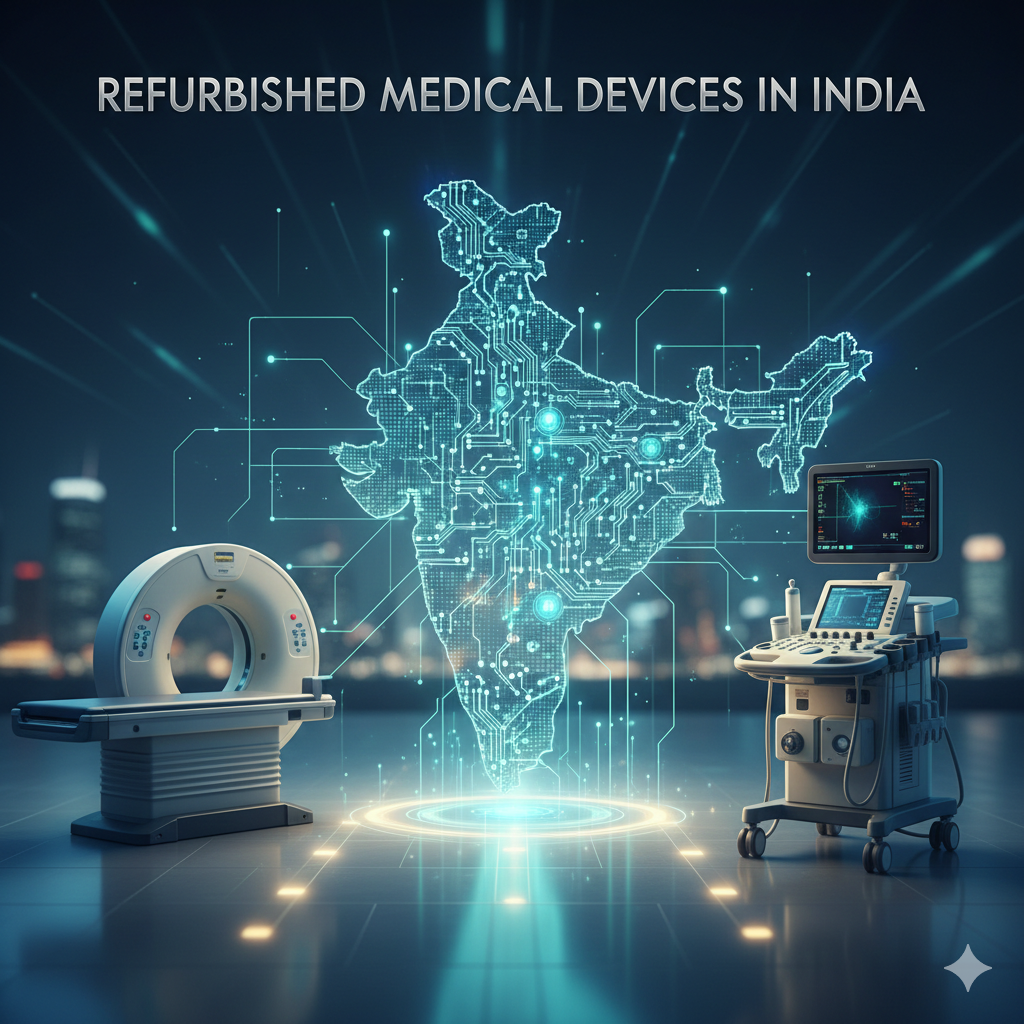
In this context, refurbished medical devices have emerged as an alternative pathway to expand healthcare access. These are pre-owned machines that are repaired, upgraded, tested, and resold at significantly lower prices. While this approach promises affordability and wider availability of diagnostic services, it also raises important concerns regarding safety, quality assurance, and its impact on India’s domestic medical device industry.
India is now at a policy crossroads: how to balance healthcare accessibility with patient safety and long-term industrial self-reliance.
What Are Refurbished Medical Devices?
Refurbished medical devices are previously used machines that undergo technical restoration before being resold. This process may include replacing worn parts, updating software, recalibrating systems, and conducting performance tests.
Typical refurbished equipment includes:
- MRI and CT scanners
- X-ray and ultrasound machines
- Endoscopy systems
- PET imaging equipment
- Certain surgical platforms
The primary attraction of refurbished devices lies in their lower cost. A machine that might cost several crores when new can often be purchased at a fraction of that price in refurbished form. This price advantage allows smaller hospitals and diagnostic centres to introduce advanced services that would otherwise be financially unviable.
As a result, refurbished devices are increasingly viewed as tools for improving healthcare reach, particularly in underserved regions.
Why Refurbished Devices Matter for India
India faces a dual healthcare challenge: rising demand for advanced diagnostics and limited infrastructure outside major cities.
Refurbished medical equipment potentially addresses several gaps:
1. Improved Access to Diagnostics
Affordable machines enable district hospitals and private clinics in Tier-II and Tier-III towns to offer imaging and diagnostic services locally, reducing patient travel and delays in diagnosis.
2. Lower Capital Barriers
Smaller healthcare providers can enter the diagnostics space without massive upfront investment, encouraging decentralised healthcare delivery.
3. Faster Infrastructure Expansion
Refurbished equipment can be deployed more quickly than waiting for new installations, helping bridge short-term infrastructure shortages.
Despite these benefits, affordability alone cannot be the guiding principle in healthcare technology.
The Regulatory Grey Zone
India currently lacks a dedicated regulatory framework specifically designed for refurbished medical devices.
Medical devices fall under the Drugs and Cosmetics Act and are overseen by Central Drugs Standard Control Organisation. However, existing rules focus primarily on new devices. Refurbished equipment does not fit neatly into current licensing categories.
As a result:
- There is no standard approval pathway tailored to refurbished imports.
- Definitions such as “used,” “refurbished,” or “reconditioned” are not clearly established in medical device regulations.
- Quality benchmarks for refurbished equipment remain ambiguous.
In practice, imports of refurbished machines often move through environmental clearance mechanisms managed by Ministry of Environment, Forest and Climate Change and authorisation by Directorate General of Foreign Trade.
This creates a fragmented system where environmental permissions exist, but medical licensing clarity is absent—raising serious governance and safety concerns.
Patient Safety Concerns
At the core of the debate is patient safety.
Medical devices directly affect clinical decisions. Any malfunction, calibration error, or software limitation can lead to incorrect diagnosis or inappropriate treatment.
Key safety issues associated with refurbished equipment include:
- Unknown usage history and wear levels
- Absence of manufacturer warranties in many cases
- Limited access to original spare parts
- Inconsistent after-sales servicing
- Outdated software or imaging standards
Unlike new devices, refurbished machines may lack full lifecycle documentation, making it difficult to verify how intensively they were used or whether critical components were replaced properly.
Without strict certification and monitoring systems, patients may unknowingly be exposed to higher clinical risks.

Impact on Domestic Manufacturing
India has been actively promoting indigenous production of medical devices under initiatives such as Make in India.
Domestic manufacturers argue that unrestricted imports of refurbished equipment could:
- Undercut locally made new devices on price
- Reduce incentives for innovation and R&D
- Discourage investment in advanced manufacturing
- Turn India into a dumping ground for outdated global equipment
For emerging Indian manufacturers, competing against low-cost refurbished imports—often from developed countries—creates an uneven playing field.
From an industrial policy perspective, excessive reliance on refurbished imports may weaken India’s ambition to become a global medical device manufacturing hub.
The Healthcare vs Industry Dilemma
The refurbished device debate highlights a classic policy trade-off:
On one side: Healthcare Accessibility
Refurbished equipment can help rapidly expand diagnostic infrastructure, particularly in resource-poor regions.
On the other: Long-Term Self-Reliance
Unregulated imports may undermine domestic production capacity and technological advancement.
A sustainable policy must reconcile both objectives rather than favouring one at the expense of the other.
International Practices: Learning from Global Models
Many countries permit refurbished medical devices, but under strict regulatory controls. Common global practices include:
- Mandatory performance certification by accredited laboratories
- Clear labelling of refurbished status
- Traceable service history documentation
- Defined warranty obligations
- Regular post-market surveillance
India currently lacks such a structured framework, making its system comparatively weak in oversight.
Adopting international best practices—while tailoring them to Indian realities—could provide a balanced path forward.
Why a Dedicated Policy Framework Is Essential
Experts widely agree that refurbished medical devices should neither be blindly accepted nor completely banned. Instead, India needs a transparent, health-centric regulatory system.
Such a framework should include:
Clear Definitions
Distinct legal categories for used, refurbished, reconditioned, and remanufactured devices.
Certification Standards
Mandatory safety and performance testing before market entry.
Traceability
Digital records of device history, upgrades, and servicing.
Licensing of Refurbishment Facilities
Only authorised centres should be allowed to refurbish equipment.
Strong Post-Market Surveillance
Continuous monitoring of device performance in hospitals.
Alignment Between Ministries
Health, environment, and trade authorities must operate under a unified policy vision.
Strategic Way Forward
India’s approach to refurbished medical devices should be guided by three principles:
1. Patient First
Safety and clinical effectiveness must remain non-negotiable.
2. Support Domestic Industry
Policies must protect and encourage indigenous innovation and manufacturing.
3. Expand Healthcare Reach
Affordable technology should reach underserved populations—but not at the cost of quality.
A regulated refurbishment ecosystem—rather than an unregulated import market—offers the most balanced solution.
Conclusion
Refurbished medical devices represent both opportunity and risk for India’s healthcare system. They can improve affordability and access, especially in smaller towns, but also pose challenges related to safety, regulation, and industrial development.
At present, fragmented oversight and regulatory ambiguity threaten to undermine all three objectives: patient welfare, healthcare expansion, and domestic manufacturing.
India now needs a comprehensive national policy that integrates health regulation, environmental safeguards, and industrial strategy. Such a framework can ensure that refurbished devices contribute positively to healthcare delivery—without compromising safety or slowing the country’s journey toward medical technology self-reliance.