Introduction
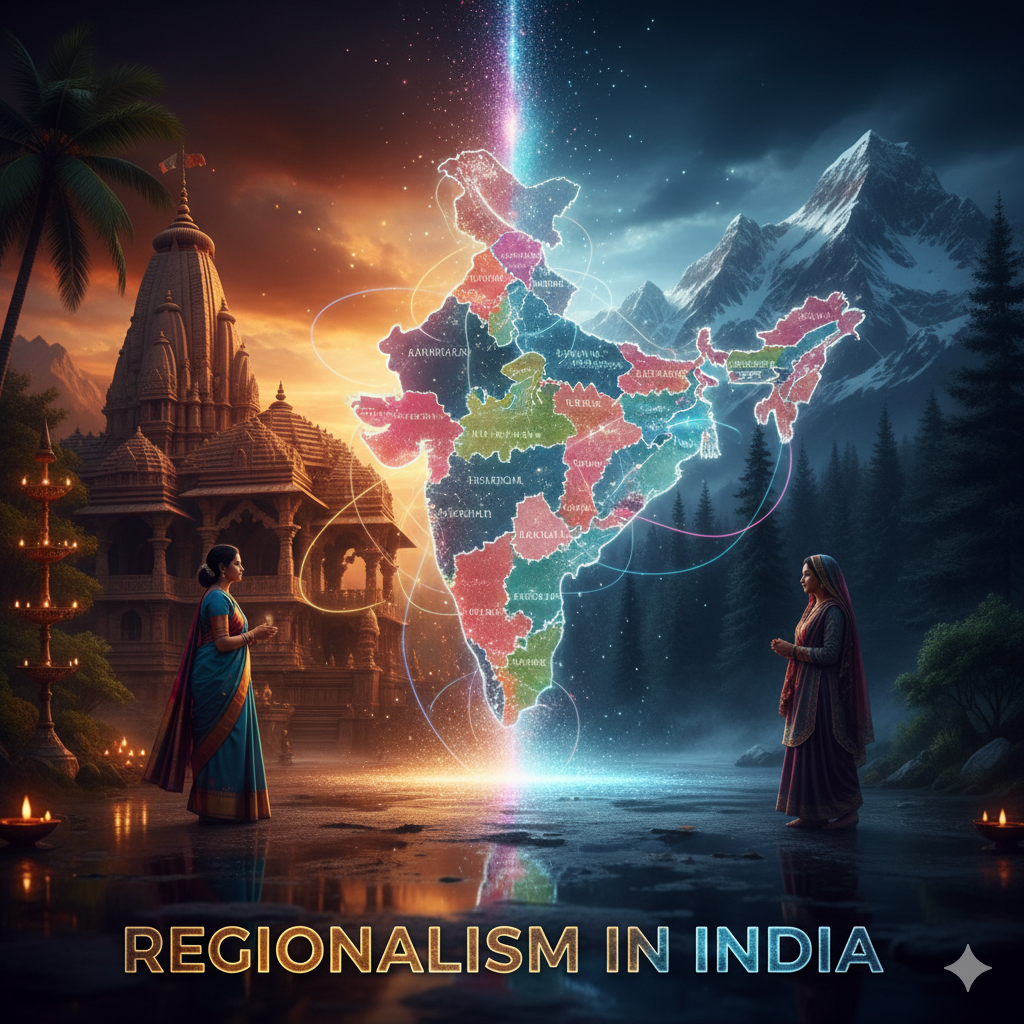
India is a civilization marked by extraordinary diversity. Its social fabric is woven from multiple languages, religions, ethnic traditions, and historical experiences. This diversity has given rise to rich cultural identities at regional levels. Alongside national consciousness, strong regional loyalties have developed over time. These loyalties sometimes express themselves as regionalism—a sentiment where people prioritize regional identity, interests, or culture over broader national considerations.
In recent decades, scholars and policymakers have increasingly linked regionalism to rising cultural assertiveness, wherein communities actively seek recognition, preservation, and political representation of their distinct cultural identities. This essay critically examines whether regionalism in India can indeed be understood as a consequence of growing cultural assertiveness. It explores historical roots, sociopolitical dynamics, and contemporary illustrations while presenting balanced arguments.
Understanding Regionalism in the Indian Context
Regionalism refers to a strong sense of attachment to one’s region based on shared language, culture, history, or economic interests. It manifests in demands for autonomy, protection of local identity, preferential policies for locals, or even separate statehood.
In India, regionalism is not inherently negative. It has often strengthened federalism by ensuring representation of local aspirations. However, when it becomes exclusionary or confrontational, it can challenge national unity.
Meaning of Cultural Assertiveness
Cultural assertiveness involves conscious efforts by communities to preserve, promote, and politically articulate their cultural uniqueness. It includes:
- Revival of language and literature
- Assertion of regional traditions
- Protection of local heritage
- Resistance to perceived cultural homogenization
- Demand for recognition in governance
Cultural assertiveness emerges especially when communities feel marginalized within larger political or cultural frameworks.
Historical Roots of Regionalism in India
Regional identity in India predates independence.
Pre-Colonial Period
India historically consisted of multiple kingdoms and cultural zones. Loyalty was often local rather than pan-Indian.
Colonial Period
British administrative policies unintentionally strengthened regional consciousness by:
- Drawing territorial boundaries
- Promoting regional languages
- Creating unequal economic development
Colonial governance produced regional elites who later articulated regional demands.
Post-Independence Federal Structure
India adopted a federal system recognizing linguistic and cultural diversity. States were reorganized largely on linguistic lines in 1956, acknowledging cultural identities as legitimate political foundations.
This institutional recognition encouraged regional pride and assertiveness.
Link Between Cultural Assertiveness and Regionalism
Rising cultural assertiveness has played a significant role in shaping regionalism through several pathways.
1. Language as a Driver of Regional Identity
Language is a powerful cultural marker.
Movements demanding linguistic recognition or protection have produced strong regional sentiments.
Illustration:
- The formation of Andhra Pradesh in 1953 following Telugu linguistic assertion marked the beginning of linguistic states.
- Tamil Nadu witnessed strong Dravidian movements emphasizing Tamil identity against perceived cultural domination.
These movements were cultural at their core but resulted in political regionalism.
2. Revival of Regional History and Heritage
Many regions actively promote local heroes, literature, and historical narratives.
This revival strengthens collective pride but can also deepen regional consciousness.
For example:
- Celebration of Shivaji Maharaj in Maharashtra
- Emphasis on Assamese identity in Assam
- Promotion of Sikh heritage in Punjab
Such cultural revivalism often translates into political mobilization.
3. Resistance to Cultural Homogenization
Globalization and centralized governance sometimes generate fears of cultural dilution.
Communities respond by asserting distinct traditions, cuisines, dress, and festivals.
This defensive cultural assertion reinforces regional solidarity.
4. Regional Political Parties and Cultural Platforms
Regional parties frequently base their legitimacy on cultural identity.
They highlight local customs, language, and grievances to mobilize voters.
Examples include:
- Dravidian parties in Tamil Nadu
- Telugu parties in Andhra Pradesh and Telangana
- Regional parties in the Northeast
These parties institutionalize cultural assertiveness into regional political power.
Economic Dimensions Supporting Cultural Regionalism
Cultural assertiveness alone does not produce regionalism. Economic disparities amplify it.
Regions experiencing perceived neglect or exploitation often express grievances through cultural language.
People frame economic demands in cultural terms, making regional identity a rallying point.
Movements for Statehood: Cultural Roots
Several new states emerged from cultural assertion:
Telangana
Demand rooted in distinct dialect, history, and socio-economic experience.
Jharkhand and Chhattisgarh
Tribal identity and cultural uniqueness played key roles.
Uttarakhand
Mountain culture and environmental consciousness combined with administrative concerns.
These movements show how cultural assertiveness converts into territorial regionalism.
Is Regionalism Always a Result of Cultural Assertiveness?
While cultural assertiveness contributes significantly, regionalism also arises from other factors:
1. Political Mobilization
Leaders sometimes manufacture regional sentiment for electoral gains.
Identity becomes a political tool rather than a cultural necessity.
2. Administrative Centralization
Excessive central control encourages regions to assert autonomy.
This may be driven more by governance concerns than cultural pride.
3. Uneven Development
Economic inequality fuels regional demands.
Culture provides emotional legitimacy to material grievances.
4. Migration and Demographic Change
Influx of outsiders can trigger cultural insecurity.
Local populations respond by asserting regional identity.
Contemporary Illustrations
Maharashtra
Movements emphasizing “sons of the soil” reflect cultural protectionism linked to employment concerns.
Northeast India
Ethnic identities and cultural preservation shape regional politics, intensified by historical isolation.
Southern India
Strong linguistic pride coexists with economic development, reinforcing regional self-confidence.
Positive Dimensions of Cultural Regionalism
Regionalism rooted in cultural assertiveness is not necessarily harmful.
It can:
- Strengthen federal democracy
- Promote linguistic diversity
- Preserve indigenous traditions
- Encourage decentralized governance
- Empower marginalized communities
India’s pluralism thrives on recognition of regional identities.
Negative Consequences
However, excessive regionalism can lead to:
- Social fragmentation
- Discrimination against migrants
- Political polarization
- Challenges to national cohesion
Balance is essential.
Youth and Cultural Identity
Young Indians navigate dual identities: regional and national.
While embracing global culture, many actively reconnect with regional heritage through music, cinema, and digital platforms.
This modern cultural assertiveness reshapes regionalism in softer forms.
Role of Media and Technology
Digital platforms amplify regional voices.
Regional cinema, online literature, and social media campaigns strengthen cultural pride.
Technology democratizes cultural expression, making regional identities more visible.
Theoretical Perspective
Sociologists view this phenomenon as identity-based regionalism, where culture becomes a framework for political negotiation.
Rather than fading, identities adapt to modern contexts.
Counterargument: Is Cultural Assertiveness a Symptom Rather Than Cause?
Some argue cultural assertiveness emerges because of regionalism, not vice versa.
According to this view:
- Economic and political marginalization come first
- Cultural expression follows as a mobilizing strategy
Thus, culture becomes a vehicle, not origin.
Synthesis: A Reciprocal Relationship
In reality, cultural assertiveness and regionalism reinforce each other.
Cultural pride fuels regional demands, and regional politics strengthens cultural consciousness.
They form a mutually reinforcing cycle.
Future Outlook
India’s challenge is to:
- Respect regional cultures
- Promote inclusive development
- Prevent exclusionary politics
- Strengthen cooperative federalism
National unity must be built on diversity, not uniformity.
Conclusion
Regionalism in India cannot be explained solely by cultural assertiveness, but rising cultural consciousness has undeniably contributed to its growth. Language revival, heritage promotion, and identity assertion have provided emotional foundations for regional political movements.
However, regionalism also draws strength from economic inequality, political strategies, administrative centralization, and migration patterns. Cultural assertiveness often becomes the visible expression of deeper structural issues.
Thus, regionalism in India is best understood as a multidimensional phenomenon where cultural pride interacts with political and economic realities. When guided constructively, it enriches India’s federal democracy; when exploited narrowly, it risks social division.
The way forward lies in nurturing cultural diversity while strengthening national integration—ensuring that regional identities coexist harmoniously within the broader Indian identity.