Introduction
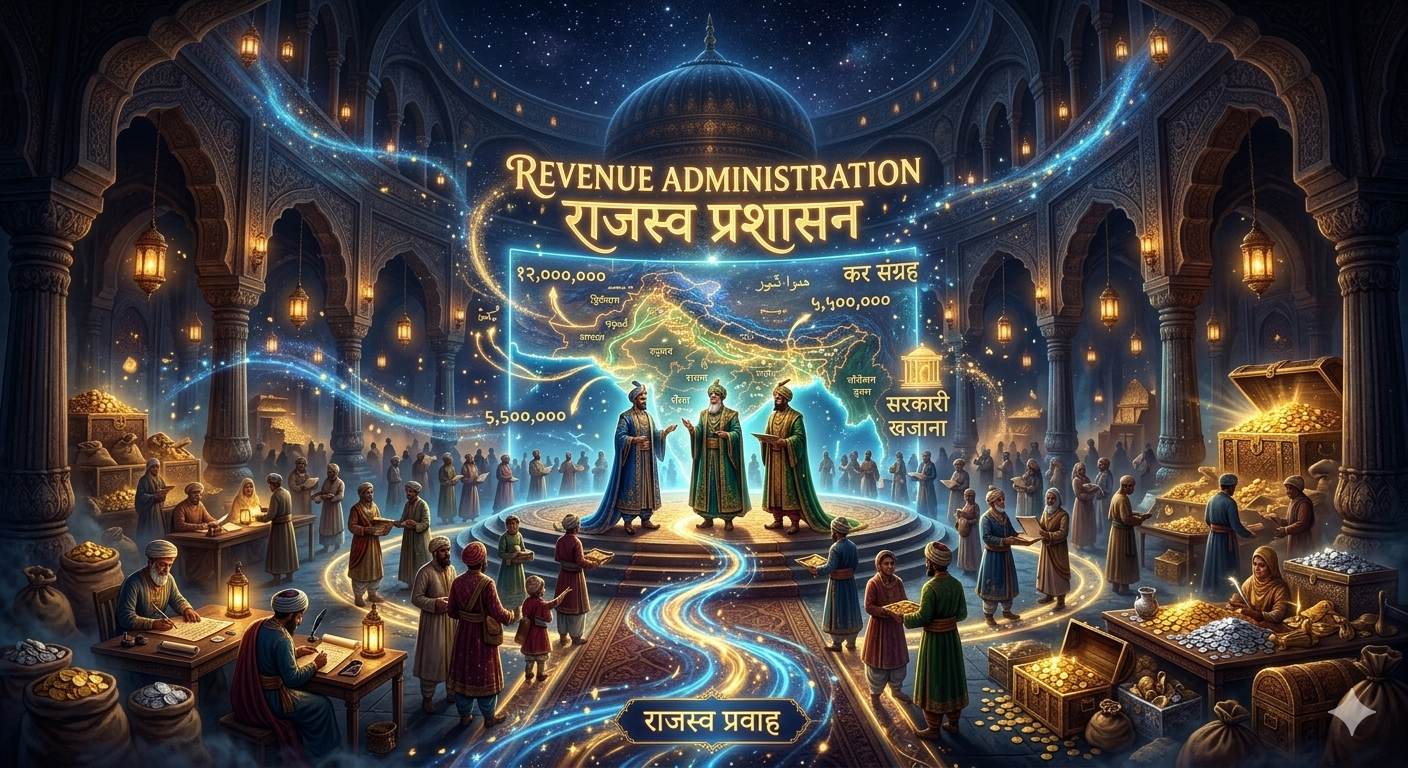
The reign of Akbar (1556–1605 CE) marks a turning point in the administrative and economic history of the Mughal Empire. Among his many achievements, the development of a systematic and efficient revenue administration stands out as a cornerstone of imperial success.
Akbar’s revenue system was not merely a mechanism for tax collection; it was a comprehensive framework that integrated agriculture, administration, and governance. It ensured a steady flow of income to the state while maintaining the welfare of the peasantry, thereby contributing significantly to the political stability and longevity of the empire.
Background of Revenue Administration before Akbar
Earlier Systems and Their Limitations
Before Akbar, revenue systems under the Delhi Sultanate and early Mughal rulers lacked uniformity and efficiency.
- Revenue demands were often arbitrary
- Local officials exercised excessive power
- Lack of proper land measurement
- Exploitation of peasants was common
These issues led to instability and reduced state income. Akbar recognized the need for reform and introduced a more rational and scientific system.
Key Features of Akbar’s Revenue Administration
Centralized Revenue Administration
Akbar established a highly organized and centralized revenue system under the supervision of the Diwan (finance minister).
Key Aspects
- The Diwan controlled all financial matters of the empire
- Revenue officials were directly accountable to the central authority
- Reduced corruption and ensured transparency
This centralization improved efficiency and strengthened imperial control.
Land Measurement System (Zabt System)
One of the most significant features of Akbar’s revenue administration was the introduction of the Zabt system.
Characteristics
- Systematic measurement of land using standard units (bigha)
- Classification of land based on productivity
- Fixation of revenue based on average produce
This method ensured fairness and accuracy in tax assessment.
Dahsala System (Ten-Year Settlement)
The Dahsala system, developed under the guidance of Raja Todar Mal, was a landmark reform.
Features
- Revenue rates were based on the average yield of the past ten years
- Prices of crops were also averaged
- Fixed cash revenue demand
Significance
- Reduced fluctuations in tax demand
- Provided predictability for both state and peasants
Classification of Land
Land was categorized into different types based on cultivation and fertility.
Types of Land
- Polaj – Regularly cultivated land
- Parauti – Fallow land for short periods
- Chachar – Fallow land for longer periods
- Banjar – Uncultivated land
This classification helped in determining appropriate revenue rates.
Mode of Revenue Payment
Akbar allowed flexibility in revenue payment.
Options
- Payment in cash
- Payment in kind (produce)
However, cash payments were encouraged to facilitate trade and monetization of the economy.
Appointment of Revenue Officials
A well-structured hierarchy of officials ensured effective implementation.
Important Officials
- Amil – Revenue collector
- Qanungo – Record keeper
- Patwari – Village-level record maintainer
Impact
- Improved record-keeping
- Reduced corruption
- Enhanced accountability
Use of Detailed Records and Documentation
Akbar emphasized maintaining accurate records.
- Land measurement records
- Crop yield data
- Revenue demand registers
This ensured transparency and minimized disputes.
Remissions and Relief Measures
Akbar showed concern for the welfare of peasants.
Measures
- Tax remissions during natural calamities
- Loans (taqavi) for farmers
- Protection from exploitation
These policies helped maintain agricultural productivity.
Role of Todar Mal in Revenue Reforms
Administrative Genius
Raja Todar Mal played a crucial role in shaping Akbar’s revenue system.
- Introduced scientific land measurement
- Standardized revenue rates
- Ensured uniform implementation
His contributions made the system efficient and sustainable.
Impact of Revenue Administration on Stability of the Empire
Economic Stability
Akbar’s revenue system ensured a steady and predictable income for the state.
- Increased state revenue
- Reduced financial uncertainty
- Enabled funding of administration and military
This economic strength was essential for imperial stability.
Agricultural Growth
The fair and systematic revenue policies encouraged agricultural expansion.
- Farmers were motivated to increase production
- Cultivation of new lands increased
- Improved irrigation and farming techniques
As agriculture was the backbone of the economy, this contributed significantly to stability.
Reduction in Peasant Exploitation
By fixing revenue rates and maintaining records, Akbar minimized arbitrary taxation.
- Peasants gained protection from corrupt officials
- Improved trust in the administration
- Reduced chances of rebellion
Administrative Efficiency
The structured system of officials and documentation enhanced governance.
- Better coordination between center and provinces
- Efficient revenue collection
- Reduced administrative chaos
Political Stability
A strong revenue system supported a strong state.
- Funded military expansion and defense
- Maintained law and order
- Strengthened central authority
This ensured long-term political stability.
Integration of the Empire
Uniform revenue policies helped integrate diverse regions.
- Standard practices across provinces
- Reduced regional disparities
- Strengthened unity of the empire
Encouragement of Trade and Commerce
The emphasis on cash payments promoted monetization.
- Growth of markets
- Increased commercial activity
- Strengthened urban economy
Evaluation of Akbar’s Revenue System
Strengths
1. Scientific and Rational Approach
The use of measurement and data made the system fair and efficient.
2. Balance between State and Peasants
Akbar ensured that revenue demands were reasonable.
3. Administrative Organization
A clear hierarchy of officials improved governance.
4. Long-Term Sustainability
The system continued with modifications under later rulers.
Limitations
1. Complexity of the System
The detailed procedures were sometimes difficult to implement.
2. Dependence on Officials
Corruption could still occur at lower levels.
3. Regional Variations
The system was more effective in core regions than in distant areas.
Historical Significance
The revenue administration of Akbar is considered one of the most advanced systems of its time.
- Laid the foundation for Mughal economic strength
- Influenced later administrative systems
- Demonstrated the importance of organized governance
Critical Analysis
Akbar’s success lay in combining economic pragmatism with administrative efficiency.
- He understood the central role of agriculture
- Focused on fairness and stability
- Ensured that the state and society benefited together
His revenue system reflects a visionary approach to governance, where economic policies were aligned with political objectives.
Conclusion
The revenue administration under Akbar was a cornerstone of the success of the Mughal Empire. Through innovations like the Zabt and Dahsala systems, he created a fair, efficient, and sustainable framework that strengthened the empire economically and politically.
Thus, Akbar’s revenue reforms not only ensured a stable source of income but also fostered agricultural growth, administrative efficiency, and social harmony—making them a key factor in the long-term stability of the Mughal Empire.