Introduction
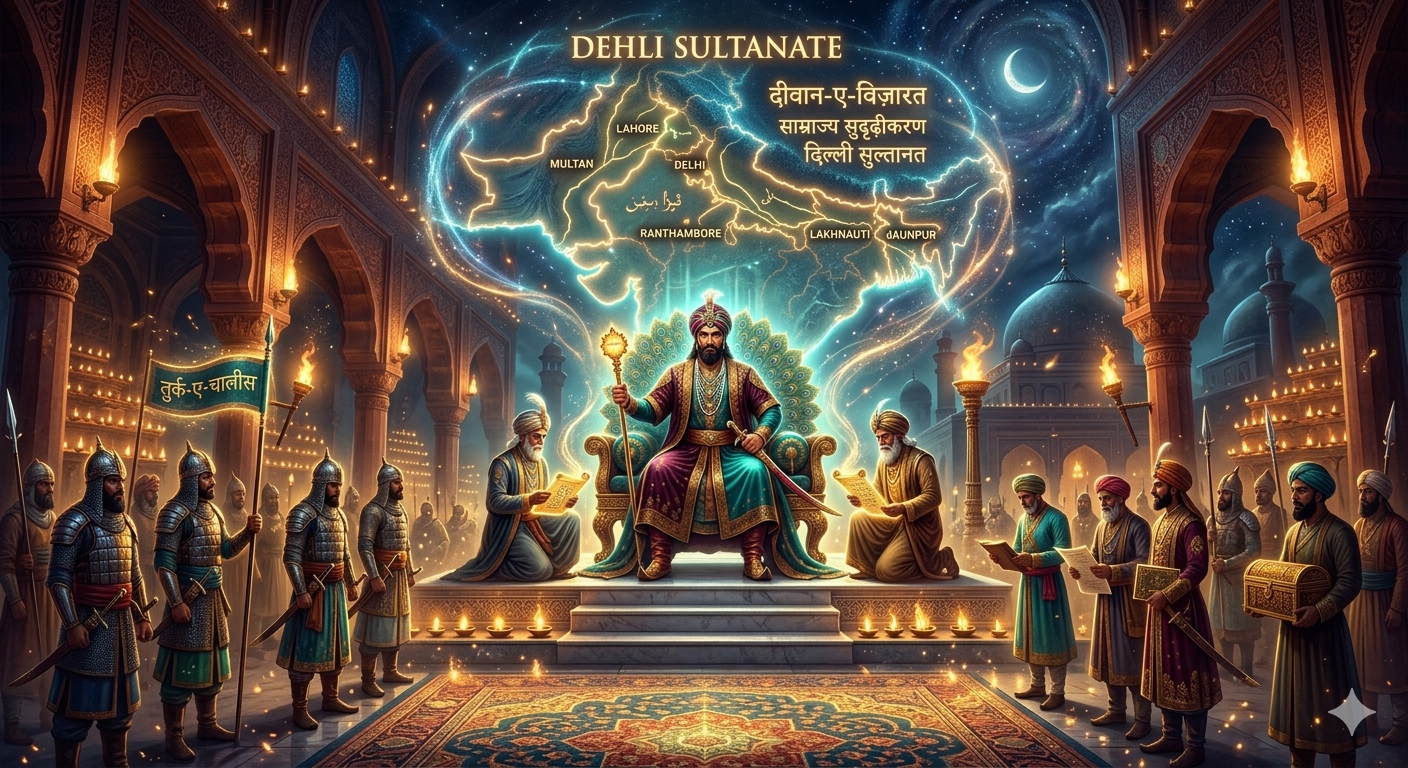
The consolidation of the Delhi Sultanate was not an automatic process after its establishment by Qutb-ud-din Aibak. It required a capable and visionary ruler to stabilize the fragile political structure. This crucial task was performed by Shams-ud-din Iltutmish (1211–1236 CE), who is widely regarded as the real consolidator of the Delhi Sultanate.
When Iltutmish ascended the throne, the Sultanate was surrounded by internal rebellions, external threats, and administrative weaknesses. Through a combination of military strength, administrative reforms, and diplomatic acumen, he transformed a weak and fragmented kingdom into a stable and enduring empire.
Political Challenges Faced by Iltutmish
Initial Instability and Rival Claims
At the time of his accession, Iltutmish faced serious opposition from rival nobles and claimants to the throne.
- The legitimacy of his rule was questioned because he was originally a slave.
- Several Turkish nobles did not accept his authority.
- Regional governors attempted to assert independence.
This unstable political environment made consolidation an urgent necessity.
Threat from Powerful Rivals
Iltutmish had to deal with multiple rivals:
- Yildiz of Ghazni, who claimed authority over Delhi
- Qubacha of Multan and Sindh, who resisted Delhi’s control
These threats posed a serious challenge to the unity of the Sultanate.
Military Consolidation of the Sultanate
Defeat of Yildiz and Qubacha
Iltutmish successfully eliminated his major rivals through decisive military action.
Key Achievements
- Defeated Yildiz, ending Ghazni’s influence over Delhi
- Subdued Qubacha, bringing Multan and Sindh under control
These victories ensured the political independence and territorial integrity of the Sultanate.
Suppression of Internal Revolts
Numerous rebellions by local chiefs and nobles threatened stability.
- Iltutmish suppressed revolts in Bengal and Rajput territories
- Strengthened central authority by punishing disloyal nobles
Through these actions, he ensured internal peace and order.
Defense Against Mongol Threat
The rise of Genghis Khan posed a serious external threat.
- When Jalal-ud-din Mangbarni sought refuge in India, Iltutmish avoided confrontation with the Mongols
- He adopted a policy of diplomatic neutrality, preventing invasion
This wise decision protected the Sultanate from destruction.
Administrative Reforms and Institutional Development
Establishment of Centralized Administration
Iltutmish strengthened the administrative framework of the Sultanate.
- Introduced a more organized bureaucratic system
- Strengthened the authority of the Sultan
This laid the foundation for future rulers.
Introduction of the Iqta System
One of his most important contributions was the development of the Iqta system.
Features
- Land assignments (iqtas) were given to officials in lieu of salary
- Iqtadars were responsible for revenue collection and administration
Impact
- Ensured efficient revenue collection
- Reduced financial burden on the central treasury
- Helped maintain a loyal administrative class
Formation of the “Chahalgani” (Group of Forty)
Iltutmish created a powerful group of trusted nobles known as the Chahalgani.
Purpose
- Assist in administration
- Strengthen the Sultan’s authority
Outcome
While initially useful, this group later became powerful enough to influence politics.
Economic and Monetary Reforms
Introduction of a Stable Currency System
Iltutmish introduced a uniform and stable coinage system.
Key Coins
- Silver Tanka
- Copper Jital
Significance
- Facilitated trade and commerce
- Strengthened the economic base of the Sultanate
Improvement in Revenue Administration
- Organized land revenue collection
- Reduced corruption through supervision
These reforms ensured a steady flow of income to the state.
Territorial Expansion and Consolidation
Expansion into Bengal and Rajputana
Iltutmish extended his authority over distant regions.
- Reasserted control over Bengal
- Subdued Rajput rulers
This helped in integrating diverse regions into a single political entity.
Control Over Strategic Regions
- Strengthened control over Delhi, Lahore, and Multan
- Secured trade routes and communication lines
This enhanced both political and economic stability.
Religious and Diplomatic Legitimacy
Recognition by the Abbasid Caliph
One of the most significant achievements of Iltutmish was obtaining recognition from the Abbasid Caliphate.
Importance
- Legitimized his rule in the Islamic world
- Strengthened his position among nobles
He was granted the title of “Sultan-i-Azam,” enhancing his prestige.
Policy of Religious Tolerance
Although a Muslim ruler, Iltutmish followed a relatively pragmatic approach.
- Allowed non-Muslims to continue their practices
- Maintained political stability by avoiding religious conflict
Cultural and Architectural Contributions
Development of Indo-Islamic Culture
Iltutmish promoted cultural integration.
- Encouraged scholars, poets, and artists
- Strengthened Indo-Islamic traditions
Architectural Achievements
- Completed the construction of the Qutub Minar started by Aibak
- Built mosques and administrative structures
These contributions symbolized the growing strength of the Sultanate.
Evaluation of Iltutmish’s Role in Consolidation
Positive Contributions
1. Political Stability
Iltutmish successfully eliminated rivals and established firm control over the empire.
2. Administrative Foundation
He laid down strong administrative systems that later rulers expanded.
3. Economic Strengthening
His monetary reforms and revenue system improved financial stability.
4. Diplomatic Wisdom
Avoiding conflict with the Mongols ensured the survival of the Sultanate.
Limitations
1. Dependence on Nobility
The Chahalgani later became a source of political instability.
2. Limited Social Integration
While politically stable, deeper social integration remained incomplete.
Historical Significance
The role of Shams-ud-din Iltutmish is crucial in medieval Indian history because:
- He transformed a fragile state into a powerful empire
- Established administrative and military systems
- Ensured continuity of the Delhi Sultanate
Without his efforts, the Sultanate might not have survived its early challenges.
Critical Analysis
Iltutmish’s success lay in his ability to balance military strength, administrative efficiency, and diplomatic strategy.
- He understood the importance of legitimacy and recognition
- Focused on consolidation rather than reckless expansion
- Combined pragmatism with strong leadership
Unlike many rulers, he prioritized stability over ambition, which proved essential for long-term success.
Conclusion
The consolidation of the Delhi Sultanate was largely the achievement of Shams-ud-din Iltutmish. Through his military victories, administrative innovations, and diplomatic foresight, he laid the foundation of a stable and enduring empire.
Thus, Iltutmish can rightly be regarded as the true architect of the Delhi Sultanate’s strength and continuity, whose contributions shaped the course of medieval Indian history.