Introduction
The Indian freedom struggle was not merely a political movement; it was a vast socio-cultural transformation in which women emerged as dynamic participants. While women had participated in earlier regional uprisings—such as the Revolt of 1857 or tribal and peasant resistances—their involvement remained limited in scope and visibility. It was only during the Gandhian phase (1915–1947) that women’s participation became widespread, organized, and nationally significant. Mahatma Gandhi’s ideology of Satyagraha, non-violence, moral strength, and mass mobilization created a space where Indian women could step out of restrictive social boundaries and claim an active role in shaping the destiny of the nation. Gandhi believed that freedom could not be achieved without the moral force and active involvement of women, whom he referred to as the “custodians of India’s soul.”
This essay examines the diverse and transformative role played by women in the freedom struggle, focusing particularly on their involvement during the Gandhian era. It highlights their contributions, forms of participation, leadership roles, socio-political influence, and the broader impact of their involvement on Indian society.
Women’s Role in the Freedom Struggle Before the Gandhian Phase
Before analyzing the Gandhian period, it is essential to understand the foundations laid earlier. Women were not entirely absent from political life prior to Gandhi’s arrival on the national scene.
1. Participation in the Revolt of 1857
Women like Rani Lakshmibai of Jhansi, Begum Hazrat Mahal, and Rani Avantibai became iconic for their military leadership. Though exceptional, these examples reflected women’s potential for courage and sacrifice.
2. Involvement in Social Reform Movements
The 19th-century social reformers such as Raja Ram Mohan Roy, Ishwar Chandra Vidyasagar, Jyotiba Phule, and Pandita Ramabai advocated for women’s rights. This reform phase improved female education, created modern public spaces, and facilitated early political consciousness.
3. Participation in Swadeshi and Early Nationalist Movements
During the Swadeshi Movement (1905–1908), women in Bengal actively boycotted foreign goods, attended political meetings, and supported revolutionary activities. Leaders like Sarala Devi Chaudhurani and Basanti Devi energized women’s nationalist involvement.
These developments laid the groundwork for the mass participation of women during the Gandhian phase.
The Gandhian Phase: A Turning Point in Women’s Political Participation
When Gandhi entered Indian politics after 1915, he brought a revolutionary vision of mass politics. For the first time, the struggle for freedom was not limited to elite male leaders but included farmers, workers, students, and especially women.
Gandhi saw women as naturally suited for non-violence, truth, sacrifice, and compassionate resistance—qualities essential for Satyagraha. He motivated thousands of women to step beyond domestic boundaries and participate fearlessly in national movements.
Why Gandhi Was Able to Mobilize Women: Key Reasons
1. Use of Non-Violence
Women could participate without violating social norms related to modesty or physical aggression.
2. Appeal to Moral Duty
Gandhi reframed patriotism as a moral responsibility, drawing women into political action as an extension of their role as nurturers and protectors.
3. Promotion of Khadi and Constructive Programmes
Activities like spinning, weaving, and picketing were seen as socially acceptable yet politically powerful roles for women.
4. Women as Symbols of National Regeneration
Gandhi portrayed women’s participation as essential for purifying society and uplifting national character.
Women’s Role in Major Gandhian Movements
1. Non-Cooperation Movement (1920–1922)
This was the first mass movement where women participated in large numbers.
Forms of Participation
- Picketing liquor shops and foreign cloth stores
- Promoting Khadi through spinning and weaving
- Boycotting foreign goods
- Organizing Prabhat Pheris (morning patriotic processions)
- Fundraising for the Tilak Swaraj Fund
- Participation in public meetings
Women Leaders in the Movement
- Annie Besant – Leader of Home Rule; mobilized women for political activism
- Sarojini Naidu – “Nightingale of India,” prominent Congress leader
- Basanti Devi – Played a crucial role in Bengal; her arrest created huge political waves
- Sundari Mohan Das’s wife, Saraladevi – Supported the boycott campaign
- Ambabai – Led thousands of women to spin Khadi
Women’s public visibility during this movement marked a major societal shift.
2. Civil Disobedience Movement (1930–1934)
This movement witnessed unprecedented female participation across India. The Salt March became symbolic of women’s involvement.
Participation in the Salt Satyagraha
Although Gandhi chose men for the Dandi March, he encouraged women to break salt laws in their own regions.
Key Women Leaders
- Sarojini Naidu – Took over leadership after Gandhi’s arrest; addressed crowds fearlessly
- Kamala Nehru – Led protests and picketing in Allahabad
- Perin Captain – Led salt satyagraha in Bombay
- Muthulakshmi Reddy – Mobilized women in the South
- Sister Nivedita’s disciples – Played important roles in Bengal
Thousands of ordinary women—rural, tribal, urban—brought salt from the sea, symbolizing rebellion.
Picketing Foreign Cloth and Liquor Stores
Women often stood for hours before shops, facing police brutality with resilience.
Imprisonment of Women
Over 17,000 women were jailed, marking a historic moment of female courage.
3. Quit India Movement (1942)
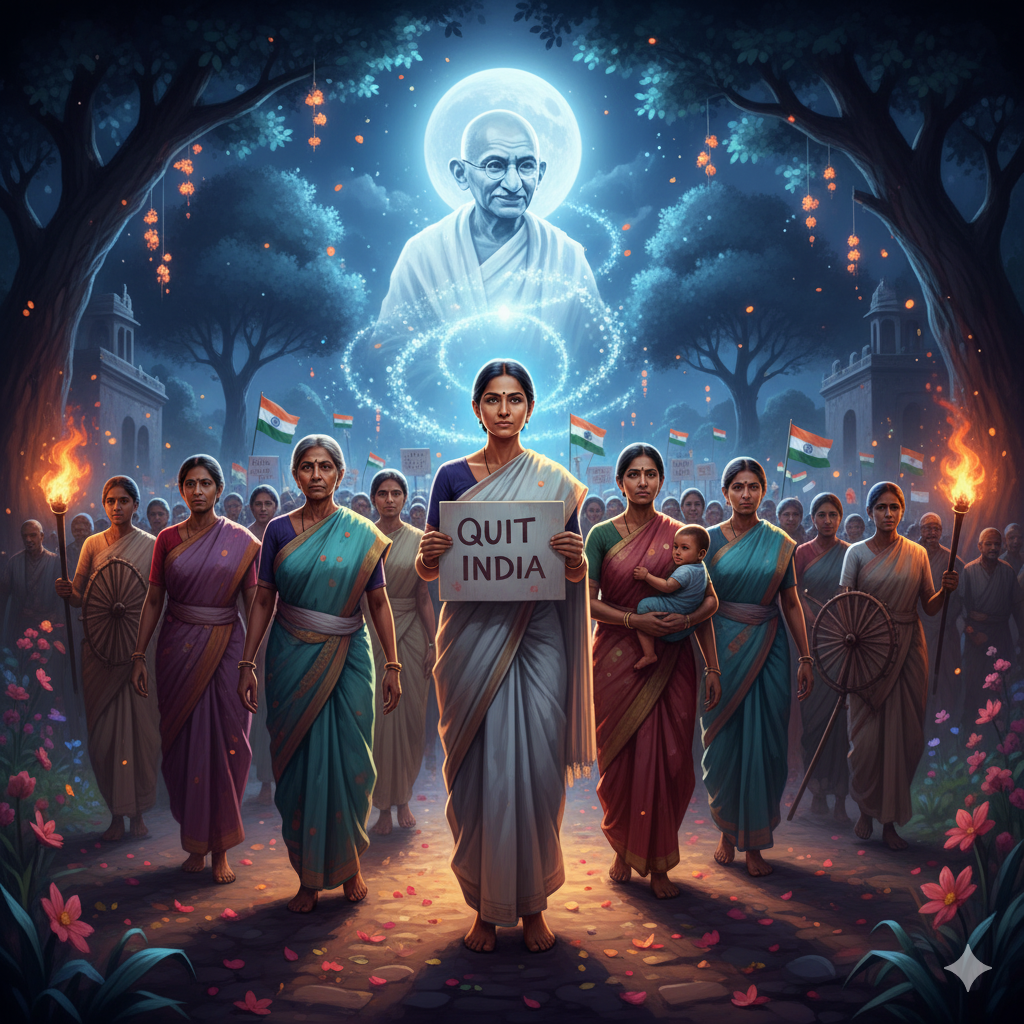
The Quit India Movement was perhaps the most revolutionary and militant phase of Gandhian politics, and women played significant roles due to the arrest of most male leaders early in the movement.
Women Leaders Who Emerged
- Aruna Asaf Ali – Hoisted the Congress flag at Gowalia Tank; became the face of the movement
- Usha Mehta – Operated the Underground Congress Radio, one of the most critical tools of communication
- Sucheta Kripalani – Organized strikes, protests, and secret meetings
- Ram Manohar Lohia’s wife Lalan Devi – Active in underground operations
- Matangini Hazra – 73-year-old woman shot dead while leading a procession with the national flag
Forms of Resistance
- Organizing underground networks
- Distributing secret pamphlets
- Sabotaging communication lines (in rare cases)
- Leading processions and strikes
- Providing shelter to underground activists
- Acting as messengers between Congress leaders
Women became the backbone of the movement when the male leadership was jailed.
Role of Women in Gandhi’s Constructive Programmes
Apart from participation in political agitations, Gandhi encouraged women to work in constructive fields that strengthened national unity.
1. Promotion of Khadi
Women took to spinning as a patriotic duty, symbolizing self-reliance and economic independence.
2. Fight Against Untouchability
Women like Mirabehn, Kamaladevi Chattopadhyay, and Sushila Nayyar worked to promote equality and social reform.
3. Village Reconstruction
Women participated in:
- Literacy programmes
- Health campaigns
- Rural sanitation
- Promotion of indigenous crafts
4. Temperance Campaign
Women led picketing of liquor shops, aligning social reform with political resistance.
Women Revolutionaries Parallel to the Gandhian Movement
While Gandhian movements emphasized non-violence, several women joined revolutionary activities, showing the diversity of nationalist approaches.
Prominent Revolutionary Women
- Kalpana Datta – Member of the Chittagong Armoury Raid
- Preetilata Waddedar – Laid down her life after attacking the Pahartali Club
- Durgawati Devi – Aided Bhagat Singh’s escape
- Bina Das – Attempted to assassinate the Bengal Governor
- Vijaya Lakshmi Pandit – Political activist and diplomat
These women represented an alternative ideological stream but still contributed to the freedom struggle.
Impact of Women’s Participation on Indian Society
1. Breaking Social Barriers
The Gandhian phase helped:
- Challenge gender norms
- Encourage women’s public participation
- Promote female education and empowerment
2. Emergence of Female Leadership
Women like Sarojini Naidu, Sucheta Kripalani, Vijaya Lakshmi Pandit, and Aruna Asaf Ali later held significant political offices in independent India.
3. Transformation of Household Roles
Women shifted from domestic caretakers to political actors, influencing:
- Family decisions
- Community attitudes
- Social behavior
4. Increased Political Consciousness
Women’s involvement led to:
- A broader social base for the freedom movement
- Greater national unity
- Emphasis on democratic participation
5. Long-term Impact
Women’s participation during the Gandhian era laid the foundation for:
- Women’s rights movements post-independence
- Adoption of policies promoting gender equality
- Visibility of women in public life
Why the Gandhian Phase Was a Watershed for Women
- Provided a moral and ideological framework
- Allowed safe entry into political spaces
- Created opportunities for leadership
- Mobilized women from diverse backgrounds—rural, urban, lower caste, tribal, elite
- Turned women into symbols of national unity and resilience
This phase transformed the freedom movement into a true mass movement, inclusive of both genders.
Conclusion
The role of women in the Indian freedom struggle, especially during the Gandhian phase, represents one of the most remarkable chapters of modern Indian history. Gandhi’s philosophy provided women with a platform that combined political participation with social reform, enabling them to contribute significantly to the national cause. Their participation was not merely symbolic; women marched, picketed, faced imprisonment, ran underground networks, and even laid down their lives for the country.
The Gandhian phase democratized the freedom struggle by breaking age-old gender barriers, empowering women to step into public life and nationalism in ways previously unimaginable. The legacy of their courage, determination, and resilience continues to inspire generations in independent India.