Introduction
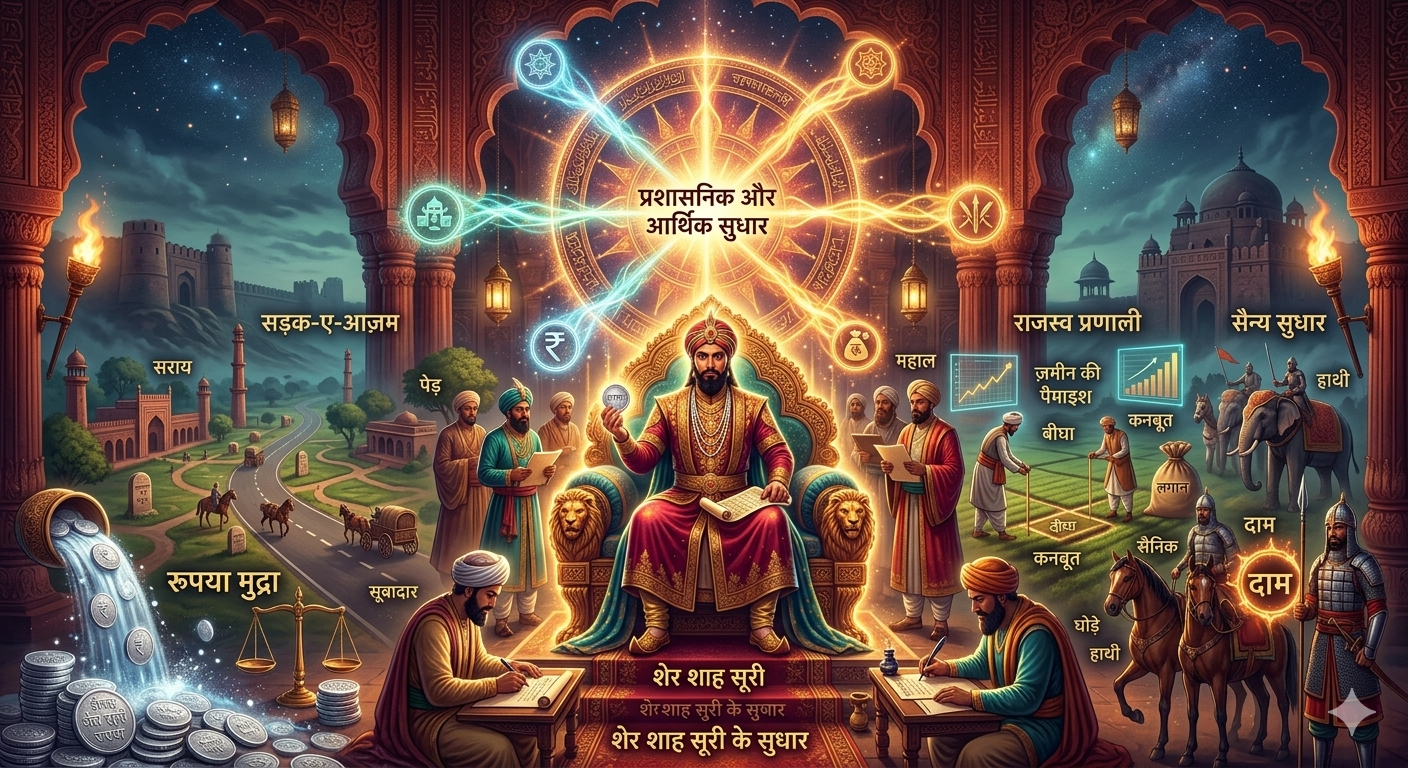
The reign of Sher Shah Suri (1540–1545 CE), though brief, represents a remarkable phase in the evolution of Indian administration. As the founder of the Sur Empire, Sher Shah introduced a series of administrative and economic reforms that were practical, efficient, and people-oriented.
His governance combined strong central authority with systematic organization, laying a solid foundation that was later adopted and refined by rulers of the Mughal Empire, particularly Akbar. Sher Shah’s reforms are often regarded as a bridge between the administrative practices of the Delhi Sultanate and the mature Mughal system.
Administrative Reforms of Sher Shah Suri
Central Administration: Strong and Efficient Governance
Sher Shah Suri established a highly centralized administrative system where the emperor exercised supreme authority. However, unlike arbitrary rule, his governance was based on efficiency, accountability, and welfare. He was personally involved in administration and maintained strict supervision over officials.
Key Features
- The emperor was the final authority in all matters
- Ministers were appointed for specialized functions
- Emphasis on merit rather than lineage
This ensured that governance remained effective and corruption was minimized.
Provincial Administration: Decentralized Yet Controlled
The empire was divided into administrative units:
- Sarkars (districts)
- Parganas (sub-districts)
- Villages (basic units)
Each level had appointed officials responsible for administration, revenue collection, and law enforcement.
Important Officials
- Shiqdar – Maintained law and order
- Amil – Collected revenue
- Qanungo – Maintained land records
Although local administration was decentralized, strict control from the center ensured uniformity and discipline.
Judicial Administration: Emphasis on Justice
Sher Shah placed great importance on justice:
- Established courts at various levels
- Ensured impartial administration of justice
- Personally supervised judicial matters
Justice was accessible to all, regardless of social status, which enhanced the legitimacy of his rule.
Police and Law Enforcement
Sher Shah improved law and order by:
- Strengthening the police system
- Making local officials responsible for crimes in their areas
- Introducing strict punishments for offenders
This resulted in a secure environment for trade and travel.
Military Administration
Sher Shah maintained a strong and disciplined army:
- Soldiers were recruited directly by the state
- Cash payments were made instead of land grants
- Introduced branding of horses (Dagh system)
This system ensured efficiency and loyalty within the army.
Economic Reforms of Sher Shah Suri
Land Revenue System: Scientific and Systematic Approach
One of Sher Shah’s most significant contributions was his reformed land revenue system.
Key Features
- Measurement of land using a standardized unit
- Classification of land based on fertility
- Fixation of revenue rates (generally one-third of produce)
Farmers were given written agreements (Patta) specifying:
- Area of land
- Amount of revenue
Similarly, peasants gave a Qabuliyat (agreement to pay revenue). This reduced exploitation and increased transparency.
Direct Relationship with Peasants
Sher Shah minimized the role of intermediaries:
- Revenue was collected directly from peasants
- Reduced corruption and exploitation
This policy improved the economic condition of farmers and increased state revenue.
Currency Reforms
Sher Shah introduced a standardized currency system:
- Issued the silver coin Rupiya
- Ensured uniform weight and purity
This facilitated trade and became the basis of the modern Indian rupee.
Trade and Commerce: Promotion and Protection
Sher Shah took several measures to promote trade:
- Abolished internal trade barriers
- Simplified taxation system
- Ensured safety of trade routes
Impact
- Increased commercial activity
- Encouraged long-distance trade
Roads and Communication System
One of Sher Shah’s greatest achievements was the development of infrastructure.
Grand Trunk Road
- Connected Bengal to Punjab
- Facilitated trade and administration
Other Measures
- Construction of roads linking major cities
- Establishment of Sarai (rest houses) at regular intervals
- Provision of water and security for travelers
This improved communication and economic integration.
Postal System
Sher Shah introduced an efficient postal system:
- Use of horses for quick communication
- Relay system between stations
This enhanced administrative efficiency and coordination.
Agricultural Development
- Encouraged cultivation of more land
- Provided protection to farmers
- Ensured fair taxation
These measures boosted agricultural productivity.
Evaluation of Sher Shah Suri’s Reforms
Strengths
1. Administrative Efficiency
Sher Shah’s system was well-organized, with clearly defined roles and responsibilities, ensuring smooth governance.
2. Welfare-Oriented Policies
His reforms were aimed at improving the condition of common people, especially peasants and traders.
3. Strong Central Control
While maintaining decentralization, he ensured strict supervision from the center.
4. Promotion of Trade and Economy
Improved infrastructure and currency system boosted economic growth.
5. Justice and Law Enforcement
His emphasis on justice created trust among people and reduced crime.
Limitations
1. Short Duration of Rule
His reign lasted only five years, limiting the long-term impact of his reforms.
2. Dependence on Personal Leadership
The system relied heavily on his personal efficiency and discipline.
3. Limited Institutionalization
Some reforms were not fully institutionalized and weakened after his death.
Influence on Mughal Administration
Adoption by Akbar
The reforms of Sher Shah Suri had a profound influence on Akbar, who adopted and refined many of them.
Land Revenue System
- Akbar’s revenue system (developed by Todar Mal) was based on Sher Shah’s methods
- Continued land measurement and classification
- Maintained records and fixed rates
Administrative Structure
- Division into provinces, districts, and villages was retained
- Appointment of officials with defined roles continued
Currency System
- The silver Rupiya introduced by Sher Shah became the standard Mughal currency
Roads and Infrastructure
- Expansion of road networks initiated by Sher Shah
- Continued use of Sarais and communication systems
Military Reforms
- Mughal system adopted branding of horses and descriptive rolls
- Strengthened military organization
Centralized Governance
- Mughal rulers continued the tradition of strong central authority
- Maintained control over provincial administration
Historical Significance
Sher Shah Suri’s reforms marked a turning point in Indian administrative history:
- Introduced scientific revenue system
- Strengthened economic foundations
- Improved governance and infrastructure
His policies bridged the gap between the administrative practices of the Delhi Sultanate and the mature system of the Mughal Empire.
Critical Analysis
Sher Shah Suri can be regarded as one of the most efficient administrators in Indian history. His reforms were practical, systematic, and people-oriented, reflecting a deep understanding of governance.
Although his rule was short-lived, his policies had a lasting impact, influencing later rulers and shaping the administrative framework of medieval India. His emphasis on efficiency, justice, and economic development set a high standard for future governance.
Conclusion
The administrative and economic reforms of Sher Shah Suri were revolutionary and far ahead of their time. They not only strengthened his own rule but also laid the foundation for the success of the Mughal Empire.
By introducing systematic land revenue policies, improving infrastructure, and ensuring efficient administration, Sher Shah Suri left a legacy that profoundly influenced Indian history. His contributions remain a vital topic for understanding the evolution of governance in India.