Introduction
The Earth, though seemingly solid and uniform from the surface, possesses a complex, layered internal structure. Since direct observation of the deep interior is not possible beyond a few kilometers, our understanding largely depends on indirect scientific methods, among which seismology (study of seismic waves) plays the most crucial role. By analyzing how seismic waves travel through the Earth during earthquakes, scientists have been able to reconstruct a detailed picture of the planet’s internal composition, density, and physical state.
Concept of Earth’s Interior
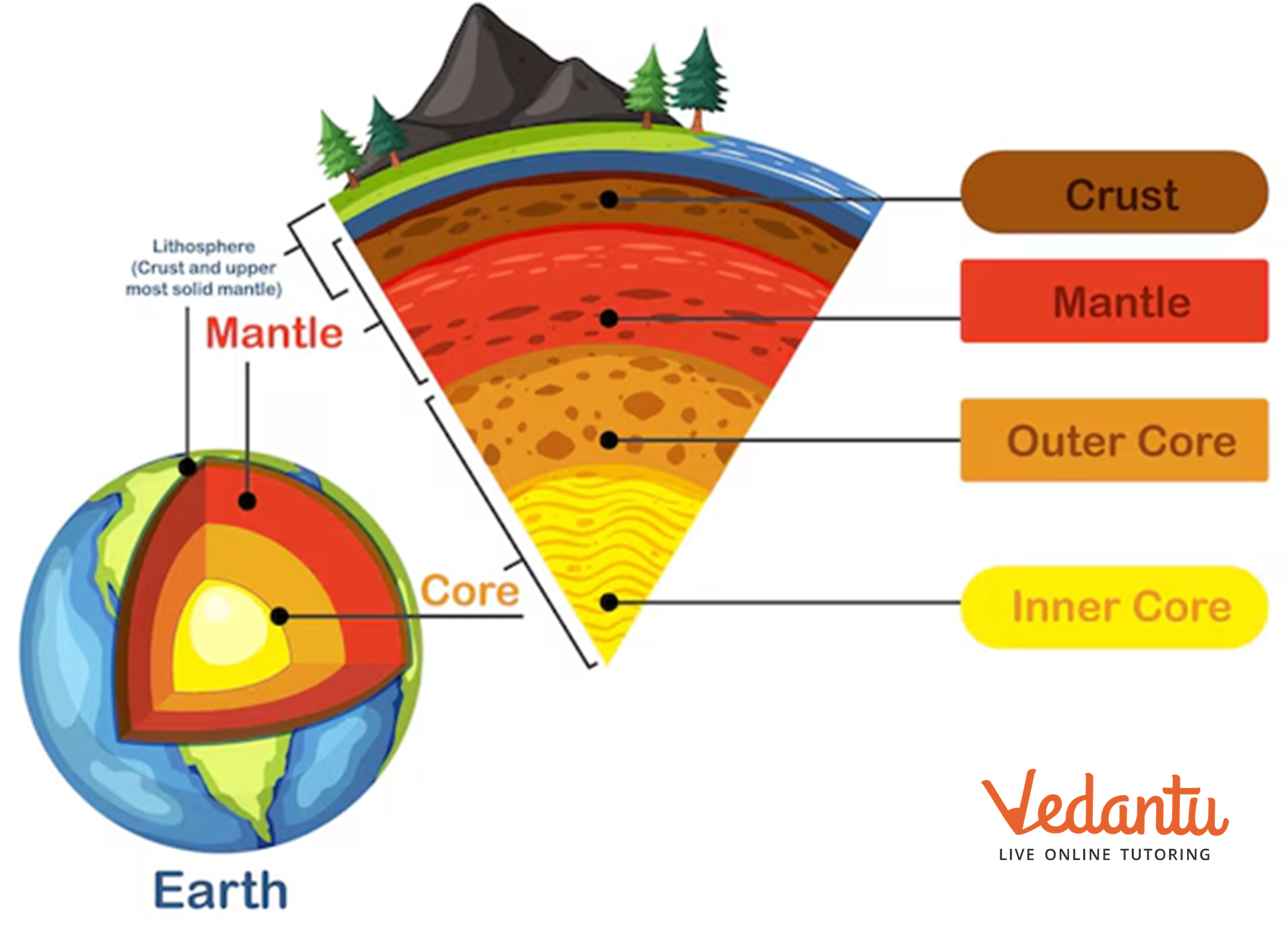
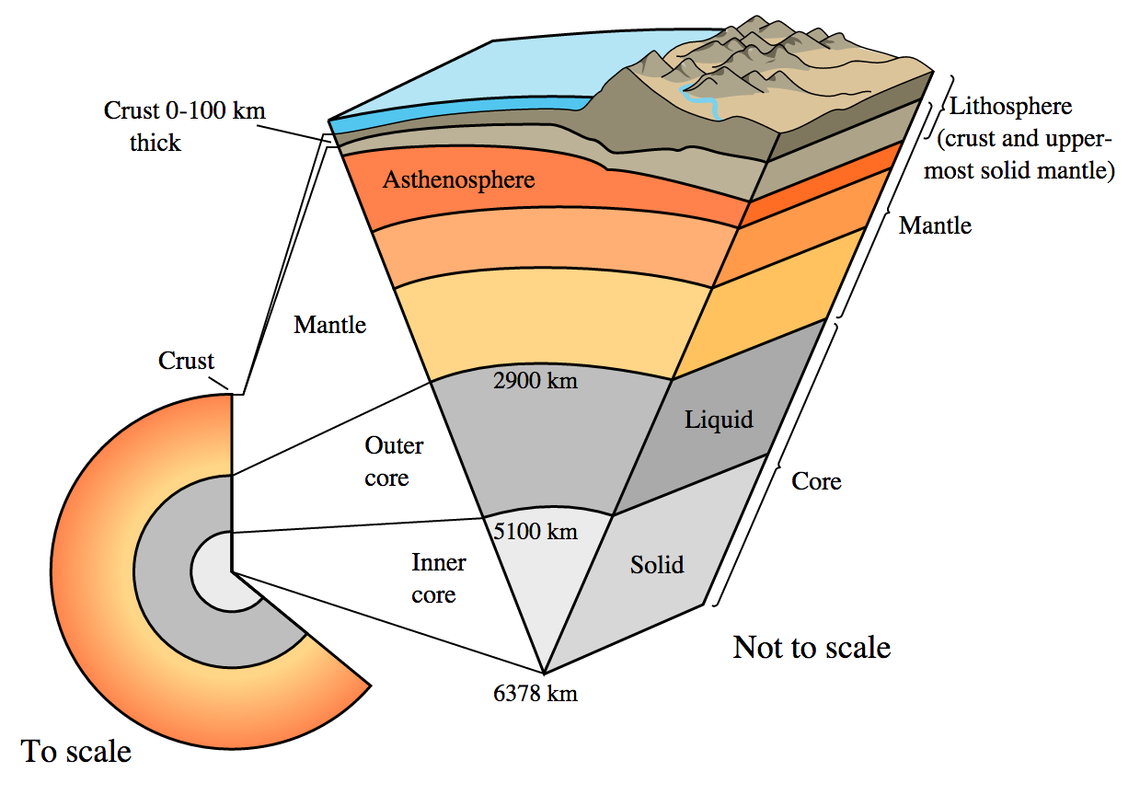
The Earth’s interior is broadly divided into three major concentric layers based on composition and physical properties:
- Crust – The outermost solid layer
- Mantle – The thick intermediate layer
- Core – The innermost dense region
Each layer has distinct characteristics in terms of thickness, composition, density, and behavior under pressure and temperature.
Overview of Earth’s Layers (Table Format)
| Layer | Depth Range | Average Thickness | Composition | Physical State |
|---|---|---|---|---|
| Crust | 0–35 km (avg) | 5–70 km | Silica, Alumina (SIAL) | Solid |
| Mantle | 35–2900 km | ~2865 km | Silicates (Mg, Fe rich) | Semi-solid |
| Core | 2900–6371 km | ~3471 km | Iron, Nickel (NIFE) | Outer liquid, inner solid |
1. The Crust
Nature and Composition
The crust is the outermost and thinnest layer of the Earth. It forms less than 1% of Earth’s total volume but is crucial as it supports life and human activities.
It is divided into:
- Continental Crust (thicker, granitic, rich in silica and alumina)
- Oceanic Crust (thinner, basaltic, rich in silica and magnesium)
Key Features
- Thickness varies from 5 km (oceans) to 70 km (continents)
- Composed mainly of igneous and metamorphic rocks
- Separated from the mantle by the Mohorovičić discontinuity (Moho)
2. The Mantle
Nature and Composition
The mantle lies beneath the crust and extends to a depth of about 2900 km, making it the largest layer of the Earth.
It is composed of:
- Silicate minerals rich in magnesium and iron
Subdivisions of Mantle
| Layer | Characteristics |
|---|---|
| Upper Mantle | Includes lithosphere and asthenosphere |
| Asthenosphere | Semi-molten, allows plate movement |
| Lower Mantle | Denser and more rigid |
Key Features
- Temperature ranges from 500°C to 4000°C
- Presence of convection currents, which drive plate tectonics
- Semi-solid nature allows slow movement of materials
3. The Core
Nature and Composition
The core is the innermost layer, extending from 2900 km to the Earth’s center at 6371 km. It is primarily composed of iron and nickel.
Subdivisions of Core
| Layer | State | Characteristics |
|---|---|---|
| Outer Core | Liquid | Responsible for Earth’s magnetic field |
| Inner Core | Solid | Extremely high pressure keeps it solid |
Key Features
- Temperature exceeds 5000°C
- High density and pressure
- Generates the geomagnetic field through fluid motion
Visual Representation of Earth’s Interior

Discontinuities within the Earth
Discontinuities are boundaries where there is a sudden change in material properties, detected through seismic wave behavior.
| Discontinuity | Location | Significance |
|---|---|---|
| Moho | Crust-Mantle boundary | Change in density |
| Gutenberg | Mantle-Core boundary | Core begins (liquid outer core) |
| Lehmann | Outer-Inner core boundary | Inner core is solid |
Seismic Waves: The Key to Understanding Earth’s Interior
What are Seismic Waves?
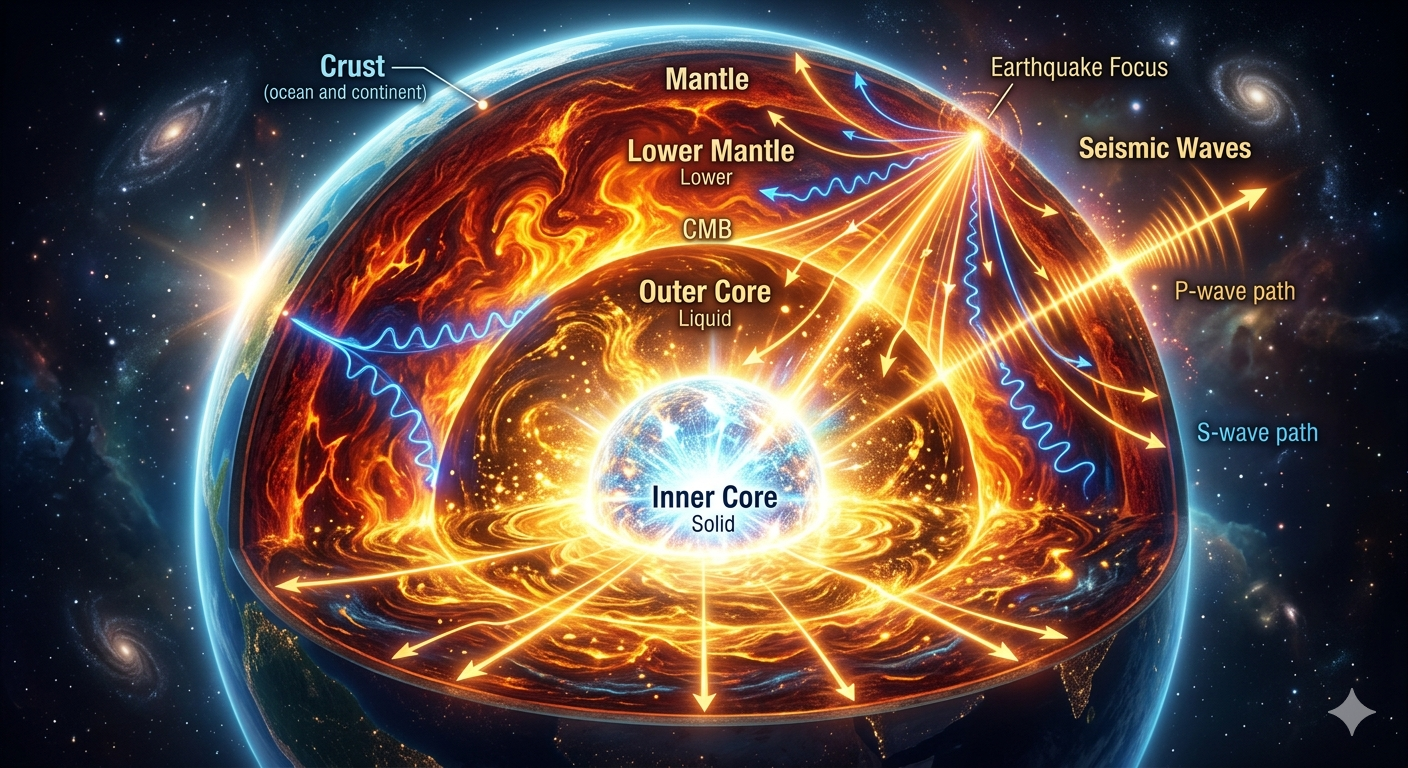
Seismic waves are energy waves generated by earthquakes, volcanic eruptions, or artificial explosions. These waves travel through the Earth and are recorded by instruments called seismographs.
They provide critical information about:
- Internal structure
- Density variations
- Physical state of materials
Types of Seismic Waves
1. Body Waves
These waves travel through the interior of the Earth.
| Type | Nature | Speed | Medium |
|---|---|---|---|
| P-Waves (Primary) | Compressional | Fastest | Solid, liquid, gas |
| S-Waves (Secondary) | Transverse | Slower | Only solids |
2. Surface Waves
- Travel along the Earth’s surface
- Cause maximum damage
- Slower than body waves
Behavior of Seismic Waves (Conceptual Graph)
- X-axis: Depth inside Earth
- Y-axis: Velocity of waves
Trend:
- Velocity increases in denser layers
- Sudden changes indicate discontinuities
- Drop in S-wave velocity indicates liquid layer
How Seismic Waves Reveal Earth’s Structure
1. Evidence for Layered Structure
Seismic waves change speed and direction when passing through different materials. This indicates that the Earth is not homogeneous but layered.
2. Identification of the Core
- S-waves do not travel through liquids, hence their absence beyond a certain depth indicates a liquid outer core
- P-waves slow down significantly in this region
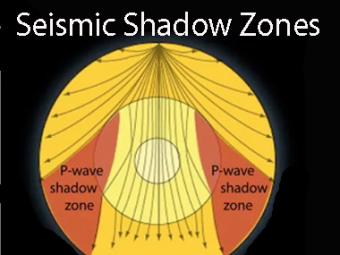
3. Shadow Zones
P-wave Shadow Zone
- Region where P-waves are not detected directly
- Caused by refraction in the outer core
S-wave Shadow Zone
- Larger area where no S-waves are detected
- Confirms that the outer core is liquid
Seismic Shadow Zones Visualization


4. Discovery of Inner Core
Changes in P-wave behavior inside the core led to the discovery of the solid inner core, separated by the Lehmann discontinuity.
5. Density and Composition Analysis
Wave velocity depends on:
- Density
- Elasticity
By analyzing velocity patterns, scientists estimate:
- Composition of layers
- Temperature and pressure conditions
Integrated Understanding (Table Format)
| Seismic Observation | Inference |
|---|---|
| Increase in wave velocity | Denser material |
| Sudden velocity change | Boundary between layers |
| Absence of S-waves | Liquid region |
| Refraction of P-waves | Change in composition |
Importance of Studying Earth’s Interior
Understanding Earth’s interior helps in:
- Predicting earthquakes and volcanic activity
- Understanding plate tectonics
- Locating mineral and energy resources
- Studying Earth’s magnetic field
Indian Context
India lies in a tectonically active region, especially along the Himalayan belt. Seismic studies have helped:
- Identify earthquake-prone zones
- Understand crustal thickness variations
- Develop disaster management strategies
Institutions like the National Centre for Seismology (NCS) play a key role in monitoring seismic activity.
Conclusion
The structure of the Earth’s interior is a layered and dynamic system, shaped by complex geological processes over millions of years. While direct exploration remains limited, seismic waves have revolutionized our understanding, acting as natural probes into the deep Earth.
Through their speed, direction, and behavior, seismic waves reveal critical information about the composition, density, and physical state of different layers. This knowledge is not only academically significant but also essential for disaster management, resource exploration, and understanding Earth’s evolution.
Thus, the study of Earth’s interior through seismic waves stands as one of the greatest achievements of modern geoscience.