Introduction
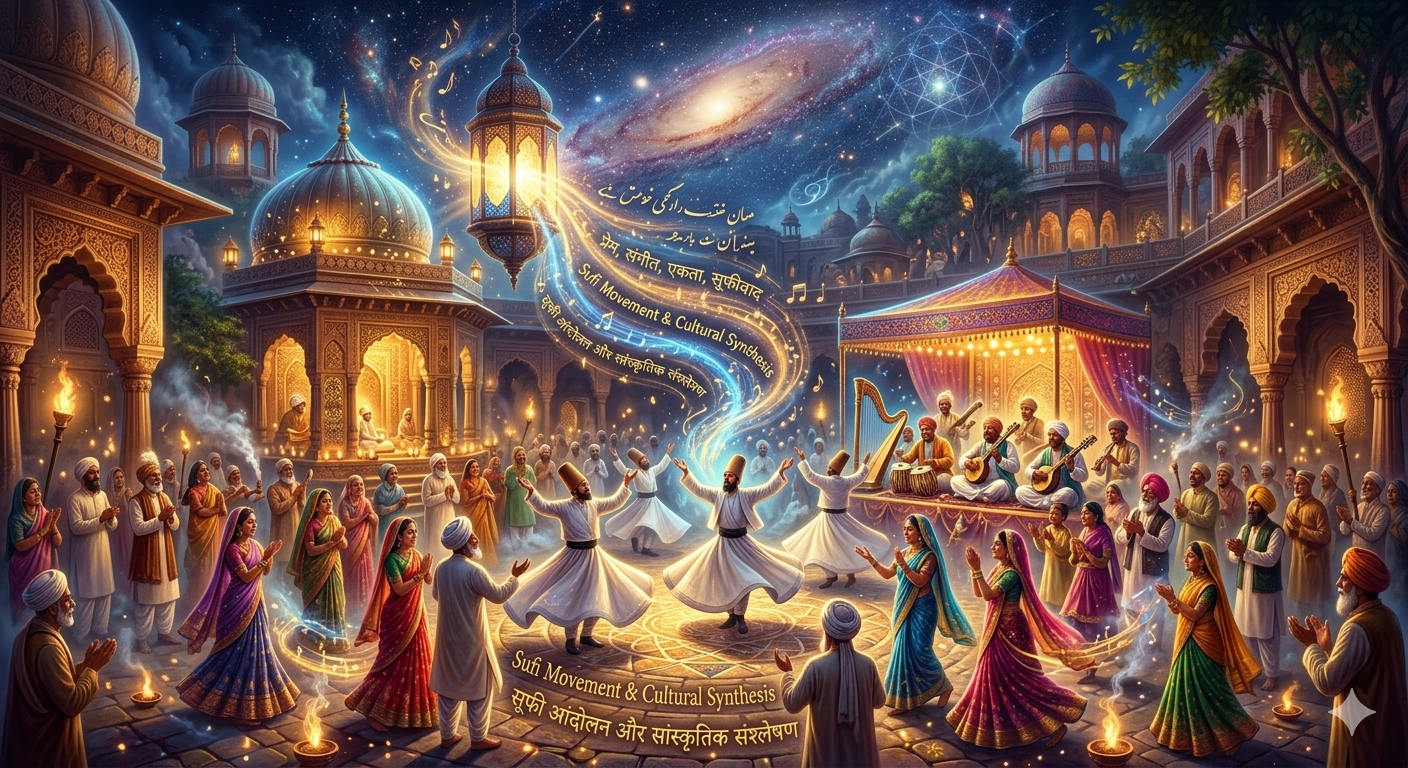
The Sufi Movement played a transformative role in shaping the socio-cultural fabric of medieval India. Sufism, the mystical dimension of Islam, emphasized love, devotion, tolerance, and a direct connection with God. Unlike orthodox religious practices, Sufis focused on inner spirituality rather than rigid rituals.
In the context of a diverse and pluralistic society, the Sufi Movement became a powerful medium for cultural synthesis, bringing together elements of Hindu and Islamic traditions. Prominent Sufi saints such as Khwaja Moinuddin Chishti, Nizamuddin Auliya, and Baba Farid contributed significantly to this process.
Understanding Cultural Synthesis in Medieval India
Meaning of Cultural Synthesis
Cultural synthesis refers to the blending and integration of different cultural, religious, and social traditions into a harmonious whole. In medieval India, this primarily involved the interaction between:
- Hindu traditions and practices
- Islamic beliefs and cultural elements
The result was the emergence of a composite culture, which became a defining feature of Indian civilization.
Historical Context
During the period of the Delhi Sultanate and later the Mughal Empire:
- There was continuous interaction between different communities
- Political expansion brought diverse populations under one rule
- Social tensions existed due to religious differences
In this environment, the Sufi Movement acted as a bridge, promoting harmony and mutual understanding.
Core Principles of the Sufi Movement
Emphasis on Love and Devotion
Sufis believed that the path to God lay through love (Ishq) and devotion.
- Love for God was considered supreme
- Love for humanity was seen as a reflection of divine love
This universal message appealed to people across religious boundaries.
Tolerance and Inclusiveness
Sufis rejected religious exclusivism:
- They welcomed followers from all communities
- Their teachings emphasized unity of God and humanity
Simplicity and Spiritual Equality
Sufis promoted a simple lifestyle:
- Rejected materialism and luxury
- Emphasized equality among all individuals
Role of Khanqahs
Khanqahs (Sufi monasteries) served as:
- Centers of spiritual learning
- Places for social interaction
People from different backgrounds gathered here, facilitating cultural exchange.
Role of the Sufi Movement in Promoting Cultural Synthesis
1. Bridging Hindu-Muslim Divide
Spiritual Common Ground
Sufi teachings shared similarities with the Bhakti Movement:
- Emphasis on devotion and love
- Rejection of rituals
- Focus on a personal relationship with God
This common ground helped reduce religious differences.
Inclusive Approach
Sufi saints like Nizamuddin Auliya welcomed people of all faiths:
- Hindus and Muslims visited their khanqahs
- Spiritual teachings transcended religious boundaries
This created a sense of unity and mutual respect.
2. Promotion of Vernacular Languages
Use of Local Languages
Sufis communicated in regional languages:
- Hindi, Punjabi, Urdu, and Bengali
- Made teachings accessible to common people
Development of Urdu
The interaction between Persian and local languages led to the emergence of Urdu:
- Became a symbol of cultural synthesis
- Used in poetry, literature, and communication
3. Contribution to Literature and Music
Sufi Literature
Sufi saints composed poetry and writings:
- Expressed spiritual ideas in simple language
- Combined Persian and Indian literary traditions
Development of Music Traditions
Sufis used music as a means of devotion:
- Introduction of Qawwali
- Use of musical instruments in spiritual gatherings
Example
- The tradition of Qawwali is closely associated with Sufi shrines and remains popular even today.
4. Social Equality and Reform
Rejection of Social Hierarchies
Sufis opposed:
- Caste discrimination
- Social inequalities
They emphasized that all individuals are equal before God.
Impact on Society
- Attracted followers from lower castes
- Provided an alternative to rigid social structures
5. Influence on Religious Practices
Syncretic Traditions
Sufi practices often incorporated local customs:
- Visiting shrines (Dargahs)
- Offering prayers and seeking blessings
Shared Religious Spaces
Dargahs became places where:
- Hindus and Muslims worshipped together
- Cultural interaction took place
Example
- The shrine of Khwaja Moinuddin Chishti in Ajmer attracts people from all religions.
6. Promotion of Peace and Harmony
Non-Political Approach
Unlike rulers, Sufis:
- Stayed away from politics
- Focused on spiritual and social harmony
Conflict Resolution
Their teachings helped:
- Reduce communal tensions
- Promote peaceful coexistence
7. Influence on Art and Architecture
Development of Indo-Islamic Culture
Sufi influence contributed to:
- Architectural styles of Dargahs and mosques
- Fusion of Persian and Indian artistic elements
Symbol of Unity
Sufi shrines became cultural centers representing:
- Unity in diversity
- Shared heritage
Evaluation of the Sufi Movement’s Role
Positive Contributions
1. Strengthening Cultural Integration
The Sufi Movement played a crucial role in blending different cultural traditions, leading to the development of a composite culture.
2. Promotion of Religious Tolerance
It encouraged mutual respect among different religious communities, reducing conflicts.
3. Social Reform
By opposing caste discrimination and promoting equality, Sufis contributed to social change.
4. Enrichment of Culture
The movement enriched Indian culture through literature, music, and language development.
Limitations
1. Limited Structural Change
While Sufis promoted equality, they could not completely eliminate social inequalities.
2. Regional Influence
The impact of the Sufi Movement varied across regions and was not uniform throughout India.
3. Dependence on Individual Saints
The effectiveness of the movement often depended on the influence of individual Sufi saints.
Comparison with the Bhakti Movement
Similarities
- Emphasis on devotion and love
- Rejection of rituals
- Use of vernacular languages
Differences
- Sufi Movement was rooted in Islamic mysticism
- Bhakti Movement was based on Hindu devotional traditions
Despite these differences, both movements contributed significantly to cultural synthesis.
Historical Significance
The Sufi Movement played a vital role in shaping the cultural identity of medieval India. It:
- Fostered unity in diversity
- Promoted shared cultural practices
- Influenced later developments in Indian society
Critical Analysis
The Sufi Movement can be seen as a bridge between different cultures and religions. Its emphasis on love, tolerance, and inclusiveness made it a powerful force for cultural synthesis. However, its impact was more cultural and spiritual than political, limiting its ability to bring about structural changes in society.
Conclusion
The Sufi Movement played a crucial role in promoting cultural synthesis in medieval India. By fostering interaction between different communities, encouraging the use of vernacular languages, and promoting values of love and tolerance, it helped create a composite culture that continues to define Indian society today.
For UPPCS aspirants, understanding the Sufi Movement is essential for analyzing the socio-cultural dynamics of medieval India and the evolution of India’s pluralistic traditions.