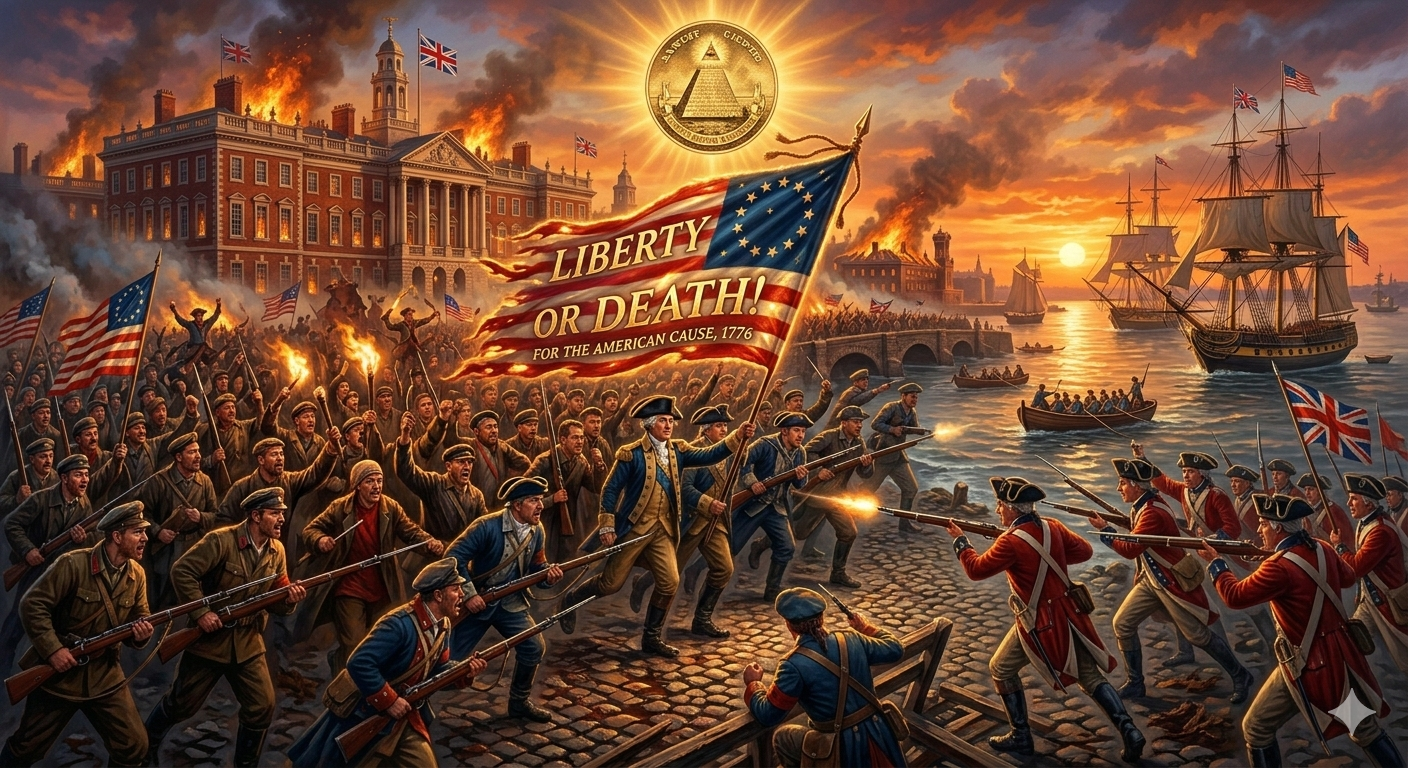
The American Revolution (1775–1783) was not merely a colonial rebellion against British authority; it was a transformative political movement that reshaped the modern world. It led to the birth of a new nation—the United States—and introduced revolutionary ideas about liberty, popular sovereignty, and constitutional government. The Revolution was rooted in economic grievances, political disputes, ideological transformation, and imperial mismanagement. Its global consequences extended far beyond North America, influencing revolutions in Europe and Latin America and redefining international political thought.
This essay analyzes the major causes of the American Revolution and evaluates its global impact in a detailed, educational, and structured manner—both paragraph-wise and point-wise.
I. Background: Colonial America Before 1776
By the mid-18th century, Britain controlled thirteen colonies along the eastern coast of North America. These colonies enjoyed a degree of self-governance under the policy of “salutary neglect.” However, after the costly Seven Years’ War, Britain faced heavy debts and sought to reorganize its empire.
The shift from neglect to active imperial control altered the relationship between Britain and the colonies. The colonists increasingly perceived British policies as threats to their economic freedom and political rights.
II. Major Causes of the American Revolution
The Revolution emerged from a combination of economic, political, ideological, and military factors. Each contributed to escalating tensions between Britain and its American colonies.
1. Economic Causes
(a) British War Debt and Colonial Taxation
The Seven Years’ War (known in America as the French and Indian War) significantly increased Britain’s national debt. British policymakers believed the colonies should contribute to defense costs.
As a result, Parliament imposed new taxes:
- Sugar Act (1764) – Tax on sugar and molasses
- Stamp Act (1765) – Tax on printed materials
- Townshend Acts (1767) – Duties on imported goods like glass and tea
- Tea Act (1773) – Monopoly granted to the British East India Company
The colonists objected not only to taxation but to taxation without representation.
Key Economic Grievances:
- No colonial representation in Parliament
- Restrictive trade laws under mercantilism
- Monopoly control over colonial commerce
- Burdensome customs enforcement
(b) Mercantilist Policies
Britain followed a mercantilist system, ensuring that colonies served the economic interests of the mother country. Under the Navigation Acts:
- Colonies could trade only with Britain.
- Certain goods had to be shipped exclusively to British ports.
This restricted colonial economic freedom and fostered resentment among merchants and traders.

2. Political Causes
(a) “No Taxation Without Representation”
Colonists argued that Parliament had no right to tax them because they lacked direct representation. British authorities responded with the doctrine of “virtual representation,” claiming Parliament represented all British subjects.
This disagreement reflected deeper constitutional differences:
- Colonists believed in local self-government.
- Britain asserted parliamentary supremacy.
(b) Erosion of Colonial Self-Government
After 1763, Britain tightened control:
- Royal governors gained more power.
- Colonial assemblies were dissolved when they protested.
- Military presence increased in cities like Boston.
The Quartering Act required colonists to house British soldiers, intensifying hostility.
3. Ideological Causes
(a) Influence of Enlightenment Thought
The American Revolution was deeply influenced by Enlightenment ideas. Thinkers like John Locke argued that:
- Individuals possess natural rights (life, liberty, property).
- Government derives authority from the consent of the governed.
- People have the right to overthrow unjust governments.
These ideas resonated strongly in colonial America.
(b) Republicanism and Natural Rights
Colonists increasingly embraced republican ideals:
- Opposition to monarchy
- Emphasis on civic virtue
- Belief in popular sovereignty
Pamphlets such as Thomas Paine’s “Common Sense” mobilized public opinion against British rule.

4. Immediate Triggers
(a) Boston Massacre (1770)
Tensions between British soldiers and colonists culminated in violence when troops fired into a crowd in Boston.
This event was used as propaganda to portray Britain as tyrannical.
(b) Boston Tea Party (1773)
In protest against the Tea Act, colonists dumped tea into Boston Harbor.
Britain responded with the Coercive (Intolerable) Acts, closing Boston’s port and limiting self-government in Massachusetts.
(c) First Continental Congress (1774)
Colonial leaders convened to coordinate resistance, marking a step toward unity.
5. Military Escalation
The conflict turned violent in April 1775 at the Battles of Lexington and Concord. Armed confrontation transformed political resistance into open war.
In 1776, the colonies formally declared independence through the Declaration of Independence, largely authored by Thomas Jefferson.
The document proclaimed:
- Equality of all men
- Natural rights
- Right to revolution
III. Key Personalities
The Revolution was shaped by influential leaders:
- George Washington – Commander-in-Chief of the Continental Army
- Thomas Jefferson – Principal author of the Declaration
- Benjamin Franklin – Diplomat securing French support
Their leadership strengthened the revolutionary cause.

IV. Consequences and Global Impact
The American Revolution had profound political, ideological, and geopolitical consequences.
1. Political Consequences in America
(a) Creation of a New Nation
The Treaty of Paris (1783) recognized American independence. The United States adopted:
- The Articles of Confederation (initial framework)
- Later, the U.S. Constitution (1787)
The Constitution established:
- Federalism
- Separation of powers
- Checks and balances
(b) Birth of Constitutional Democracy
The American Revolution institutionalized:
- Written constitution
- Bill of Rights
- Representative government
It became a model for future democratic systems.
2. Ideological Impact on Europe
(a) Influence on the French Revolution
The success of the American Revolution inspired reformers in France. Veterans and intellectuals carried revolutionary ideas back to Europe.
The French Revolution adopted similar principles:
- Liberty
- Equality
- Fraternity
Financial strain from aiding America also worsened France’s economic crisis.
(b) Spread of Liberalism
Across Europe:
- Monarchies faced ideological challenges.
- Liberal movements demanded constitutional reforms.
The American example proved that monarchy could be replaced by a republic.
3. Impact on Latin America
Revolutionary ideas spread to Latin American colonies. Leaders like:
- Simón Bolívar
- José de San Martín
drew inspiration from American independence.
Colonial liberation movements gained momentum in the early 19th century.
4. Transformation of the British Empire
Britain reassessed colonial governance. Instead of strict control, it gradually moved toward granting self-governance to settler colonies like Canada and Australia.
The loss of the American colonies also shifted British imperial focus toward Asia and Africa.
5. Global Spread of Republicanism
The Revolution popularized:
- Popular sovereignty
- Constitutional governance
- Anti-colonial nationalism
It contributed to the emergence of modern nation-states.
6. Social Impact
(a) Expansion of Political Participation
Property requirements for voting were gradually reduced.
(b) Slavery and Contradictions
Despite proclaiming equality, slavery continued in the southern states. This contradiction eventually contributed to internal conflicts, including the Civil War.
V. Critical Evaluation
Positive Outcomes:
- Establishment of democratic governance
- Protection of civil liberties
- Model for constitutional republics
- Strengthening of human rights discourse
Limitations:
- Slavery remained intact
- Women lacked political rights
- Native American lands were expanded into
Thus, while revolutionary in political thought, social equality was incomplete.
VI. Comparative Perspective
When compared with the Russian Revolution, the American Revolution:
- Focused on political independence rather than economic equality.
- Created a liberal democratic state instead of a socialist one.
- Preserved private property and capitalist structures.
This distinction shaped future ideological divisions between capitalism and socialism.

VII. Conclusion
The American Revolution was a turning point in world history. Its causes lay in economic exploitation, political disputes, Enlightenment ideology, and imperial mismanagement. The slogan “No taxation without representation” symbolized broader demands for self-rule and constitutional governance.
Its global impact was immense:
- Inspired the French and Latin American revolutions
- Promoted democratic ideals worldwide
- Altered the course of British imperial policy
- Contributed to the rise of modern nationalism
Although imperfect in achieving social equality, the American Revolution fundamentally reshaped political thought and laid the foundation for constitutional democracy in the modern world.