Introduction
The Renaissance was one of the most significant cultural and intellectual movements in European history. Originating in the Italian city-states during the 14th century and spreading across Europe between the 15th and 17th centuries, it marked the transition from the medieval world to the early modern age. The term “Renaissance” literally means “rebirth,” referring to the revival of classical learning, art, philosophy, and science from ancient Greece and Rome.
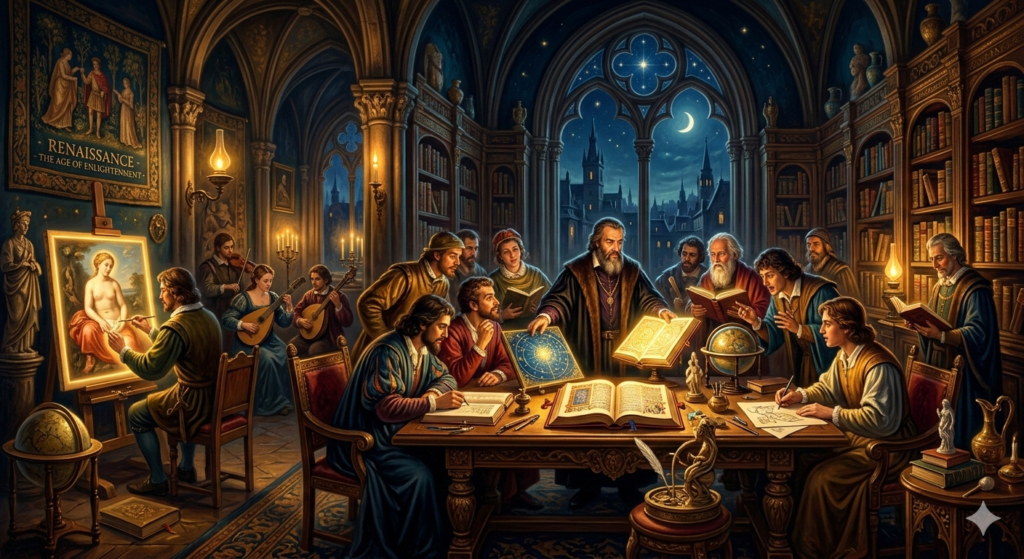
The Renaissance brought profound changes in the intellectual, cultural, artistic, scientific, and social spheres of European society. It encouraged critical thinking, revived classical knowledge, promoted human potential, and challenged the dominance of medieval scholastic traditions. This transformation influenced literature, philosophy, education, art, science, politics, and religion, eventually paving the way for later movements such as the Scientific Revolution and the Enlightenment.
The following sections evaluate the impact of the Renaissance on the intellectual and cultural life of Europe in a comprehensive manner.
1. Revival of Classical Learning
One of the most important intellectual impacts of the Renaissance was the rediscovery of classical Greek and Roman knowledge.
Explanation
During the medieval period, much of the classical literature and philosophical knowledge had been lost or remained confined to monasteries. Renaissance scholars actively searched for ancient manuscripts and revived classical texts related to philosophy, history, literature, mathematics, and science.
Key Developments
- Scholars began studying classical authors such as Plato, Aristotle, and Cicero.
- Greek manuscripts entered Europe after the Fall of Constantinople, when Byzantine scholars migrated to Italy.
- Classical education emphasized rhetoric, grammar, history, poetry, and moral philosophy.
Impact
This revival broadened intellectual horizons and encouraged Europeans to appreciate the achievements of ancient civilizations. It laid the foundation for modern humanities and liberal education.
2. Rise of Humanism
Humanism became the dominant intellectual movement of the Renaissance.
Meaning of Humanism
Humanism was an intellectual philosophy that emphasized human dignity, individual potential, and secular learning. Unlike medieval scholasticism, which focused mainly on theology, humanism placed greater importance on human experiences and worldly knowledge.
Major Humanist Thinkers
Important Renaissance humanists included:
- Francesco Petrarch
- Desiderius Erasmus
- Giovanni Pico della Mirandola
Contributions
Humanists:
- Encouraged critical analysis of classical texts.
- Promoted education based on literature, ethics, and history.
- Emphasized moral philosophy and civic responsibility.
Impact
Humanism transformed intellectual life by encouraging independent thinking, creativity, and intellectual curiosity. It shifted European thought from purely religious concerns to a broader understanding of human society and culture.
3. Transformation in Education
The Renaissance brought major reforms in the educational system of Europe.
Changes in Curriculum
Education during the Renaissance focused on the studia humanitatis, which included:
- Grammar
- Rhetoric
- Poetry
- History
- Moral philosophy
Educational Reforms
Humanist educators advocated:
- Classical language studies (Latin and Greek)
- Development of moral character
- Training for civic life
Impact
Educational reforms helped create a more well-rounded intellectual class capable of contributing to politics, literature, science, and governance.
4. Development of Renaissance Literature
Renaissance literature reflected humanist ideals and a renewed interest in classical forms.
Major Writers
Some of the greatest literary figures emerged during this period:
- Dante Alighieri
- William Shakespeare
- Geoffrey Chaucer
- Miguel de Cervantes
Characteristics of Renaissance Literature
- Use of vernacular languages instead of Latin.
- Exploration of human emotions and individuality.
- Interest in classical themes and mythology.
- Realistic portrayal of society.
Impact
The use of vernacular languages made literature accessible to common people, which helped promote literacy and cultural awareness across Europe.
5. Artistic Revolution
The Renaissance led to one of the greatest artistic transformations in European history.
Characteristics of Renaissance Art
Renaissance art was marked by:
- Realism and naturalism
- Use of perspective
- Study of human anatomy
- Balanced compositions
Famous Renaissance Artists
Some of the most celebrated artists include:
- Leonardo da Vinci
- Michelangelo
- Raphael
Major Artistic Achievements
These artists produced masterpieces in painting, sculpture, and architecture that reflected the beauty of human form and nature.
Impact
The Renaissance transformed European cultural life by creating artistic traditions that still influence modern art and aesthetics.
6. Scientific Curiosity and the Scientific Revolution
The Renaissance stimulated scientific curiosity and laid the groundwork for the Scientific Revolution.
Scientific Developments
Scholars began to question traditional beliefs and rely on observation and experimentation.
Important scientists included:
- Nicolaus Copernicus
- Galileo Galilei
- Johannes Kepler
Key Ideas
- Development of the heliocentric theory, which proposed that the Sun is at the center of the solar system.
- Advancement of astronomy, physics, anatomy, and mathematics.
Impact
Scientific inquiry challenged medieval beliefs and promoted rational thinking, eventually leading to modern scientific methods.
7. Growth of Individualism
The Renaissance emphasized the importance of individual achievements and personal expression.
Features
Individualism encouraged:
- Personal fame and reputation
- Artistic and intellectual originality
- Exploration of human potential
Example
Artists such as Leonardo da Vinci gained fame for their unique talents and innovations.
Impact
Individualism helped transform European society by encouraging creativity, innovation, and intellectual independence.
8. Rise of Vernacular Languages
Before the Renaissance, most scholarly works were written in Latin.
Change During the Renaissance
Writers began using local languages such as:
- Italian
- English
- French
- Spanish
Importance
The use of vernacular languages:
- Made knowledge accessible to a wider audience.
- Strengthened national identities.
- Encouraged literary creativity.
Impact
This linguistic transformation greatly influenced European culture and helped shape modern national literatures.
9. Patronage and Cultural Development
The Renaissance flourished due to the support of wealthy patrons.
Major Patrons
One of the most important patrons was the Cosimo de’ Medici, whose family supported many artists and scholars.
Role of Patrons
Patrons funded:
- Artists
- Architects
- Scholars
- Scientists
Impact
Patronage helped create cultural centers in cities such as Florence, Rome, and Venice.
10. Influence on Religion and the Reformation
The Renaissance also had indirect effects on religion.
Intellectual Criticism
Humanist scholars criticized corruption and moral decline within the Church.
For example:
- Desiderius Erasmus advocated religious reform and moral renewal.
Impact
Renaissance ideas contributed to the emergence of the Protestant Reformation, which challenged the authority of the Catholic Church.
11. Printing Revolution and Spread of Knowledge
The invention of the printing press dramatically accelerated the spread of Renaissance ideas.
Major Development
The printing press was invented by:
- Johannes Gutenberg
Impact
Printing led to:
- Mass production of books
- Increased literacy
- Rapid dissemination of knowledge
Books became cheaper and more accessible, allowing Renaissance ideas to spread throughout Europe.
12. Cultural Exchange and Global Awareness
The Renaissance coincided with the Age of Exploration, which expanded European knowledge of the world.
Key Explorers
Famous explorers included:
- Christopher Columbus
- Vasco da Gama
Impact
Exploration increased cultural interaction between Europe, Asia, Africa, and the Americas, influencing European intellectual and cultural life.
13. Political Thought and Statecraft
The Renaissance also influenced political philosophy.
Major Thinker
The most influential political thinker of the period was:
- Niccolò Machiavelli
Key Work
His famous book The Prince discussed realistic approaches to governance and power.
Impact
This marked the beginning of modern political science and secular political analysis.
14. Architectural Developments
Renaissance architecture revived classical Greek and Roman styles.
Characteristics
- Symmetry and proportion
- Columns and domes
- Geometric balance
Example
One of the most famous Renaissance architects was:
- Filippo Brunelleschi
Impact
Renaissance architecture influenced building styles throughout Europe and continues to inspire modern design.
15. Social and Cultural Transformation
The Renaissance influenced everyday cultural life.
Changes
- Growth of urban culture
- Development of artistic communities
- Expansion of education and intellectual debates
Impact
These changes contributed to the emergence of a modern European cultural identity.
Critical Evaluation of the Renaissance
Although the Renaissance brought many positive changes, its impact was not uniform across Europe.
Positive Impacts
- Revival of classical knowledge
- Development of art, literature, and science
- Growth of humanism and individualism
- Expansion of education and literacy
Limitations
- Renaissance ideas initially benefited mainly the elite and urban populations.
- Rural areas remained largely influenced by medieval traditions.
- Women had limited access to Renaissance education and intellectual life.
Nevertheless, the Renaissance marked a decisive turning point in European intellectual and cultural history.
Conclusion
The Renaissance profoundly transformed the intellectual and cultural life of Europe. By reviving classical learning, promoting humanism, encouraging artistic creativity, and stimulating scientific inquiry, it reshaped European thought and culture. The movement fostered individualism, expanded education, promoted vernacular literature, and stimulated political and religious debates.
The Renaissance also laid the foundations for later historical developments such as the Scientific Revolution, the Protestant Reformation, and the Enlightenment. Its emphasis on human potential, rational thinking, and cultural creativity continues to influence modern civilization.
Thus, the Renaissance stands as one of the most significant turning points in world history, marking the transition from the medieval age to the modern era.