1. Introduction
The Earth receives energy from the Sun in the form of sunlight. This solar energy warms the planet’s surface and supports life on Earth. However, not all of the heat absorbed by the Earth escapes back into space. A portion of this heat is trapped in the atmosphere by certain gases, creating a natural warming process known as the Greenhouse Effect.
The greenhouse effect is a natural and essential process that keeps the Earth’s temperature suitable for life. Without this phenomenon, the planet would be extremely cold, making it difficult for plants, animals, and humans to survive. The presence of greenhouse gases in the atmosphere ensures that some heat remains trapped, maintaining a stable climate.
However, human activities have increased the concentration of these gases in the atmosphere. As a result, more heat is trapped than necessary, leading to a rise in global temperature. This enhanced greenhouse effect is closely related to Global Warming and broader climate changes observed around the world.
2. Meaning and Concept of the Greenhouse Effect
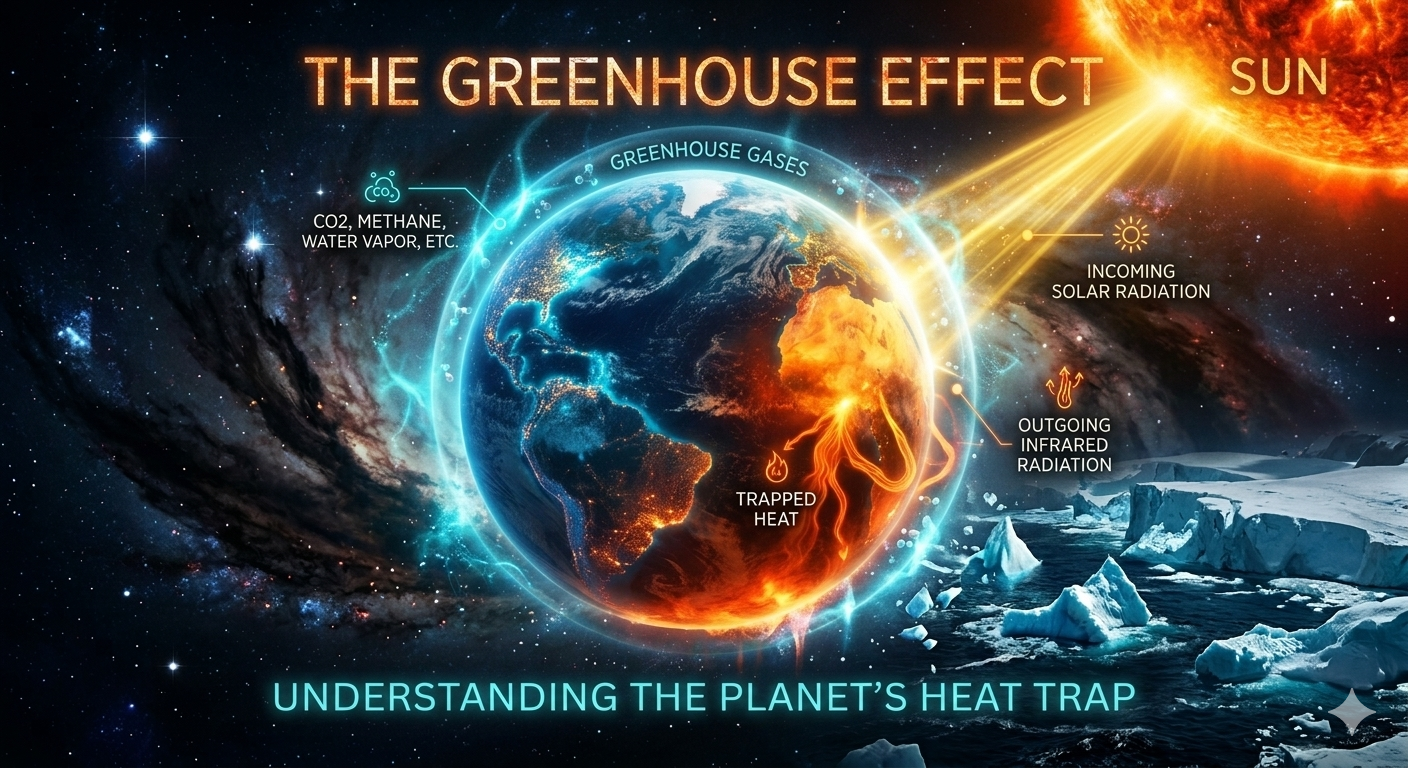
The greenhouse effect refers to the process by which certain gases in the atmosphere absorb and re-emit heat energy. When sunlight reaches the Earth, some of it is reflected back into space, while the rest is absorbed by land, oceans, and vegetation. The absorbed energy warms the planet’s surface.
As the Earth warms, it emits heat in the form of infrared radiation. Greenhouse gases in the atmosphere absorb part of this outgoing heat and radiate it back toward the Earth’s surface. This process prevents heat from escaping completely into space and keeps the atmosphere warm.
This natural heat-trapping process is similar to the way a glass greenhouse works. In a greenhouse used for growing plants, sunlight enters through the glass panels and warms the interior. The heat remains trapped inside, allowing plants to grow even in cold weather.
Key Points about the Greenhouse Effect
- It is a natural atmospheric process that traps heat.
- It maintains the Earth’s temperature at a livable level.
- It involves gases that absorb and release heat energy.
- Without it, the Earth would be much colder.
- Human activities have intensified the natural greenhouse effect.
3. How the Greenhouse Effect Works
The greenhouse effect occurs through a series of steps involving solar radiation and atmospheric gases. The Sun continuously emits energy toward the Earth. When this energy reaches the planet, some of it is reflected back by clouds, ice, and other bright surfaces. The remaining energy is absorbed by the Earth’s surface, causing it to warm.
After absorbing this energy, the Earth releases heat in the form of infrared radiation. Greenhouse gases in the atmosphere absorb part of this radiation and then re-emit it in different directions. Some of the heat returns to the Earth’s surface, maintaining a warm environment.
This process creates a balance between incoming solar energy and outgoing heat. If the concentration of greenhouse gases increases, more heat becomes trapped, leading to higher global temperatures.
Steps in the Greenhouse Effect
- Solar radiation from the Sun reaches the Earth.
- Part of the radiation is reflected back into space.
- The remaining energy is absorbed by the Earth’s surface.
- The surface warms and releases heat as infrared radiation.
- Greenhouse gases absorb some of this heat.
- The absorbed heat is re-emitted toward the Earth, warming the atmosphere.
4. Major Greenhouse Gases
Several gases in the atmosphere contribute to the greenhouse effect. These gases differ in their ability to trap heat.
4.1 Carbon Dioxide
Carbon dioxide is the most significant greenhouse gas produced by human activities. It is released when fossil fuels such as coal, oil, and natural gas are burned.
Key Points
- Produced by burning fossil fuels
- Released during industrial processes
- Also emitted through deforestation
- Remains in the atmosphere for a long time
4.2 Methane
Methane is another powerful greenhouse gas. Although it exists in smaller quantities than carbon dioxide, it has a stronger heat-trapping ability.
Key Points
- Produced during livestock digestion
- Released from rice fields
- Emitted from landfills and natural gas systems
- More effective at trapping heat than carbon dioxide
4.3 Nitrous Oxide
Nitrous oxide is released mainly through agricultural activities and industrial processes.
Key Points
- Produced from nitrogen-based fertilizers
- Emitted during fuel combustion
- Contributes to atmospheric warming
4.4 Water Vapor
Water vapor is the most abundant greenhouse gas in the atmosphere. It plays a significant role in regulating temperature.
Key Points
- Naturally present in the atmosphere
- Increases as temperature rises
- Enhances the warming effect of other greenhouse gases
5. Natural vs Enhanced Greenhouse Effect
Natural Greenhouse Effect
The natural greenhouse effect is essential for maintaining the Earth’s temperature. Without it, the average temperature of the planet would be far below freezing, making life impossible.
Features
- Maintains a stable climate
- Supports ecosystems and biodiversity
- Enables the existence of liquid water
Enhanced Greenhouse Effect
The enhanced greenhouse effect occurs when human activities increase the concentration of greenhouse gases in the atmosphere.
Features
- Caused by industrialization and deforestation
- Leads to higher global temperatures
- Contributes to climate change
6. Causes of the Enhanced Greenhouse Effect
Several human activities increase greenhouse gas emissions.
Burning of Fossil Fuels
Energy production, transportation, and industries rely heavily on fossil fuels. Burning these fuels releases large amounts of carbon dioxide into the atmosphere.
Deforestation
Cutting down forests reduces the number of trees that absorb carbon dioxide. It also releases stored carbon into the atmosphere.
Agricultural Activities
Livestock farming and fertilizer use release methane and nitrous oxide.
Industrial Development
Factories and manufacturing processes emit greenhouse gases during production.
7. Impacts of the Greenhouse Effect
The natural greenhouse effect supports life, but the enhanced greenhouse effect leads to several environmental problems.
7.1 Rising Global Temperatures
Increased greenhouse gases cause more heat to be trapped, raising global temperatures.
7.2 Climate Change
Changes in temperature influence rainfall patterns, storms, and seasonal cycles.
7.3 Melting of Glaciers
Higher temperatures cause glaciers and polar ice caps to melt.
7.4 Rising Sea Levels
Melting ice and thermal expansion of oceans lead to higher sea levels.
7.5 Impact on Ecosystems
Many plants and animals struggle to adapt to rapidly changing climate conditions.
8. Importance of Understanding the Greenhouse Effect
Understanding the greenhouse effect is essential for addressing environmental challenges.
Key Points
- Helps scientists study climate systems
- Guides environmental policy decisions
- Encourages sustainable practices
- Promotes awareness of climate change
9. Measures to Reduce the Enhanced Greenhouse Effect
Several strategies can help reduce greenhouse gas emissions.
Important Measures
- Increasing the use of renewable energy sources
- Protecting forests and planting more trees
- Improving energy efficiency in industries
- Promoting sustainable transportation
- Reducing waste and encouraging recycling
International cooperation also plays a key role in addressing climate change through agreements such as the Paris Agreement.
10. Conclusion
The greenhouse effect is a natural atmospheric process that keeps the Earth warm and suitable for life. It occurs when gases in the atmosphere trap heat from the Sun and prevent it from escaping completely into space. While this process is essential for maintaining a stable climate, human activities have intensified it by increasing the concentration of greenhouse gases.
The enhanced greenhouse effect leads to rising temperatures, climate change, melting glaciers, and other environmental challenges. Understanding this concept helps societies recognize the importance of reducing greenhouse gas emissions and adopting sustainable practices.
By promoting renewable energy, protecting forests, and encouraging responsible use of natural resources, it is possible to limit the negative effects of the enhanced greenhouse effect and ensure a healthier planet for future generations.