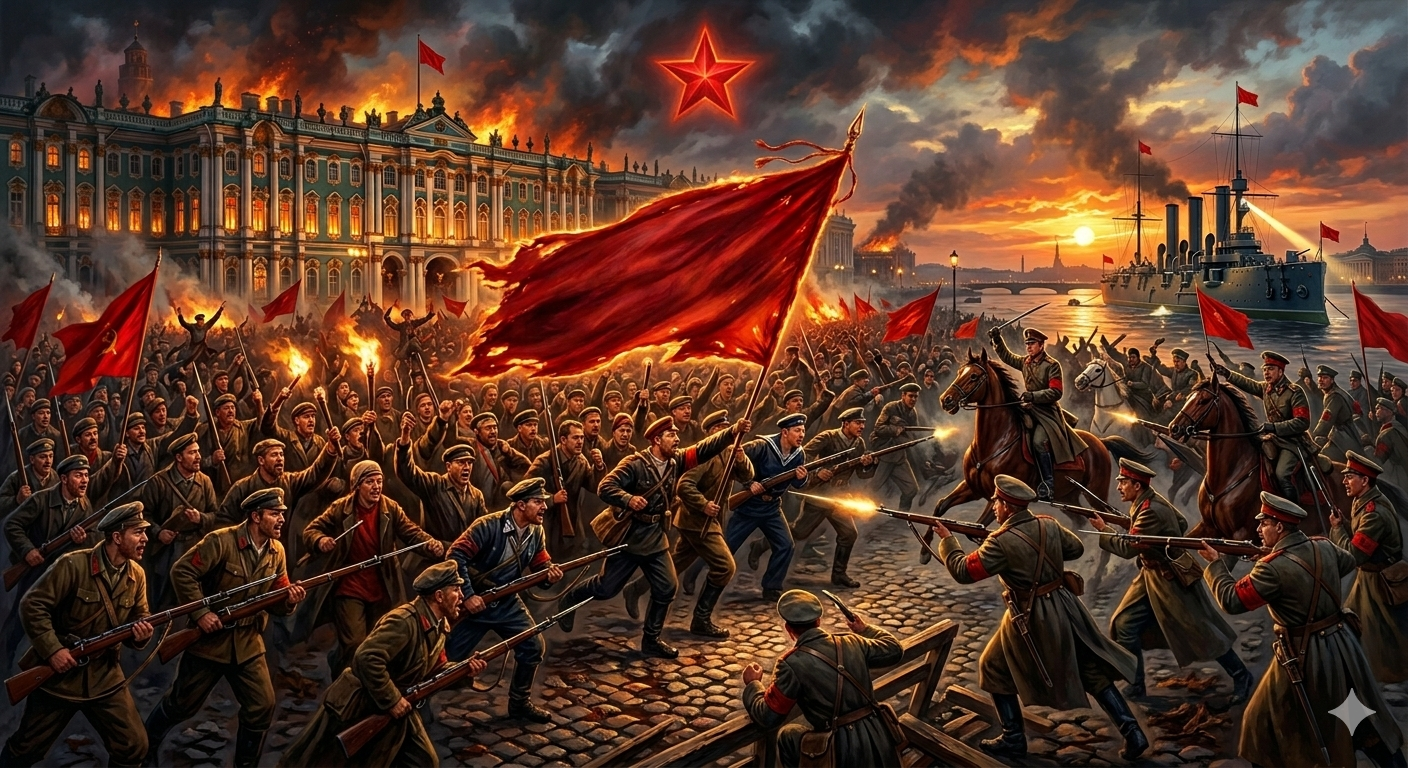
The Russian Revolution of 1917 stands as one of the most transformative events of the twentieth century. It not only overthrew centuries of autocratic rule in Russia but also reshaped global politics by introducing the world’s first large-scale socialist state. The Revolution unfolded in two major phases—the February Revolution and the October Revolution—leading to the collapse of the Romanov dynasty and the rise of Bolshevik power under Vladimir Lenin.
This essay reviews the major causes and consequences of the Russian Revolution, focusing on Bolshevik ideology, the fall of Tsarism, and the rise of socialism, in a structured paragraph-wise and point-wise format for educational purposes.
I. Background: Russia Before 1917
Before 1917, Russia was ruled by the autocratic Romanov dynasty, with Nicholas II as the last Tsar. Unlike Western European countries, Russia had not fully industrialized or democratized. Political power was concentrated in the hands of the Tsar, who believed in divine right and resisted constitutional reforms.
Russia’s social structure was highly unequal:
- The nobility and aristocracy enjoyed privileges.
- Peasants, who made up nearly 80% of the population, faced poverty and land shortages.
- Industrial workers suffered from long working hours, low wages, and unsafe conditions.
This rigid and unequal system laid the foundation for revolutionary unrest.
II. Causes of the Russian Revolution
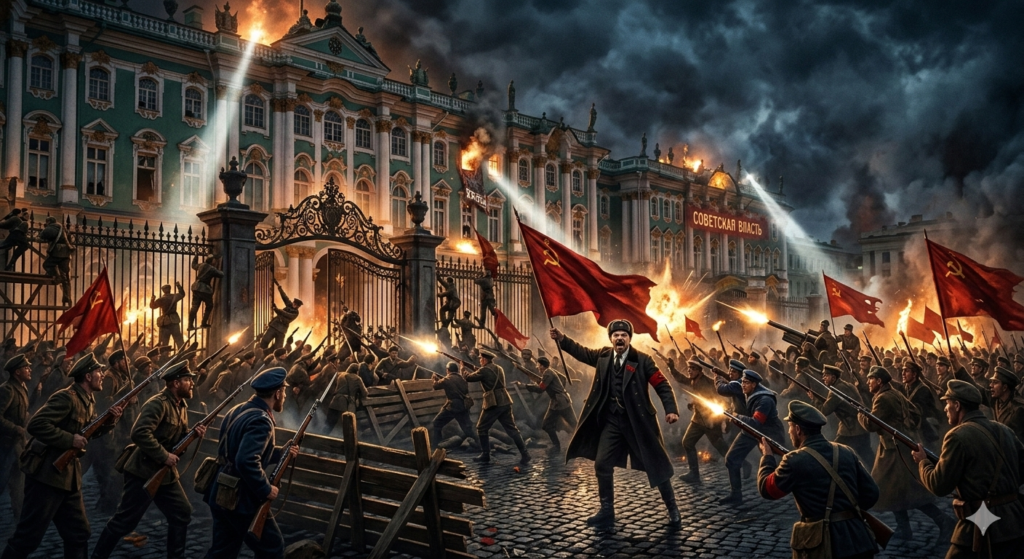
The Revolution was not the result of a single event but a culmination of political, economic, social, and ideological factors.
1. Political Causes
(a) Autocratic Rule of Tsar Nicholas II
Russia lacked a democratic political system. Tsar Nicholas II:
- Ruled without accountability.
- Suppressed dissent through secret police (Okhrana).
- Ignored demands for political reform.
Even after the 1905 Revolution, when a legislative assembly (Duma) was created, the Tsar retained ultimate authority and frequently dissolved it when it opposed him.
Key Point: The absence of political freedom and representative government created widespread dissatisfaction.
(b) Weak Governance and Corruption
The Tsar’s administration was inefficient and corrupt. Decision-making was centralized, and incompetent officials held power.
The influence of figures like Grigori Rasputin further damaged the monarchy’s credibility. Rasputin’s involvement in royal affairs created public suspicion and anger.
Impact: Loss of public trust in the monarchy accelerated revolutionary sentiments.
2. Economic Causes
(a) Agrarian Crisis
Despite the abolition of serfdom in 1861, peasants:
- Lacked sufficient land.
- Faced heavy taxes.
- Remained economically backward.
Agriculture was inefficient, leading to frequent famines and rural poverty.
(b) Industrial Exploitation
Industrialization began late in Russia. Rapid industrial growth in cities like Petrograd and Moscow created:
- Overcrowded urban areas.
- Harsh factory conditions.
- Low wages and long working hours.
Workers began organizing strikes and unions.
Key Economic Causes in Points:
- Extreme income inequality
- Poor working conditions
- Food shortages
- Inflation during wartime
3. Social Causes
(a) Class Inequality
Russian society was deeply divided:
- Aristocracy and clergy at the top
- Peasants and workers at the bottom
The lack of upward mobility increased frustration.
(b) Growth of Revolutionary Ideas
Intellectuals and workers were influenced by socialist ideas based on the works of Karl Marx and Friedrich Engels.
Marxism emphasized:
- Class struggle
- Overthrow of capitalism
- Establishment of a proletarian state
These ideas inspired revolutionary groups in Russia.
4. Role of Bolshevik Ideology
The Bolsheviks were a radical faction of the Russian Social Democratic Labour Party led by Vladimir Lenin.
Core Principles of Bolshevik Ideology:
- Dictatorship of the Proletariat – Workers should control the state.
- Revolutionary Vanguard Party – A disciplined party should lead the revolution.
- Abolition of Private Property – Means of production should be state-controlled.
- Immediate Peace and Land Redistribution – “Peace, Land, and Bread” became their slogan.
The Bolsheviks promised solutions to:
- War fatigue
- Land hunger
- Industrial exploitation
Their clear, direct messaging helped them gain popular support.
5. Impact of the 1905 Revolution
The 1905 Revolution was triggered by “Bloody Sunday,” when peaceful protesters were fired upon.
Consequences:
- Creation of the Duma
- Limited reforms
However, reforms were superficial, and dissatisfaction persisted.
Lesson Learned: The monarchy could be challenged.
6. World War I as a Catalyst
Russia’s involvement in World War I worsened internal problems.
Effects of the War:
- Heavy military losses
- Economic collapse
- Food shortages
- Inflation
Tsar Nicholas II personally took command of the army, linking military failure directly to his leadership.
Result: War accelerated the fall of the monarchy.
III. The Fall of the Tsar (February Revolution 1917)
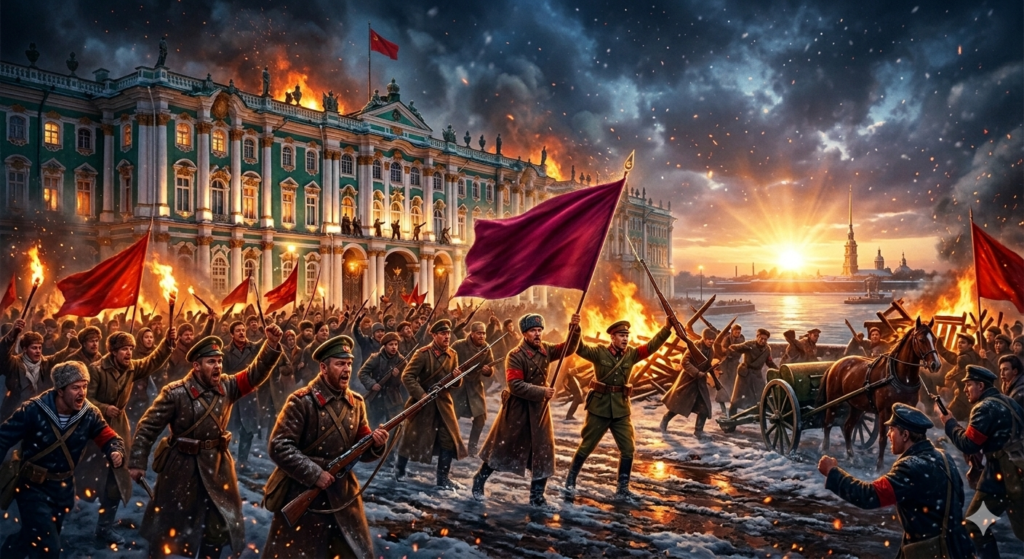
In early 1917:
- Food shortages led to protests in Petrograd.
- Workers went on strike.
- Soldiers refused to suppress demonstrations.
The Tsar lost military support and abdicated in March 1917.
Key Outcomes:
- End of Romanov rule
- Formation of a Provisional Government
- Beginning of political uncertainty
The fall of Tsar Nicholas II marked the end of centuries of autocracy.
IV. The Rise of the Bolsheviks (October Revolution 1917)
The Provisional Government failed to:
- End the war
- Solve land issues
- Improve economic conditions
This allowed the Bolsheviks to gain support.
In October 1917:
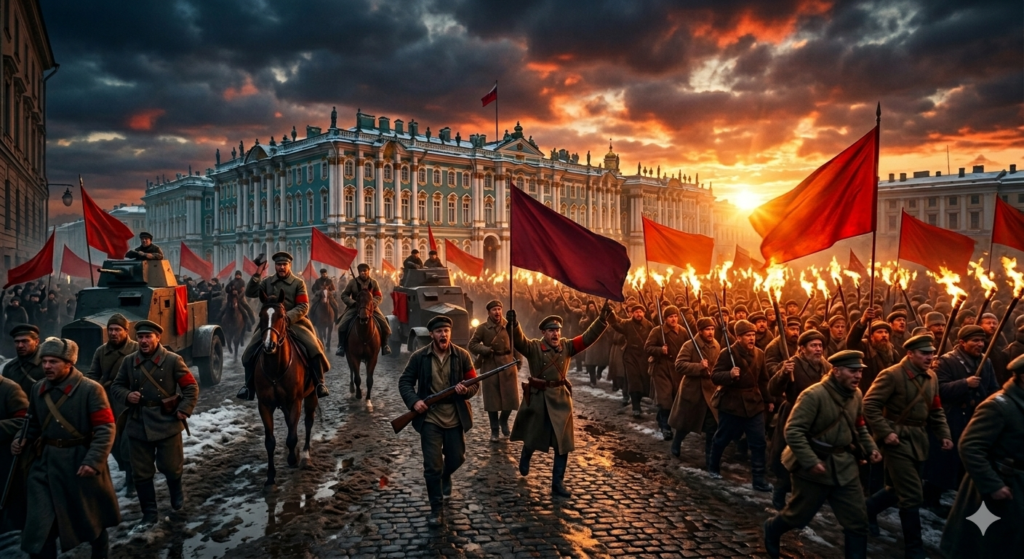
- Bolsheviks seized key government buildings.
- The Winter Palace was captured.
- The Provisional Government collapsed.
Lenin became head of the new government.
Significance: Establishment of a socialist state based on Marxist principles.
V. Consequences of the Russian Revolution
The Revolution had profound national and global consequences.
1. Political Consequences
(a) Establishment of a Communist State
In 1922, the Union of Soviet Socialist Republics (USSR) was formed.
Features:
- One-party rule
- Centralized authority
- Suppression of opposition
(b) Civil War
The Bolsheviks fought the “White” forces (anti-communists). The Red Army emerged victorious.
Outcome: Consolidation of Bolshevik control.
2. Economic Consequences
(a) Nationalization of Industry
Private property was abolished. Industries, banks, and land were nationalized.
(b) War Communism and New Economic Policy (NEP)
- War Communism centralized production.
- Later, limited capitalism was allowed under the NEP.
This marked a pragmatic shift in economic policy.
3. Social Consequences
(a) Land Redistribution
Peasants received land, fulfilling a major revolutionary demand.
(b) Education and Literacy
The Soviet regime promoted:
- Mass literacy campaigns
- Women’s rights
- Worker participation
Social mobility increased compared to Tsarist times.
4. Global Consequences
(a) Spread of Communism
The Revolution inspired communist movements worldwide:
- China
- Eastern Europe
- Cuba
It led to the formation of the Communist International (Comintern).
(b) Beginning of Ideological Polarization
The Russian Revolution contributed to:
- Capitalism vs Socialism divide
- Formation of communist parties globally
- Eventually, tensions leading to the Cold War
5. Rise of Authoritarian Socialism
While socialism promised equality, it also led to:
- Political repression
- Censorship
- Centralized control
Under later leaders, especially Joseph Stalin, authoritarian governance intensified.
VI. Evaluation of the Russian Revolution
Positive Aspects:
- End of autocracy
- Expansion of education
- Industrial modernization
- Women’s emancipation
Negative Aspects:
- Civil war and violence
- Suppression of political opposition
- Economic hardships
- Authoritarian rule
The Revolution replaced one form of autocracy with another centralized system, though under a socialist framework.
VII. Conclusion
The Russian Revolution was a landmark event that transformed Russia from a feudal autocracy into a socialist state. Rooted in political oppression, economic inequality, and ideological influence, it culminated in the fall of Tsar Nicholas II and the rise of Bolshevik power under Vladimir Lenin.
Its consequences were far-reaching:
- Creation of the USSR
- Spread of socialist ideology
- Redefinition of global political alignments
While it achieved significant social transformation, it also introduced authoritarian governance and political repression. Thus, the Russian Revolution remains a complex historical phenomenon—both a struggle for equality and a foundation for a powerful centralized state.