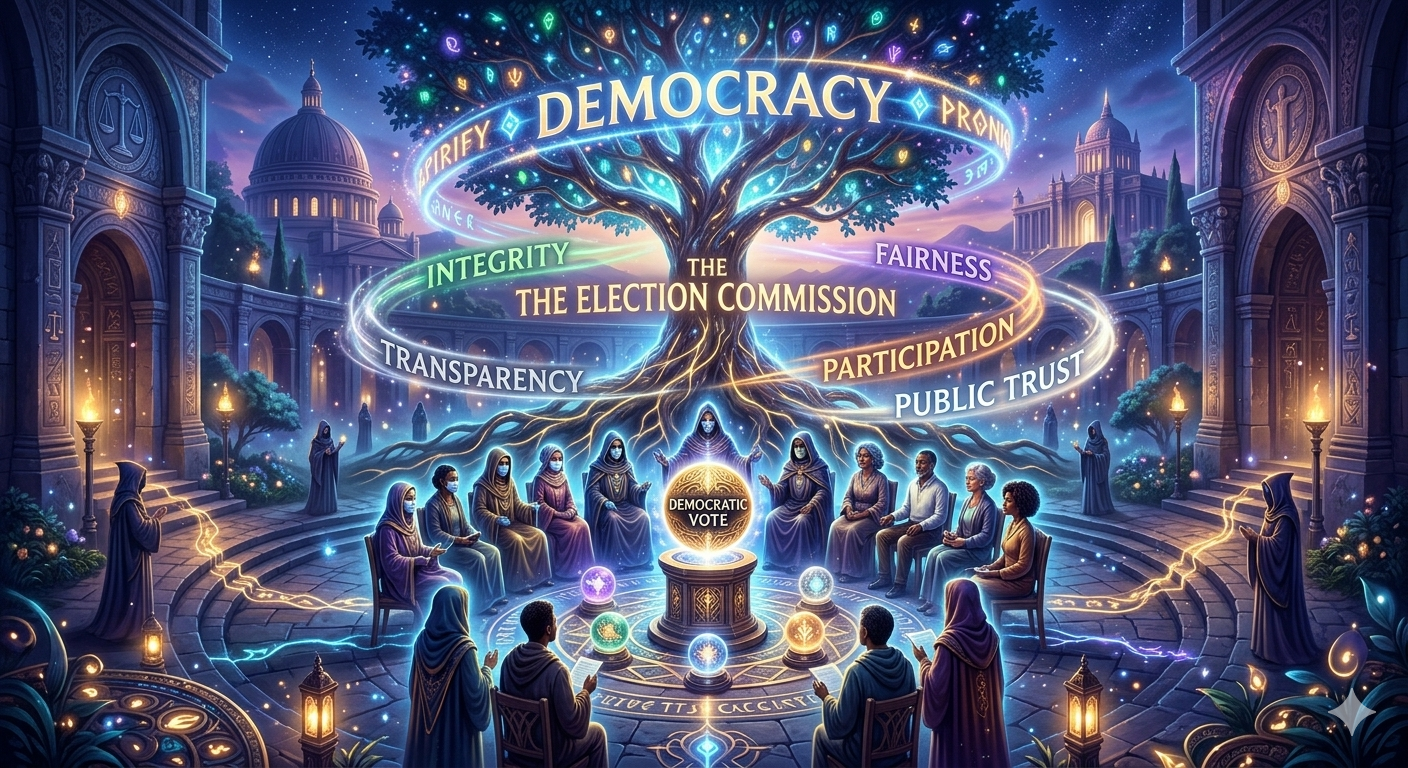
Democracy thrives on the principle that the people have the ultimate authority to choose their representatives through periodic elections. For elections to be meaningful and legitimate, they must be conducted in a free, fair, transparent, and impartial manner. In India, this crucial responsibility is entrusted to the Election Commission of India.
The Election Commission is one of the most important constitutional institutions responsible for safeguarding the democratic process in the country. It ensures that elections to Parliament, State Legislatures, and the offices of the President and Vice-President are conducted in accordance with constitutional provisions and electoral laws.
The role of the Election Commission goes far beyond simply organizing elections. It acts as the guardian of electoral integrity, ensuring that citizens can exercise their voting rights freely and without intimidation. By maintaining transparency, fairness, and accountability in elections, the Commission strengthens the foundations of democracy in India.
Constitutional Basis of the Election Commission
Establishment under the Constitution
The Election Commission of India derives its authority from Article 324 of the Constitution of India, which provides for the creation of an independent constitutional body responsible for supervising, directing, and controlling elections in India.
This article empowers the Election Commission to manage the entire electoral process and ensures that it operates independently of political influence.
Composition of the Commission
Originally, the Election Commission consisted of only one official known as the Chief Election Commissioner. However, over time the structure evolved into a multi-member body.
The Commission currently includes:
- The Chief Election Commissioner of India
- Two Election Commissioners
All members have equal decision-making powers and collectively ensure that the electoral process remains neutral and transparent.
Independence of the Commission
The Constitution provides several safeguards to protect the independence of the Election Commission. These include:
- Security of tenure for the Chief Election Commissioner
- Removal procedures similar to those of Supreme Court judges
- Financial independence through the Consolidated Fund of India
These safeguards ensure that the Commission can perform its duties without external interference.
Functions of the Election Commission of India
The Election Commission performs a wide range of administrative, regulatory, and advisory functions that help maintain the credibility of elections.
Conducting National and State Elections
One of the primary functions of the Election Commission of India is to conduct elections to:
- The Lok Sabha
- The Rajya Sabha
- State Legislative Assemblies
- The offices of the President and Vice-President
The Commission prepares election schedules, coordinates polling arrangements, and ensures the proper counting of votes.
Preparation and Maintenance of Electoral Rolls
Another important responsibility of the Election Commission is the preparation and maintenance of accurate electoral rolls. These voter lists include the names of all eligible citizens who have the right to vote.
The Commission ensures that:
- Every eligible citizen is registered as a voter
- Duplicate or fraudulent entries are removed
- Electoral rolls are regularly updated
This process is crucial for ensuring universal adult franchise in India.
Delimitation of Constituencies
Delimitation refers to the process of determining the boundaries of electoral constituencies. Although this process is primarily carried out by the Delimitation Commission of India, the Election Commission plays a supportive role in implementing delimitation decisions.
Proper delimitation ensures fair representation by maintaining roughly equal population distribution across constituencies.
Powers of the Election Commission in Ensuring Free and Fair Elections
Supervisory Powers
Under Article 324 of the Constitution of India, the Election Commission has the authority to supervise, direct, and control the entire electoral process.
This includes:
- Monitoring election campaigns
- Regulating political parties
- Ensuring adherence to election laws
The Commission can intervene whenever it observes irregularities or violations during elections.
Enforcement of the Model Code of Conduct
To maintain fairness during elections, the Election Commission enforces the Model Code of Conduct. This code outlines ethical guidelines for political parties and candidates during election campaigns.
The Model Code of Conduct prohibits activities such as:
- Misuse of government resources for campaign purposes
- Hate speech and communal appeals
- Bribery and voter intimidation
Although the code is not a statutory law, its strict enforcement has significantly improved the fairness of electoral campaigns.
Registration and Regulation of Political Parties
The Election Commission has the authority to register political parties under the Representation of the People Act 1951.
It also determines whether a political party qualifies as a national or state party based on its electoral performance.
This regulatory function ensures that political parties operate within the framework of democratic norms and electoral laws.
Allocation of Election Symbols
In India, election symbols play an important role because they help voters identify political parties and candidates, particularly in rural areas where literacy levels may vary.
The Election Commission is responsible for allocating and regulating election symbols to recognized political parties and independent candidates.
Role in Strengthening Democratic Participation
Promoting Voter Awareness
The Election Commission actively promotes voter awareness through various campaigns and educational programs. One of its key initiatives is the Systematic Voters’ Education and Electoral Participation Program.
This program aims to:
- Encourage voter registration
- Increase voter turnout
- Educate citizens about their electoral rights and responsibilities
Such initiatives strengthen democratic participation and ensure that elections reflect the true will of the people.
Ensuring Universal Adult Franchise
India follows the principle of universal adult franchise, which means that every citizen above the age of 18 has the right to vote.
The Election Commission ensures that:
- Voters from remote and marginalized communities are included
- Polling stations are accessible to persons with disabilities
- Special arrangements are made for elderly voters
These measures help ensure inclusive and participatory elections.
Use of Technology in Electoral Processes
Electronic Voting Machines
To improve efficiency and transparency, the Election Commission introduced Electronic Voting Machine in elections. These machines replaced traditional paper ballots and helped reduce errors, fraud, and delays in vote counting.
EVMs have significantly streamlined the voting process and enhanced the credibility of election results.
Voter Verifiable Paper Audit Trail
To further enhance transparency, the Commission introduced the Voter Verifiable Paper Audit Trail system.
This technology allows voters to verify that their vote has been correctly recorded. It also provides a paper trail that can be used for auditing election results if necessary.
Challenges Faced by the Election Commission
Despite its strong constitutional status, the Election Commission faces several challenges in maintaining the integrity of elections.
Influence of Money Power
The use of excessive money during election campaigns is a major concern. Political parties and candidates sometimes attempt to influence voters through financial incentives or expensive campaign activities.
Criminalization of Politics
Another challenge is the participation of candidates with criminal backgrounds in elections. Although electoral laws require candidates to disclose criminal records, stronger reforms are needed to address this issue.
Misuse of Social Media
The rapid growth of social media has created new challenges for the Election Commission. False information, fake news, and online propaganda can influence voter perceptions and disrupt fair elections.
Political Pressure
As a powerful constitutional body, the Election Commission occasionally faces criticism or pressure from political parties. Maintaining neutrality and public trust remains a critical responsibility.
Reforms and Measures to Strengthen the Election Commission
Electoral Reforms
Several reforms have been suggested to improve the electoral system and strengthen the role of the Election Commission. These include:
- Strict regulation of campaign financing
- Disqualification of candidates with serious criminal charges
- Greater transparency in political funding
Strengthening Institutional Independence
Experts have recommended improving the appointment process of Election Commissioners to ensure greater independence and neutrality.
Technological Innovations
The adoption of advanced technologies such as secure digital voter registration systems and improved election monitoring tools can enhance transparency and efficiency in elections.
Importance of the Election Commission in Indian Democracy
The Election Commission plays a crucial role in ensuring the stability and legitimacy of India’s democratic system. Its work helps maintain public confidence in the electoral process.
The Commission contributes to democracy by:
- Protecting the right to vote
- Ensuring free and fair elections
- Promoting transparency and accountability
- Strengthening democratic participation
Without an independent and efficient Election Commission, the democratic system would face serious challenges.
Conclusion
The Election Commission of India is a cornerstone of India’s democratic framework. Established under Article 324 of the Constitution of India, it plays a vital role in conducting free, fair, and transparent elections across the country.
Through its powers and functions—such as managing electoral rolls, regulating political parties, enforcing the Model Code of Conduct, and implementing technological innovations—the Commission ensures that elections reflect the genuine will of the people.
Despite facing challenges such as money power, misinformation, and political pressures, the Election Commission continues to safeguard the integrity of India’s democratic system. Strengthening this institution through electoral reforms, technological advancements, and enhanced independence will further reinforce democratic governance in the country.
Ultimately, the Election Commission acts as the guardian of electoral democracy in India, ensuring that the voice of every citizen is heard and respected through the ballot.