Introduction
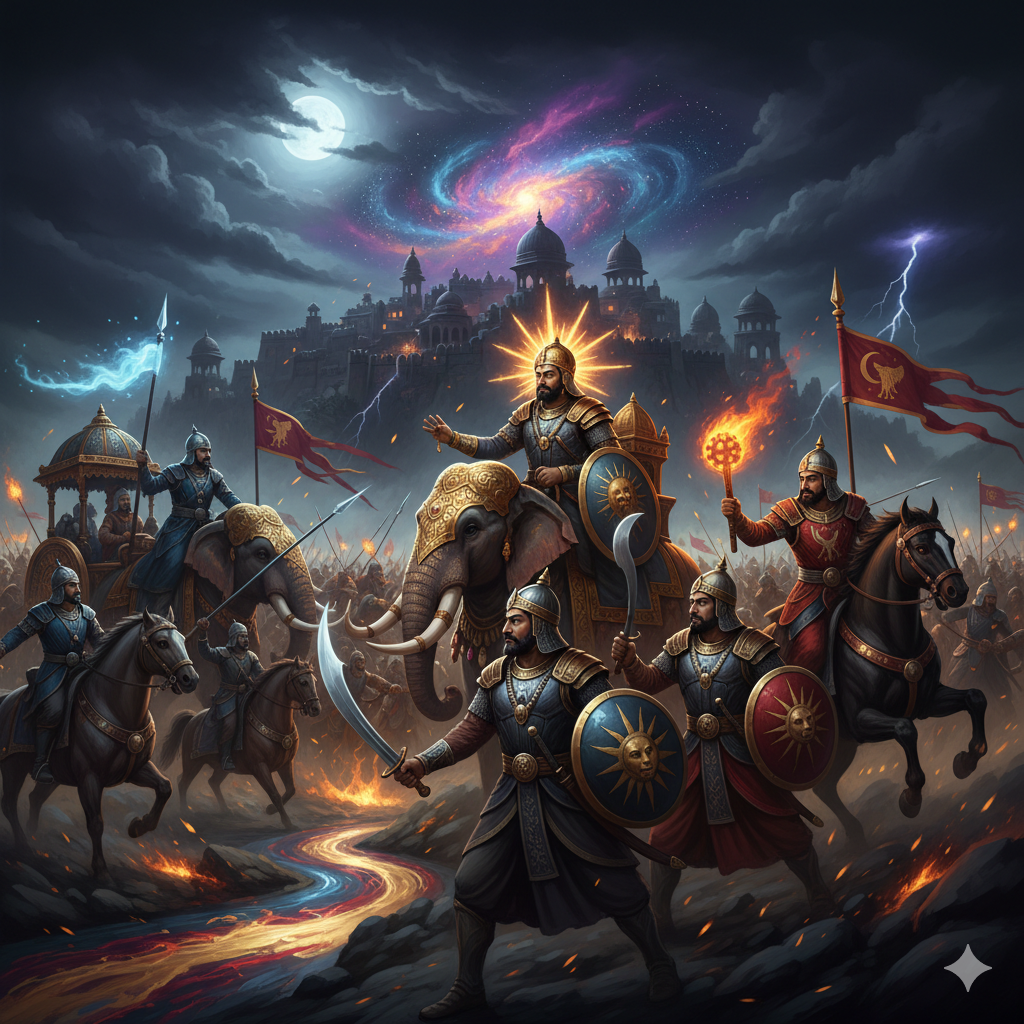
The post-Gupta period in Indian history represents a complex era of political fragmentation, regional assertion, and intense power rivalry among emerging dynasties. After the decline of the Gupta Empire in the 6th century CE, northern India witnessed the rise of several powerful kingdoms, each seeking to establish its supremacy over the fertile and strategically important Gangetic plains. One of the most significant and defining conflicts of this era was the Tripartite Struggle (Tripakshiya Sangharsh) for control over Kannauj, a prominent city located in present-day Uttar Pradesh.
Kannauj, owing to its geographical position and political prestige, became the focal point of contention between three powerful dynasties — the Palas of Bengal, the Pratiharas of western India, and the Rashtrakutas of the Deccan. This prolonged struggle, spanning nearly two centuries, had far-reaching political, economic, and cultural implications for the Indian subcontinent. It symbolizes not only the quest for regional dominance but also the shifting nature of political power in early medieval India.
Historical Background: The Decline of the Gupta Empire
The Gupta Empire (4th–6th century CE) is often referred to as the “Golden Age” of ancient India due to its remarkable achievements in arts, science, literature, and governance. However, by the mid-6th century CE, the empire began to disintegrate due to internal weaknesses, Hun invasions, and administrative decline.
As central authority weakened, regional powers asserted independence in different parts of northern and eastern India. The vacuum left by the fall of the Guptas gave rise to several new political entities, including:
- The Maukharis of Kannauj
- The Later Guptas of Magadha
- The Gaudas of Bengal
- The Pushyabhutis of Thanesar
Among these, the Pushyabhuti dynasty under Harshavardhana (606–647 CE) successfully unified northern India for a brief period. Harsha made Kannauj his capital and transformed it into a flourishing center of administration and culture. However, after his death without an heir, his empire quickly disintegrated. This fragmentation once again led to regional rivalries and struggles for power — setting the stage for the future Tripartite Struggle.
The Rise of Kannauj as a Political Centre
Strategic and Economic Importance of Kannauj
Kannauj’s prominence in the post-Gupta period can be attributed to its strategic location and economic prosperity. Situated on the banks of the River Ganga, it served as a key node on trade routes connecting eastern, western, and northern India. The fertile plains surrounding Kannauj made it agriculturally rich and capable of sustaining large populations and armies.
Additionally, being located almost in the center of northern India, Kannauj was a gateway to political dominance. Any ruler controlling Kannauj could effectively influence both eastern and western regions of the subcontinent. Its prestige as the former capital of Harshavardhana also made it a symbol of legitimate imperial authority in northern India.
The Emergence of the Three Rival Powers
1. The Gurjara-Pratiharas
The Gurjara-Pratiharas rose to prominence in western and northern India, with their initial base in Rajasthan and later capital at Kanauj itself. Founded by Nagabhata I (8th century CE), the dynasty reached its zenith under Mihira Bhoja (836–885 CE) and Mahendrapala I. They were known for their military strength and patronage of Hinduism. Their ambition to control the rich Gangetic plains and secure trade routes drew them into conflict over Kannauj.
2. The Palas of Bengal
The Pala dynasty, founded by Gopala around 750 CE in Bengal, was a dominant power in eastern India. His successor, Dharmapala (770–810 CE), extended the empire westward and aimed to restore the imperial tradition of Harshavardhana by controlling Kannauj. The Palas were Buddhist rulers and patrons of famous institutions like Nalanda and Vikramashila, reflecting their cultural and intellectual prestige.
3. The Rashtrakutas of the Deccan
The Rashtrakutas, originating from the Deccan plateau, emerged as a powerful empire under Dantidurga and later under Dhruva Dharavarsha and Govinda III. With their capital at Manyakheta (modern Karnataka), the Rashtrakutas controlled vast territories across central and southern India. Their ambitions to extend influence into northern India and to control the lucrative trade routes of the Gangetic region brought them into direct conflict with the northern dynasties.
Causes of the Tripartite Struggle
1. Strategic Importance of Kannauj
Kannauj’s position as the gateway to northern India and its proximity to key trade routes made it a prize of immense strategic value. Controlling Kannauj meant dominance over northern India and access to both eastern and western markets.
2. Economic Significance
The region around Kannauj was agriculturally prosperous and rich in resources. Control over its revenues provided financial strength to sustain large armies and extensive administrations.
3. Political Legitimacy
Since Harshavardhana’s reign, Kannauj had become a symbol of imperial authority. Each of the three dynasties sought to claim the mantle of the “successor to Harsha” by capturing Kannauj, thereby legitimizing their rule and asserting supremacy over rival powers.
4. Religious and Cultural Rivalries
The Palas were major patrons of Buddhism, while the Pratiharas were staunch Hindus, and the Rashtrakutas, though tolerant, leaned toward Shaivism and Jainism. This religious diversity occasionally influenced their political motivations and alliances.
5. Control of Northern Trade Routes
Kannauj was located at the crossroads of ancient trade routes linking Bengal, the Deccan, and northwestern India. Control of Kannauj meant control over inland trade and tribute networks that were vital for economic expansion.
Phases of the Tripartite Struggle
Phase I: The Initial Expansion (8th Century CE)
The conflict began when Dharmapala of the Pala dynasty expanded westward after consolidating his power in Bengal and Bihar. He invaded northern India and captured Kannauj, installing a local ruler, Chakrayudha, as his vassal.
However, Vatsaraja, the Pratihara ruler, challenged Dharmapala and defeated his forces near Kannauj. In turn, the Rashtrakuta king Dhruva Dharavarsha invaded northern India, defeating both Vatsaraja and Dharmapala around 790 CE. This marked the first clear instance of three-way rivalry among the Palas, Pratiharas, and Rashtrakutas.
Phase II: Intensification under Successors (9th Century CE)
After Dhruva’s death, his son Govinda III (793–814 CE) continued the northern campaigns. He again defeated Dharmapala and advanced as far as the Himalayas, making the Pratihara ruler Nagabhata II submit to his authority. However, the Rashtrakutas could not maintain direct control over the distant north and soon withdrew.
Taking advantage of this, Nagabhata II reasserted Pratihara power and occupied Kannauj, temporarily establishing it as his capital. Dharmapala’s son, Devapala (810–850 CE), later renewed hostilities but failed to dislodge the Pratiharas.
Thus, by the mid-9th century, the Gurjara-Pratiharas emerged as the dominant power in northern India, though the Palas retained control of the eastern territories.
Phase III: The Zenith of Pratihara Power (9th–10th Century CE)
Under Mihira Bhoja (836–885 CE), the Pratiharas consolidated their power and firmly established Kannauj as their imperial capital. Bhoja adopted the title “Adivaraha”, signifying his divine and sovereign status. His reign marked the height of Pratihara power, as the dynasty successfully repelled Rashtrakuta invasions and maintained control over the Gangetic plains.
During this phase, Devapala of the Palas concentrated on eastern India, while the Rashtrakutas under Amoghavarsha I focused on consolidating their southern territories. The struggle over Kannauj temporarily subsided, though rivalries persisted.
Phase IV: Decline of the Rivals (10th Century CE)
By the 10th century CE, all three dynasties began to weaken due to internal dissension and external invasions:
- The Pratiharas, after Mahendrapala I, faced feudal revolts and attacks from the Rashtrakutas and Paramaras.
- The Palas suffered decline after Devapala due to weak successors and growing independence of vassal states.
- The Rashtrakutas, after Indra III and Krishna III, also declined due to dynastic disputes.
Ultimately, the Pratiharas lost control of Kannauj by the early 11th century, when it was captured by Mahmud of Ghazni (1018 CE). The long-drawn Tripartite Struggle had exhausted the resources of all three dynasties, paving the way for new political forces like the Chandelas, Gahadavalas, and later, the Delhi Sultanate.
Consequences of the Tripartite Struggle
1. Political Consequences
- Weakening of Northern India:
The prolonged wars between the three dynasties drained their resources and destabilized northern India, making it vulnerable to foreign invasions. - Rise of Regional Kingdoms:
The decline of these imperial powers led to the rise of regional dynasties such as the Chandelas of Bundelkhand, the Kalachuris of Tripuri, and the Gahadavalas of Kannauj. - End of Imperial Unity:
Unlike the Gupta or Harsha periods, India remained politically fragmented. No single power could unite the subcontinent again until the Delhi Sultanate.
2. Economic Consequences
- Disruption of Trade and Agriculture:
Continuous warfare disrupted trade routes and destroyed agricultural productivity in the Gangetic plains. This resulted in economic stagnation in many regions. - Decline of Kannauj’s Prosperity:
Once a thriving metropolis, Kannauj suffered from repeated invasions and plundering. By the 11th century, its prominence as a trade and cultural hub had faded.
3. Cultural and Religious Consequences
- Cultural Exchange among Regions:
Despite political turmoil, this period saw rich cultural interactions between Bengal, the Deccan, and northern India. The spread of art styles, religious thought, and architecture was facilitated by movement of people and ideas. - Patronage of Learning and Religion:
The Palas continued to support Buddhist universities like Nalanda and Vikramashila, while the Pratiharas encouraged the revival of Hindu temple architecture. The Rashtrakutas, too, left behind marvels like the Ellora Kailasa Temple. - Blending of Cultural Traditions:
The struggle indirectly fostered a synthesis of artistic and cultural traditions from north and south India.
4. Military Consequences
- Expansion of Cavalry and Fortifications:
The extensive wars led to innovations in military organization, including the use of cavalry and improved fortifications. - Decline of Imperial Armies:
However, the long conflicts depleted the military capacities of the three empires, leaving northern India exposed to future invasions by foreign powers.
5. Impact on Future Indian Politics
The exhaustion of the three dynasties created a power vacuum that facilitated the rise of new political entities. When Mahmud of Ghazni invaded northern India in the early 11th century, he faced little organized resistance. The disunity that characterized post-Tripartite India thus directly contributed to the eventual establishment of Muslim rule in northern India.
Assessment of the Tripartite Struggle
The Tripartite Struggle of Kannauj stands as a turning point in Indian history. While it was ostensibly a military conflict over territorial control, it also represented deeper political and ideological aspirations. Each of the three powers sought not merely to conquer Kannauj, but to claim the symbolic legacy of imperial sovereignty once held by the Guptas and Harshavardhana.
However, the long and exhausting nature of the struggle brought more harm than benefit. The absence of a unifying power weakened the subcontinent’s northern region and marked the end of an era of centralized imperial governance. Yet, the cultural vitality of the period — evident in art, architecture, and literature — demonstrates that even amidst political chaos, India’s civilizational continuity remained strong.
Conclusion
The Tripartite Struggle for Kannauj in the post-Gupta period encapsulates the dynamic interplay of power, ambition, and regionalism in early medieval India. Originating from the political vacuum left after Harsha’s death, it drew three major dynasties — the Palas, Pratiharas, and Rashtrakutas — into a prolonged contest for supremacy over northern India.
The struggle’s causes lay in Kannauj’s strategic, economic, and symbolic importance, while its consequences were far-reaching: political fragmentation, economic decline, and eventual foreign domination. Yet, it also contributed indirectly to cultural diffusion and regional diversity, shaping the trajectory of Indian civilization for centuries to come.
Kannauj thus stands not merely as a city of past glory but as a historical symbol of India’s transition from ancient imperial unity to the complex regional politics of the medieval era — a transition that set the stage for the later transformations under the Delhi Sultanate and the Mughals.