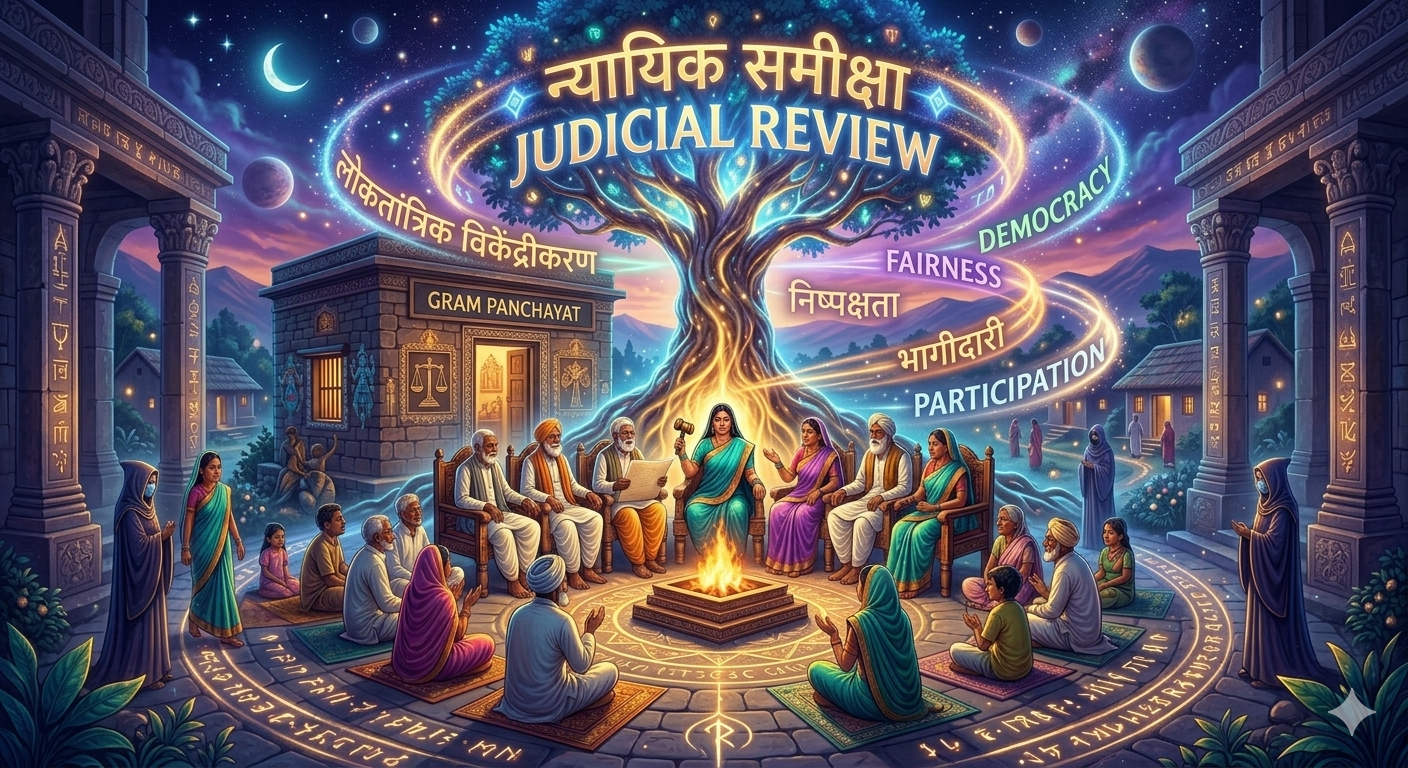
Judicial review is one of the most important features of the constitutional system of India. It refers to the power of the judiciary to examine the constitutionality of laws, executive actions, and administrative decisions. If any law or government action violates the Constitution, the judiciary has the authority to declare it unconstitutional and invalid.
In India, this power is primarily exercised by the Supreme Court of India and the High Courts of India. Judicial review ensures that the government functions within the limits of the Constitution and respects the fundamental rights of citizens.
The concept of judicial review plays a crucial role in maintaining the supremacy of the Constitution, protecting democratic values, and preventing misuse of power by legislative and executive authorities.
Meaning and Concept of Judicial Review
Definition of Judicial Review
Judicial review can be defined as the power of courts to review and evaluate the constitutionality of legislative acts, executive decisions, and administrative policies.
If the judiciary finds that any law or action violates constitutional provisions, it can declare such measures void and unenforceable.
In simple terms, judicial review ensures that:
- The Constitution remains the supreme law of the land
- Government authorities do not exceed their powers
- Citizens’ rights are protected
Origin of the Concept
The concept of judicial review originated in the United States through the famous case of Marbury v. Madison. In this landmark decision, the US Supreme Court established the principle that courts have the authority to review laws and declare them unconstitutional if they violate the Constitution.
India adopted this concept while framing its Constitution to ensure checks and balances among different branches of government.
Constitutional Basis of Judicial Review in India
Constitutional Provisions
Judicial review in India is derived from several constitutional provisions that empower courts to protect the Constitution and citizens’ rights.
Important provisions include:
- Article 13 – declares that any law violating fundamental rights is void.
- Article 32 – gives citizens the right to approach the Supreme Court for enforcement of fundamental rights.
- Article 226 – empowers High Courts to issue writs for protecting fundamental rights and other legal rights.
- Article 131 and Article 136 – provide the Supreme Court authority to examine constitutional matters.
These provisions collectively establish the foundation of judicial review in the Indian constitutional system.
Role of the Constitution as Supreme Law
The Constitution of India is the supreme law of the country. All laws and government actions must conform to its provisions. Judicial review ensures that the legislative and executive branches operate within constitutional limits.
Thus, judicial review acts as a safeguard against arbitrary governance.
Role of the Supreme Court in Judicial Review
Constitutional Guardian of the Nation
The Supreme Court of India is the highest judicial authority in the country and plays a central role in exercising judicial review.
As the guardian of the Constitution, the Supreme Court ensures that:
- Parliamentary laws comply with constitutional provisions
- Government policies do not violate fundamental rights
- Federal balance between the Union and states is maintained
Power to Protect Fundamental Rights
Under Article 32, citizens can directly approach the Supreme Court when their fundamental rights are violated.
The Court can issue various writs such as:
- Habeas Corpus
- Mandamus
- Prohibition
- Certiorari
- Quo Warranto
These writs enable the Court to enforce constitutional rights and prevent misuse of governmental power.
Judicial Review of Constitutional Amendments
The Supreme Court also has the authority to review constitutional amendments passed by Parliament.
In the historic Kesavananda Bharati v. State of Kerala, the Court introduced the Basic Structure Doctrine.
According to this doctrine, Parliament can amend the Constitution but cannot alter its basic structure, which includes principles such as:
- Rule of law
- Separation of powers
- Judicial independence
- Federalism
- Fundamental rights
This doctrine significantly strengthened judicial review in India.
Role of High Courts in Judicial Review
Constitutional Authority of High Courts
The High Courts of India also exercise judicial review within their respective jurisdictions.
Under Article 226, High Courts have broader powers than the Supreme Court because they can issue writs not only for fundamental rights but also for other legal rights.
Supervisory Jurisdiction
High Courts supervise the functioning of subordinate courts and administrative authorities within their states. They ensure that public authorities act within the scope of law.
Through judicial review, High Courts can:
- Invalidate unconstitutional state laws
- Review administrative decisions
- Protect citizens against arbitrary actions of government officials
This role makes High Courts an important pillar of constitutional governance.
Significance of Judicial Review in the Indian Constitutional System
Protection of Fundamental Rights
One of the most important functions of judicial review is the protection of fundamental rights.
Courts act as guardians of these rights and ensure that no law or government policy infringes upon the liberties guaranteed to citizens.
Without judicial review, citizens would have limited protection against misuse of governmental power.
Maintaining Constitutional Supremacy
Judicial review ensures that the Constitution remains the supreme law of the land.
By examining the validity of laws and policies, the judiciary prevents the legislature and executive from exceeding their constitutional authority.
Ensuring Rule of Law
Judicial review promotes the principle of rule of law, which means that all individuals and institutions are subject to the law.
It ensures that government actions are based on legal authority rather than arbitrary power.
Maintaining Balance of Power
The Indian Constitution establishes a system of checks and balances among the three branches of government:
- Legislature
- Executive
- Judiciary
Judicial review enables the judiciary to check the actions of the other two branches and maintain balance in governance.
Strengthening Democracy
By protecting citizens’ rights and ensuring accountability of the government, judicial review strengthens democratic governance.
It ensures that public authorities remain answerable to constitutional principles.
Landmark Judgments Demonstrating Judicial Review
Golaknath Case
In the case of Golaknath v. State of Punjab, the Supreme Court ruled that Parliament could not amend fundamental rights. Although this judgment was later modified, it highlighted the judiciary’s role in protecting constitutional rights.
Kesavananda Bharati Case
The landmark decision in Kesavananda Bharati v. State of Kerala established the Basic Structure Doctrine, which limited Parliament’s power to amend the Constitution.
This judgment is considered one of the most important milestones in the evolution of judicial review in India.
Minerva Mills Case
In Minerva Mills v. Union of India, the Supreme Court reaffirmed the Basic Structure Doctrine and emphasized that limited government and judicial review are essential features of the Constitution.
Limitations of Judicial Review
Although judicial review is essential for constitutional governance, it also has certain limitations.
Judicial Overreach
Critics sometimes argue that courts exceed their authority by interfering excessively in legislative or executive matters. Such actions are often referred to as judicial activism or judicial overreach.
Delay in Judicial Process
The judicial system in India often faces delays due to a large number of pending cases. This can slow down the effectiveness of judicial review.
Lack of Implementation
Even when courts declare laws unconstitutional, effective implementation of judgments sometimes faces administrative challenges.
Conclusion
Judicial review is a fundamental component of the Indian constitutional system. It empowers the judiciary to examine the validity of laws and government actions to ensure that they conform to constitutional principles.
The Supreme Court of India and the High Courts of India play a vital role in exercising this power. Through judicial review, these courts protect fundamental rights, maintain constitutional supremacy, and ensure the rule of law.
Landmark judgments such as Kesavananda Bharati v. State of Kerala have further strengthened this doctrine by establishing the Basic Structure principle.
Despite certain challenges, judicial review remains an essential safeguard for democracy in India. It ensures that the Constitution continues to guide the functioning of the government and protects the rights and freedoms of citizens.