Introduction
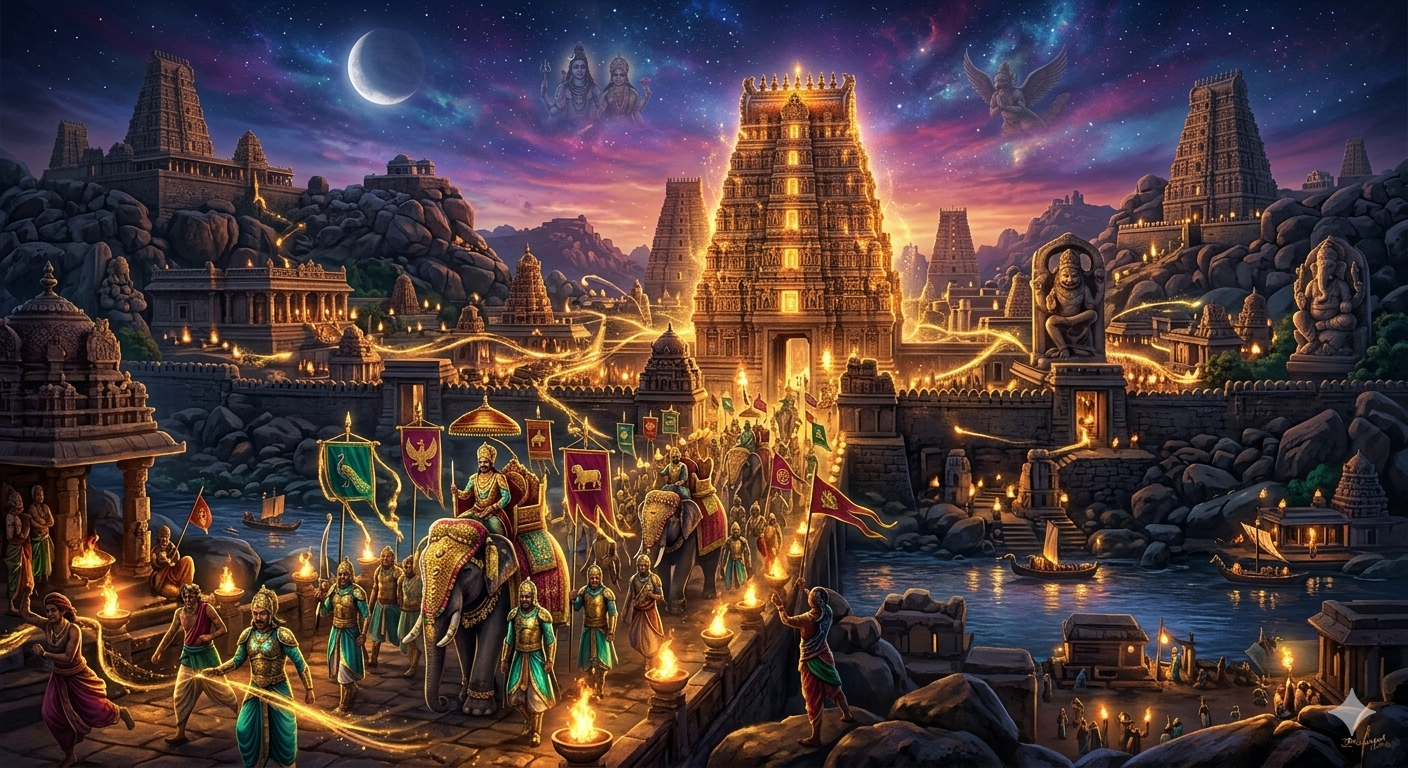
The Vijayanagara Empire (1336–1646 CE) represents one of the most remarkable phases in South Indian history, particularly in terms of cultural development. Established by Harihara and Bukka under the guidance of Vidyaranya, the empire emerged as a powerful political and cultural center in peninsular India. At a time when much of North India was under the Delhi Sultanate, Vijayanagara acted as a stronghold of indigenous traditions while simultaneously embracing cultural synthesis.
The cultural contributions of the Vijayanagara Empire span across architecture, literature, art, religion, language, music, and social life. These contributions not only enriched South Indian culture but also left a lasting legacy on Indian civilization as a whole.
Architectural Contributions
Temple Architecture as the Cultural Core
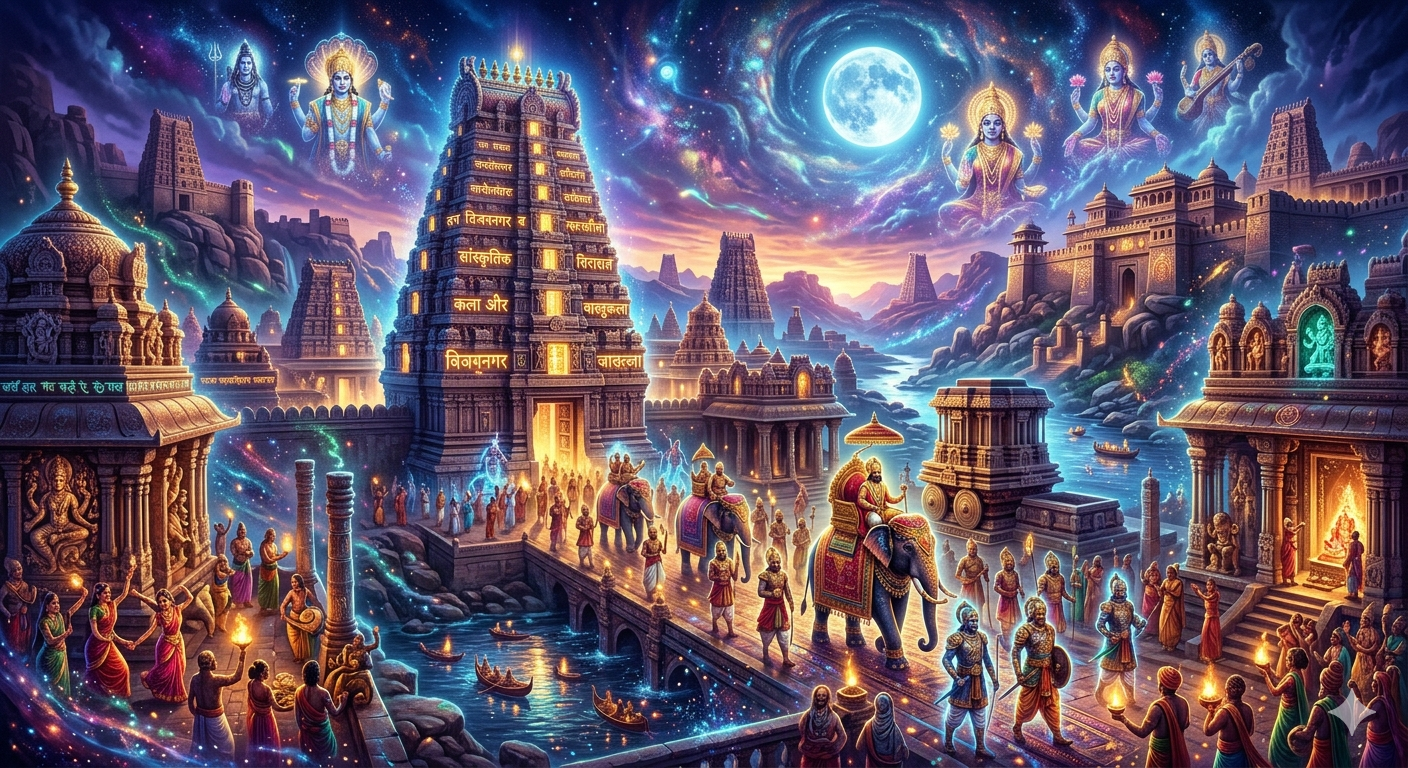
Architecture was the most prominent cultural expression of the Vijayanagara Empire. Temples were not merely religious centers but also hubs of economic, social, and artistic activities.
- The Vijayanagara style of temple architecture is characterized by large temple complexes, gopurams (towering gateways), and mandapas (pillared halls).
- Temples such as Virupaksha Temple and Vittala Temple at Hampi are prime examples.
- The use of granite gave durability and grandeur to the structures.
Distinctive Features of Vijayanagara Architecture
- Rayagopurams: Tall and elaborately decorated gateway towers became a hallmark.
- Musical Pillars: Found in the Vittala Temple, these pillars produce musical notes when struck.
- Kalyana Mandapas: Used for ceremonial purposes, especially divine marriages.
- Stone Chariots: Symbolic and artistic representations, as seen in Hampi.
Urban Planning and City Design
- The capital city Hampi was well-planned with fortifications, water systems, markets, and residential zones.
- Foreign travelers like Domingo Paes and Niccolò de’ Conti described it as one of the largest and richest cities in the world.
- The integration of natural landscapes with architecture showed advanced planning.
Literary Contributions
Development of Regional Languages
The Vijayanagara Empire was a major patron of literature in regional languages, especially:
- Telugu – Reached its golden age.
- Kannada – Continued its classical tradition.
- Tamil and Sanskrit – Also received royal support.
Telugu Literature: The Golden Age
- The reign of Krishnadevaraya is often called the Golden Age of Telugu Literature.
- The court had the famous Ashtadiggajas (Eight Scholars).
Important Contributions:
- Krishnadevaraya himself authored Amuktamalyada.
- Poets like Allasani Peddana (known as Andhra Kavita Pitamaha) enriched Telugu literature.
Sanskrit and Kannada Literature
- Scholars produced works on philosophy, religion, grammar, and poetry.
- Madhavacharya and Sayana contributed to Vedic literature.
- Kannada literature saw works in both religious and secular themes.
Religious and Philosophical Contributions
Religious Tolerance and Pluralism
The Vijayanagara rulers were primarily followers of Hinduism, but they practiced religious tolerance.
- Patronage was extended to Shaivism, Vaishnavism, and Shaktism.
- Jainism and even Islam were allowed to coexist peacefully.
Revival of Hindu Traditions
- The empire played a crucial role in reviving and preserving Hindu culture during a period of political instability.
- Temples were restored and new ones constructed.
Bhakti Movement Influence
- The Bhakti movement flourished under Vijayanagara patronage.
- Saints and poets spread ideas of devotion and social equality.
Artistic Contributions
Sculpture and Iconography
- Sculpture was an integral part of temple architecture.
- Intricate carvings depicted mythological scenes, deities, dancers, and animals.
- Emphasis on realism and dynamic movement.
Painting and Murals
- Though fewer paintings survive, temple murals indicate a vibrant tradition.
- Themes included religious narratives and court life.
Bronze and Metal Art
- Skilled artisans produced idols and decorative items.
- Metalwork reflected high craftsmanship and religious devotion.
Music and Dance
Development of Carnatic Music
- The Vijayanagara period saw the early development of Carnatic music.
- Royal patronage encouraged musicians and composers.
Role of Temples in Performing Arts
- Temples acted as centers for music and dance performances.
- Devadasi system was associated with temple arts.
Dance Traditions
- Classical dance forms like Bharatanatyam evolved during this period.
- Dance was both a religious offering and a form of entertainment.
Social and Cultural Life
Festivals and Celebrations
- Festivals like Dussehra (Mahanavami) were celebrated with grandeur.
- Public participation reflected cultural unity and prosperity.
Status of Women
- Women participated in cultural activities like music and dance.
- Some royal women were educated and influential.
- However, practices like child marriage and devadasi system also existed.
Dress, Food, and Lifestyle
- Rich cultural diversity in clothing and cuisine.
- Foreign travelers noted the prosperity and vibrant lifestyle of people.
Economic and Cultural Linkages
Trade and Cultural Exchange
- Vijayanagara had strong trade relations with Arab, Persian, and European traders.
- Cultural exchange influenced art, architecture, and daily life.
Patronage System
- Kings and nobles supported artists, scholars, and craftsmen.
- This patronage ensured the flourishing of culture.
Language and Education
Multilingual Culture
- The empire encouraged the use of multiple languages.
- Sanskrit remained the language of scholarship, while regional languages flourished.
Centers of Learning
- Temples and mathas (monasteries) acted as educational centers.
- Knowledge in religion, philosophy, astronomy, and medicine was promoted.
Influence on South Indian Culture
Legacy in Architecture
- The Vijayanagara style influenced later South Indian temple architecture.
- Nayaka rulers continued this tradition.
Cultural Continuity
- Many traditions established during this period continue in South India today.
- Festivals, music, and temple rituals still reflect Vijayanagara influence.
Decline and Its Cultural Impact
Battle of Talikota (1565)
- The defeat of Vijayanagara led to the destruction of Hampi.
- However, cultural traditions survived and spread to other regions.
Dispersal of Artists and Scholars
- After the fall, artists migrated to different parts of South India.
- This helped in the wider dissemination of Vijayanagara culture.
Critical Evaluation
Strengths of Vijayanagara Culture
- Strong patronage led to flourishing arts and literature.
- Cultural synthesis without losing indigenous identity.
- Preservation and promotion of Hindu traditions.
Limitations
- Cultural development was often centered around temples and elites.
- Social inequalities and rigid caste structures persisted.
Conclusion
The Vijayanagara Empire stands as a monumental chapter in Indian cultural history. Its contributions in architecture, literature, religion, music, and social life were profound and far-reaching. The empire not only preserved traditional Indian culture during a period of political upheaval but also enriched it through innovation and synthesis.
Despite its eventual decline, the cultural legacy of Vijayanagara continues to influence South Indian traditions and remains a symbol of artistic excellence and cultural resilience. Its achievements highlight the importance of patronage, stability, and openness in the growth of civilization.