Introduction
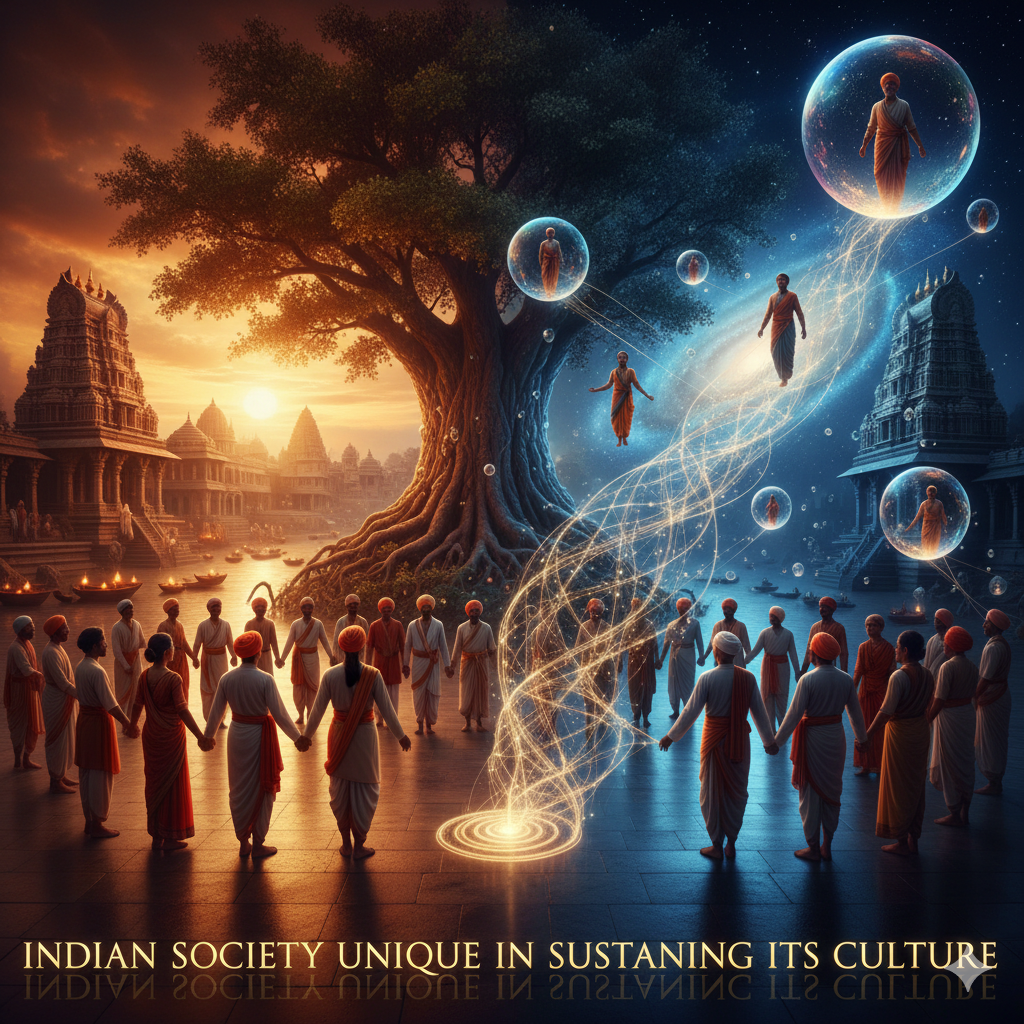
Indian society is often described as one of the oldest living civilizations in the world. Despite centuries of political upheavals, foreign invasions, colonial rule, and rapid modernization, India has remarkably preserved its cultural continuity. From ancient philosophical traditions to everyday social practices, Indian culture continues to thrive alongside modern institutions.
What makes this resilience particularly striking is India’s immense diversity—languages, religions, ethnicities, customs, and lifestyles coexist within a single social framework. Yet, instead of fragmenting, this diversity has largely been woven into a shared civilizational fabric. The uniqueness of Indian society lies not merely in preserving traditions but in its ability to adapt them creatively over time.
This essay explores the key social, cultural, philosophical, and institutional factors that make Indian society unique in sustaining its culture.
Civilizational Continuity and Historical Depth
One of the most distinctive features of Indian society is its uninterrupted civilizational history. Unlike many cultures that experienced complete breaks due to invasions or revolutions, Indian civilization absorbed external influences while retaining its core values.
Ancient ideas related to dharma (duty), karma (action), and moksha (liberation) continue to shape ethical behavior and social outlook even today. Classical texts, epics, and philosophical traditions remain relevant through reinterpretation rather than replacement. This continuity provides cultural stability across generations.
Diversity Within Unity
India’s cultural sustainability rests on its remarkable ability to accommodate diversity.
Pluralistic Social Structure
India is home to multiple religions, languages, and ethnic groups. Instead of enforcing uniformity, Indian society historically encouraged coexistence. Different communities retain distinct identities while participating in shared festivals, markets, and civic life.
This pluralism fosters mutual tolerance and cultural exchange, strengthening collective heritage.
Linguistic and Regional Adaptability
India’s linguistic diversity is another pillar of cultural survival. Regional languages preserve local traditions, folk literature, and oral histories. At the same time, multilingualism enables communication across communities, preventing cultural isolation.
Each region expresses Indian culture in its own way, ensuring richness without fragmentation.
Family System as a Cultural Carrier
The family plays a central role in transmitting cultural values.
Intergenerational Learning
In Indian households, children learn customs, rituals, stories, and moral lessons directly from elders. Festivals, ceremonies, and daily practices reinforce collective memory.
The joint family system, though evolving, historically ensured close intergenerational interaction, making cultural transmission natural and continuous.
Emotional Bonds and Social Responsibility
Strong family ties cultivate respect for elders, community orientation, and social responsibility. These values stabilize society and sustain cultural norms even amid modernization.
Spiritual and Philosophical Foundations
Indian culture is deeply rooted in spiritual inquiry rather than rigid dogma.
Tolerance of Multiple Truths
Indian philosophical traditions emphasize plurality of thought. Concepts like “unity in diversity” and acceptance of different paths to truth encourage intellectual openness.
This flexibility allows traditions to evolve rather than stagnate.
Integration of Material and Spiritual Life
Indian culture does not view spirituality as separate from everyday life. Rituals, ethics, and social duties are interwoven, giving cultural practices practical relevance.
Adaptive Nature of Traditions
Unlike static cultures, Indian traditions demonstrate remarkable adaptability.
Reform From Within
Social reform movements emerged organically to address regressive practices. Thinkers and leaders challenged caste discrimination, gender inequality, and superstition while working within cultural frameworks.
This internal reform mechanism prevented cultural breakdown while enabling progress.
Syncretism and Cultural Fusion
India absorbed influences from Persian, Islamic, European, and other civilizations, integrating them into art, architecture, cuisine, and language. This synthesis enriched Indian culture without erasing indigenous roots.
Role of Rituals, Festivals, and Arts
Cultural expression in India is not confined to elite spaces—it is embedded in everyday life.
Festivals as Cultural Reinforcement
Festivals unite communities across social boundaries, reinforcing shared values and historical memory. They act as living classrooms where traditions are performed rather than merely taught.
Arts and Folk Traditions
Classical dance, music, crafts, and folk arts preserve regional identities while contributing to national culture. These practices remain relevant through adaptation to contemporary themes.
Constitutional Support for Cultural Diversity
Modern India institutionalized cultural preservation through constitutional safeguards.
Freedom of religion, linguistic rights, and cultural autonomy empower communities to protect their heritage. Democratic structures provide space for cultural expression while promoting national integration.
This legal recognition strengthens cultural sustainability in a rapidly changing world.
Education and Knowledge Systems
Traditional and modern education coexist in India.
Ancient centers of learning emphasized holistic development, while contemporary institutions integrate scientific knowledge. The blending of old and new ensures continuity without intellectual stagnation.
Increasing digitization further extends cultural education to wider populations.
Community Institutions and Social Networks
Local institutions such as temples, mosques, gurudwaras, village councils, and cultural associations function as hubs of social life. They preserve customs, mediate conflicts, and organize collective activities.
These grassroots networks sustain cultural practices beyond formal governance structures.
Resilience Amid Globalization
Globalization presents challenges through cultural homogenization, consumerism, and identity shifts. Yet Indian society shows resilience by selectively adopting global influences while preserving core traditions.
Yoga, Ayurveda, Indian cuisine, and festivals now enjoy global recognition, reflecting cultural confidence rather than erosion.
Challenges to Cultural Sustainability
Despite strengths, Indian society faces challenges:
- Urbanization weakening community bonds
- Decline of indigenous languages
- Commercialization of traditions
- Generational gaps in cultural knowledge
Addressing these requires conscious efforts through education, policy, and community engagement.
Way Forward: Strengthening Cultural Continuity
Sustaining India’s cultural uniqueness requires:
- Promoting heritage education
- Supporting local art forms
- Encouraging intercultural dialogue
- Integrating tradition with technology
- Empowering youth participation
Balanced modernization can enhance, rather than replace, cultural values.
Conclusion
Indian society’s uniqueness lies in its ability to preserve continuity while embracing change. Cultural sustainability is achieved not through rigid traditionalism but through adaptability, pluralism, spiritual depth, and strong social institutions.
India demonstrates that culture is not a static inheritance but a living process shaped by dialogue between past and present. By honoring diversity, fostering reform, and integrating tradition with modernity, Indian society offers a powerful model of cultural resilience in a globalized world.