Introduction
The rise of the Maratha power in the 17th century marks a significant turning point in Indian history, particularly in the context of resistance against centralized imperial authority. At the heart of this transformation stood Chhatrapati Shivaji Maharaj, whose visionary leadership, military genius, and administrative acumen laid the foundation of a powerful and enduring state in the Deccan.
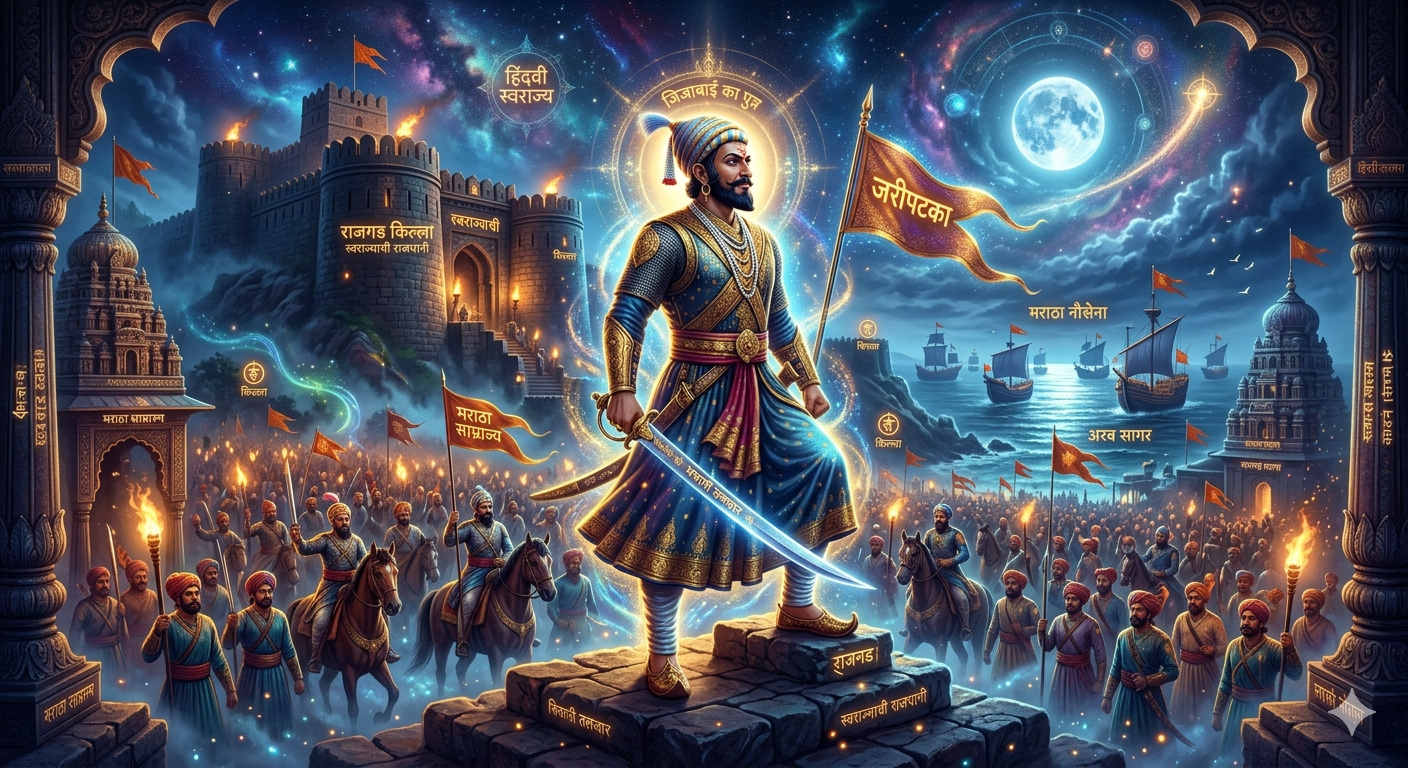
Shivaji not only carved out an independent kingdom from the declining Deccan Sultanates and the expansive Mughal Empire but also established a new political ideology rooted in regional identity and self-rule (Swarajya). His role in the rise of Maratha power was multifaceted, encompassing military innovation, administrative reforms, cultural revival, and strategic diplomacy.
Background: Conditions Favoring the Rise of Maratha Power
Political Situation in the Deccan
Before Shivaji’s rise, the Deccan was marked by political instability.
- The Mughal Empire was expanding southward.
- The Deccan Sultanates like Bijapur and Golconda were weakened by internal conflicts.
- Local chieftains (Deshmukhs) exercised semi-autonomous authority.
This fragmentation created opportunities for a strong leader like Shivaji to consolidate power.
Socio-Economic and Cultural Factors
- The Marathi-speaking population shared a sense of regional identity.
- The Bhakti movement had already fostered unity and social awakening.
- Agrarian distress and heavy taxation created dissatisfaction among peasants.
Shivaji effectively mobilized these factors to build a strong support base.
Shivaji’s Early Life and Influences
Formative Influences
Shivaji’s upbringing played a crucial role in shaping his vision.
- He was influenced by his mother Jijabai, who instilled values of courage and dharma.
- His guardian and mentor Dadoji Konddev trained him in administration and warfare.
- The epics like Ramayana and Mahabharata inspired his ideals of righteous rule.
These influences helped him conceptualize Swarajya.
Military Contributions of Shivaji
Introduction of Guerrilla Warfare (Ganimi Kava)
One of Shivaji’s most significant contributions was his innovative military strategy.
- He adopted guerrilla warfare techniques suited to the rugged terrain of the Western Ghats.
- Surprise attacks, mobility, and intelligence gathering became key features.
- Avoidance of open battles against stronger enemies ensured survival and success.
Impact of Guerrilla Warfare
- Enabled a smaller force to defeat larger armies.
- Disrupted Mughal and Sultanate military strategies.
- Established Maratha dominance in the Deccan hills.
Fort-Based Defense System
Shivaji understood the strategic importance of forts.
- He captured and built numerous forts like Raigad, Pratapgad, and Sinhagad.
- Forts served as administrative centers, military bases, and symbols of authority.
Key Features
- Strong fortifications with natural defenses.
- Efficient supply and communication systems.
- Strategic placement for territorial control.
This network of forts became the backbone of Maratha power.
Naval Power and Coastal Defense
Shivaji was one of the first Indian rulers to recognize the importance of naval strength.
- He developed a navy to protect the Konkan coast.
- Built naval bases and fortified coastal regions.
Significance
- Protected trade routes from foreign powers like the Portuguese.
- Strengthened economic stability.
- Marked the beginning of organized naval defense in India.
Administrative Reforms
Establishment of Efficient Governance
Shivaji laid the foundation of a well-organized administrative system.
- The kingdom was divided into provinces for efficient management.
- Emphasis on accountability and discipline among officials.
Ashta Pradhan Council
Shivaji introduced a council of eight ministers known as the Ashta Pradhan.
Key Positions
- Peshwa (Prime Minister)
- Amatya (Finance Minister)
- Sachiv (Secretary)
- Mantri (Interior Affairs)
- Senapati (Commander-in-Chief)
- Sumant (Foreign Affairs)
- Nyayadhish (Chief Justice)
- Panditrao (Religious Affairs)
Significance
- Ensured division of responsibilities.
- Prevented concentration of power.
- Improved administrative efficiency.
Revenue System
Shivaji reformed the revenue system to benefit peasants.
- Introduced a systematic land measurement system.
- Reduced exploitation by intermediaries.
- Fixed a reasonable share of produce as tax.
Impact
- Increased agricultural productivity.
- Gained the support of peasants.
- Strengthened the economic base of the state.
Religious and Cultural Policies
Policy of Religious Tolerance
Despite being a Hindu ruler, Shivaji followed a secular approach.
- Respected all religions and protected places of worship.
- Appointed Muslims in key positions.
Significance
- Promoted social harmony.
- Strengthened unity among diverse communities.
Promotion of Marathi Culture
- Encouraged the use of Marathi and Sanskrit in administration.
- Patronized literature and local traditions.
This fostered a sense of regional identity and pride.
Diplomatic Skills and Political Strategy
Relations with the Mughals
Shivaji skillfully handled relations with the Mughal Empire.
- He fought against Mughal expansion under Aurangzeb.
- Signed the Treaty of Purandar when necessary.
- Used diplomacy to gain time and consolidate power.
Conflict with Deccan Sultanates
- Initially served Bijapur but later revolted.
- Captured territories from Bijapur and Golconda.
Significance
- Expanded Maratha territory.
- Established independence from Sultanate control.
Coronation and Legitimacy
Coronation at Raigad (1674)
Shivaji’s coronation was a landmark event.
- He assumed the title of “Chhatrapati.”
- Established legitimacy as a sovereign ruler.
Importance
- Strengthened political authority.
- Inspired loyalty among subjects.
- Marked the formal establishment of the Maratha state.
Economic Contributions
Promotion of Trade and Commerce
- Encouraged internal and external trade.
- Secured trade routes from bandits and enemies.
Efficient Resource Management
- Controlled resources like forests and minerals.
- Ensured proper utilization for state development.
Impact
- Economic stability supported military expansion.
- Growth of urban centers and markets.
Role in the Rise of Maratha Power
Creation of Swarajya
Shivaji’s greatest contribution was the establishment of Swarajya.
- A state based on self-rule and regional identity.
- Free from foreign domination.
Mobilization of Local Support
- United peasants, warriors, and local leaders.
- Created a strong sense of belonging and purpose.
Foundation of a Strong State
- Established a stable administration.
- Built a powerful military.
- Created economic sustainability.
These factors ensured the growth of Maratha power even after his death.
Limitations and Challenges
Internal Constraints
- Limited resources compared to the Mughal Empire.
- Dependence on guerrilla warfare rather than large-scale battles.
External Pressures
- Constant conflict with powerful enemies.
- Need for continuous military engagement.
Despite these challenges, Shivaji successfully established a strong state.
Legacy of Shivaji
Expansion under Successors
After Shivaji’s death, the Maratha Empire expanded under leaders like the Peshwas.
- Became a dominant power in India.
- Challenged Mughal supremacy.
Inspiration for Future Generations
- Symbol of resistance and nationalism.
- Role model for leadership and governance.
Critical Evaluation
Positive Contributions
- Founder of a powerful Maratha state.
- Pioneer of guerrilla warfare.
- Efficient administrator and visionary leader.
- Promoter of cultural and religious harmony.
Limitations
- Limited territorial control during his lifetime.
- Administrative system faced challenges after his death.
Conclusion
Chhatrapati Shivaji Maharaj played a निर्णायक (decisive) role in the rise of Maratha power through his military innovation, administrative excellence, and visionary leadership. He transformed a fragmented region into a strong and unified state, laying the foundation for the Maratha Empire, which later emerged as a major political force in India.
His emphasis on Swarajya, efficient governance, and cultural pride not only ensured the rise of Maratha power but also left a lasting legacy in Indian history. Shivaji remains a symbol of courage, resilience, and nation-building, whose contributions continue to inspire generations.