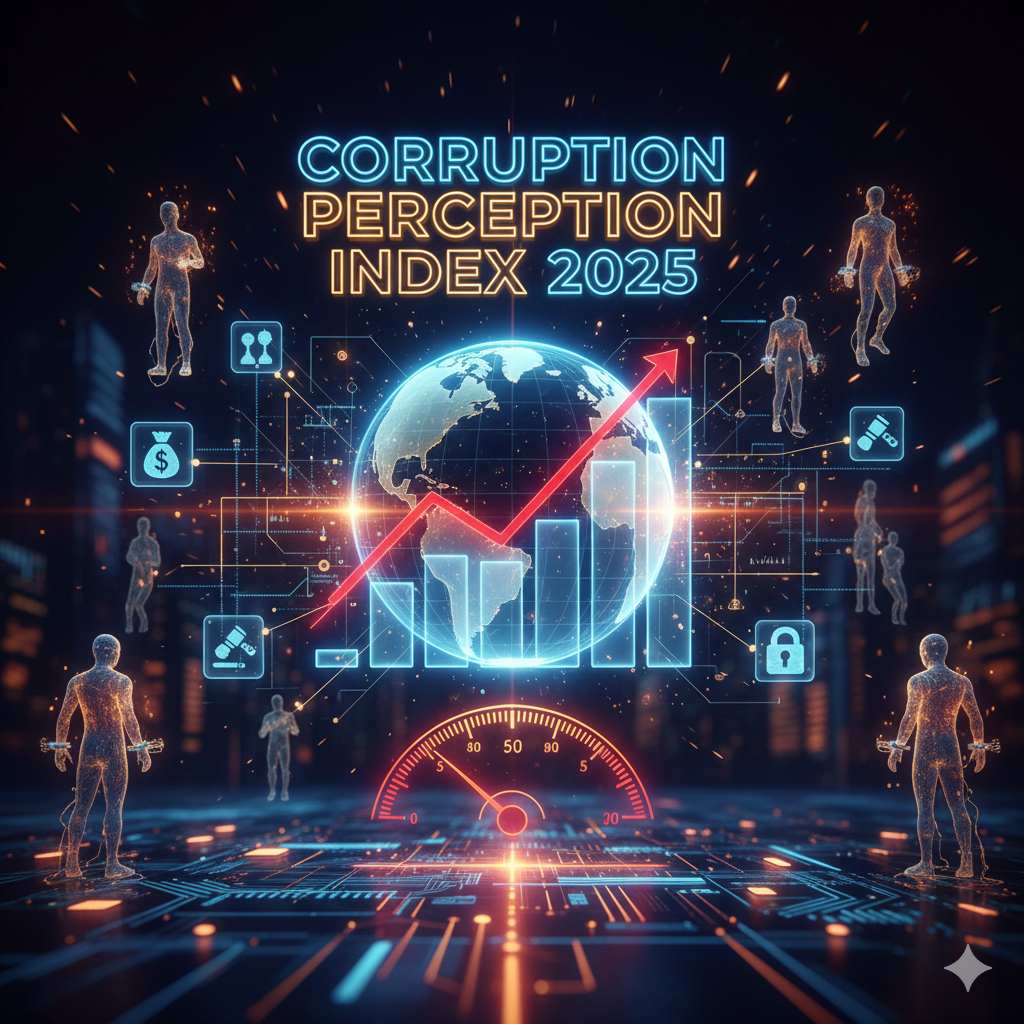
In 2025, Transparency International released the latest edition of its flagship global ranking — the Corruption Perceptions Index (CPI). The index assessed 182 countries and territories, measuring perceived levels of public-sector corruption on a scale from 0 (highly corrupt) to 100 (very clean).
More than just a ranking exercise, CPI 2025 offers critical insights into how corruption shapes governance, economic development, democratic institutions, and social equity across the world.
This article explains the CPI 2025 in detail — its methodology, significance, global trends, implications for developing countries, and why combating corruption remains central to sustainable development.
📌 Key Consequences for India (as reflected in CPI 2025)
| Area | Likely Impact |
|---|---|
| Investment Climate | Reduced foreign investor confidence due to governance risks |
| Public Trust | Lower faith in institutions and administrative systems |
| Service Delivery | Leakages in welfare schemes and delays in public services |
| Development Outcomes | Slower progress in health, education, and infrastructure |
| Global Image | Moderate standing in international governance rankings |
✅ Recommendations to Improve India’s CPI Performance
| Focus Area | Suggested Action |
|---|---|
| Transparency | Expand open-data portals and public disclosure of contracts |
| Political Finance | Ensure greater clarity in electoral funding |
| Enforcement | Speed up corruption-related investigations and trials |
| Digital Governance | Further reduce human discretion through e-services |
| Civic Engagement | Strengthen social audits and citizen oversight mechanisms |
📉 Regional Consequences Highlighted by CPI 2025
| Dimension | Impact Across South Asia |
|---|---|
| Economic Growth | Lower investor confidence and higher project costs |
| Public Services | Leakages in welfare schemes and infrastructure spending |
| Democratic Trust | Reduced faith in political and administrative institutions |
| Social Equity | Poor communities disproportionately affected |
| Regional Cooperation | Weak governance slows cross-border development projects |
✅ Strategic Recommendations (Especially Relevant for India)
| Area | Action Needed |
|---|---|
| Political Funding | Transparent disclosure of donations and expenditures |
| Judicial Efficiency | Faster disposal of corruption-related cases |
| Digital Governance | Expand e-procurement and online service delivery |
| Anti-Corruption Bodies | Greater autonomy and investigative powers |
| Citizen Oversight | Strengthen social audits and RTI mechanisms |
✍️ Short Conclusion
India’s CPI 2025 score of 39 places it in the middle of South Asia, performing better than Pakistan and Bangladesh but behind Bhutan and slightly below Sri Lanka. The regional pattern shows that institutional strength — not income alone — determines corruption outcomes. For India, sustained reforms in transparency, political accountability, and enforcement remain critical to improving both governance quality and global perception.
Understanding the Corruption Perceptions Index
The Corruption Perceptions Index is one of the world’s most widely referenced tools for assessing corruption in government institutions. It does not measure corruption directly; instead, it compiles expert assessments and business surveys to capture perceptions of corruption in the public sector.
Core Features of CPI
The CPI:
- Evaluates corruption in government and public administration
- Uses a standardized scale from 0 to 100
- Aggregates data from multiple independent institutions
- Covers areas such as bribery, misuse of public funds, nepotism, and effectiveness of anti-corruption frameworks
Each country’s score reflects how transparent and accountable its public institutions are perceived to be by experts and business leaders.
Methodology: How CPI 2025 Was Compiled
CPI 2025 draws upon data from several credible international sources including:
- Global risk assessments
- Business confidence surveys
- Governance indicators
- Expert evaluations
To be included in the index, a country must appear in at least three independent data sources. These datasets are then normalized and averaged to produce a final score.
What CPI Actually Measures
CPI focuses on:
- Bribery in public services
- Diversion of public funds
- Abuse of office for private gain
- Appointment of officials without merit
- Effectiveness of anti-corruption laws
- Ability of governments to prosecute corruption
It deliberately excludes private-sector corruption and petty household-level bribery, concentrating instead on systemic governance failures.
Global Snapshot of CPI 2025
CPI 2025 reveals a deeply uneven global picture.
Key Observations
- Persistent Global Stagnation
Most countries continue to struggle with corruption. Average global scores show little improvement over previous years, highlighting the entrenched nature of the problem. - Democratic Backsliding and Corruption
Countries experiencing erosion of democratic institutions often show declining CPI scores. Weak legislatures, constrained media, and reduced judicial independence create fertile ground for corruption. - Conflict and Fragility
States affected by war or political instability tend to occupy the bottom of the rankings, demonstrating how corruption thrives when accountability mechanisms collapse. - High Performers Share Common Traits
Countries scoring above 80 typically have:
- Strong rule of law
- Independent judiciaries
- Free press
- Robust public oversight systems
- Transparent procurement processes
Why Public-Sector Corruption Matters
Corruption is not merely a moral issue; it directly affects development outcomes and citizens’ everyday lives.
Economic Consequences
Corruption:
- Discourages foreign investment
- Raises the cost of public infrastructure
- Distorts market competition
- Reduces tax collection
- Weakens fiscal discipline
The result is slower economic growth and inefficient use of national resources.
Social Impact
For ordinary citizens, corruption translates into:
- Poor-quality healthcare and education
- Unequal access to public services
- Reduced employment opportunities
- Higher poverty levels
- Loss of faith in institutions
The poorest communities suffer the most, as corruption diverts funds meant for welfare programs.
Political Consequences
When corruption becomes systemic:
- Electoral integrity weakens
- Political patronage expands
- Citizens disengage from democratic processes
- Extremism and populism gain ground
Ultimately, corruption erodes the legitimacy of the state.
CPI 2025 and Sustainable Development
CPI 2025 reinforces the close relationship between corruption and progress toward global development goals.
Countries with low CPI scores consistently lag in:
- Health indicators
- Education outcomes
- Gender equality
- Environmental protection
- Infrastructure development
Corruption undermines climate action as well, with funds meant for green transitions often misallocated or siphoned off.
Thus, fighting corruption is not separate from development—it is foundational to it.
Institutional Strength as the Antidote
One of the strongest lessons from CPI 2025 is that institutions matter more than intentions.
Countries that perform well typically have:
1. Independent Judiciary
Courts that can prosecute powerful individuals without political pressure.
2. Transparent Public Procurement
Open bidding systems and digital platforms reduce opportunities for favoritism.
3. Free Media
Investigative journalism plays a crucial role in exposing wrongdoing.
4. Strong Audit Mechanisms
Supreme audit institutions ensure public money is spent as intended.
5. Active Civil Society
Citizen engagement increases accountability and oversight.
Technology and Anti-Corruption Efforts
Digital governance has emerged as a powerful tool in reducing corruption.
Examples include:
- Direct Benefit Transfers
- Online service delivery
- Digital land records
- E-procurement systems
- Open data portals
These initiatives reduce human discretion, minimize middlemen, and improve traceability of funds.
However, technology alone is insufficient without political commitment and institutional safeguards.
Corruption, Climate Finance, and Global Equity
CPI 2025 highlights a growing concern: corruption in climate-related funding.
Developing nations often receive international finance for climate adaptation and mitigation. Weak oversight can lead to:
- Misuse of green funds
- Inflated project costs
- Delayed implementation
- Reduced impact on vulnerable communities
This threatens global climate goals and deepens inequality between nations.
Lessons for Developing Economies
For emerging economies, CPI 2025 offers several actionable lessons:
Strengthen Legal Frameworks
Anti-corruption laws must be clear, enforceable, and uniformly applied.
Protect Whistleblowers
Individuals who expose corruption need legal safeguards.
Promote Transparency
Public access to government data increases accountability.
Reform Political Financing
Opaque campaign funding often fuels policy capture.
Invest in Ethics Training
Civil servants must be trained in integrity and public service values.
Education as a Long-Term Solution
Combating corruption is not only about laws—it is also about culture.
Educational systems play a critical role by:
- Teaching civic responsibility
- Promoting ethical reasoning
- Encouraging critical thinking
- Building awareness of rights and duties
Societies that value integrity from an early age create future leaders who resist corruption.
Limitations of the CPI
While CPI is influential, it has certain constraints:
- Measures perception, not actual corruption
- Focuses only on public sector
- May reflect media coverage rather than ground reality
- Cannot capture local-level variations
Therefore, CPI should be viewed as a diagnostic tool rather than a definitive verdict.
Conclusion: CPI 2025 as a Call to Action
The Corruption Perceptions Index 2025 sends a clear message: corruption remains one of the greatest obstacles to equitable development and democratic governance.
Progress is possible, as demonstrated by countries that have invested in strong institutions, transparency, and civic participation. Yet global averages show that reforms are too slow and political will often insufficient.
For policymakers, CPI 2025 is a roadmap highlighting where governance systems fail. For citizens, it is a reminder that accountability begins with awareness and participation. For students and educators, it provides a framework to understand how integrity shapes nations.
Ultimately, fighting corruption is not just about improving rankings—it is about building societies where public power truly serves public good.