Introduction
Desertification is a gradual transformation of productive land into degraded, unproductive terrain due to environmental stress and unsustainable human activities. It is most prominent in arid and semi-arid regions, where ecological balance is already fragile. Instead of being a sudden phenomenon, desertification evolves over time through the interaction of climate variability and anthropogenic pressures.
Concept of Desertification (Table Format)
| Aspect | Explanation |
|---|---|
| Definition | Degradation of fertile land into barren or less productive land |
| Regions Affected | Arid, semi-arid, and dry sub-humid regions |
| Nature of Process | Slow, cumulative, and often irreversible |
| Main Drivers | Climate change + human activities |
| Key Indicators | Soil erosion, vegetation loss, declining productivity |
Causes of Desertification (Analytical Table)
| Category | Specific Cause | Mechanism | Impact on Land |
|---|---|---|---|
| Climatic | Low rainfall | Reduced soil moisture | Vegetation decline |
| Rising temperature | High evaporation | Soil dryness | |
| Droughts | Prolonged water scarcity | Land degradation | |
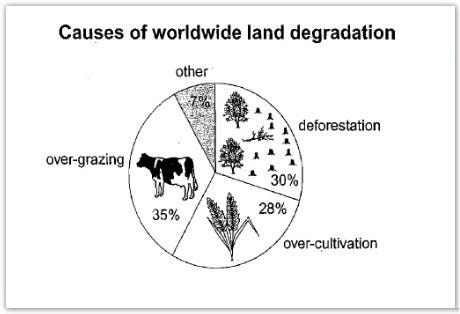
| Human | Deforestation | Removal of vegetation cover | Soil erosion |
| Overgrazing | Excessive livestock pressure | Soil compaction | |
| Over-cultivation | Nutrient depletion | Reduced fertility | |
| Urbanization | Land conversion | Loss of productive land | |
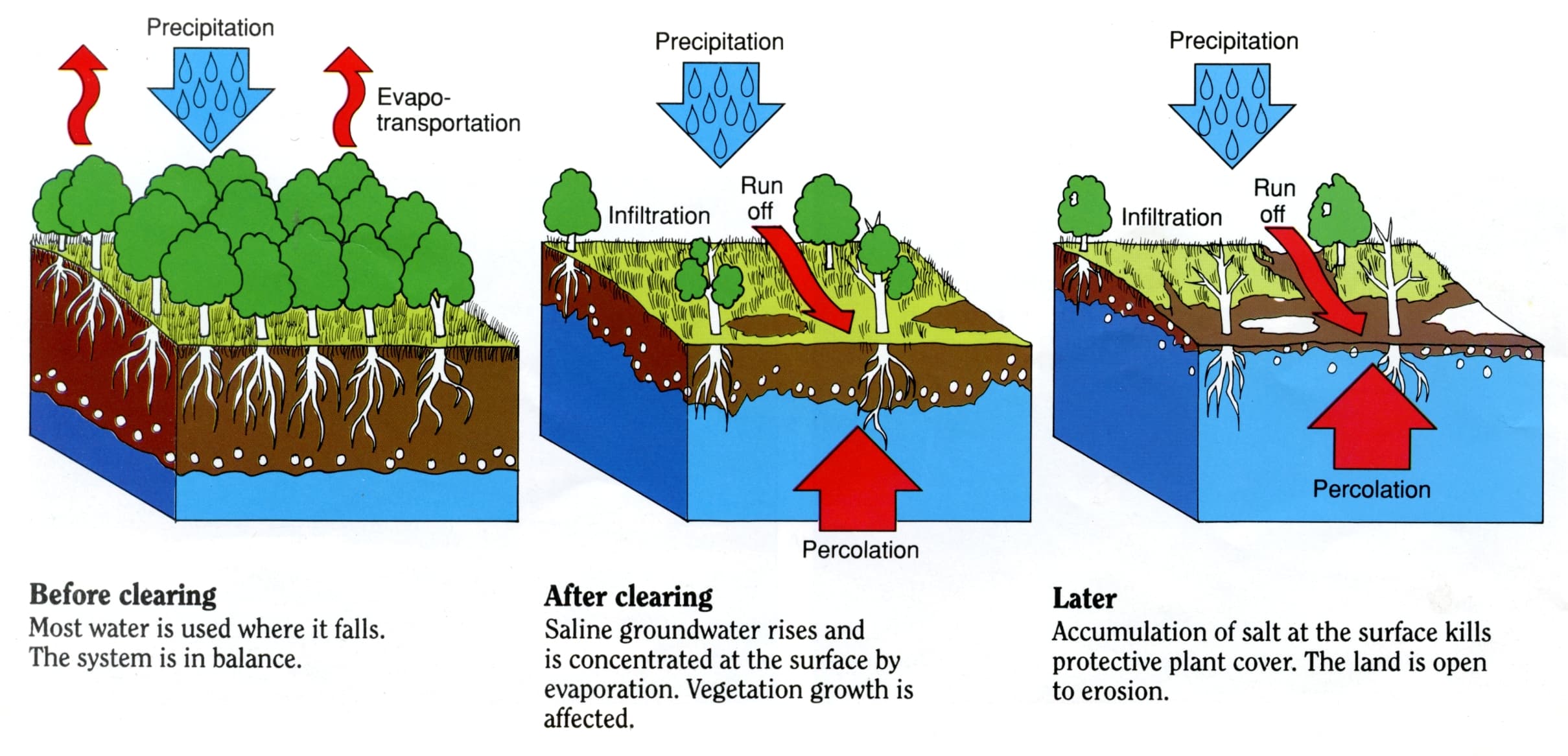
| Water-related | Over-irrigation | Salt accumulation | Soil salinity |
| Groundwater depletion | Lower water table | Reduced productivity | |
| Soil Factors | Wind erosion | Removal of topsoil | Loss of nutrients |
| Water erosion | Soil washing away | Land degradation |
Cause-Effect Chain (Graph-Based Concept)
This conceptual flow explains how desertification develops:
Deforestation / Overgrazing / Climate Stress → Loss of Vegetation → Soil Exposure → Erosion → Nutrient Loss → Reduced Productivity → Land Degradation → Desertification
Visual Understanding of Desertification Process

Consequences of Desertification (Table Format)
| Dimension | Impact | Explanation |
|---|---|---|
| Environmental | Soil degradation | Loss of fertility and structure |
| Biodiversity loss | Habitat destruction | |
| Water scarcity | Reduced groundwater recharge | |
| Economic | Decline in agriculture | Reduced crop yields |
| Loss of livelihood | Impact on farmers and pastoralists | |
| Social | Migration | Movement to urban areas |
| Poverty | Reduced income opportunities | |
| Climatic | Increased temperature | Reduced vegetation cover |
| Dust storms | Loose soil particles carried by wind |
Impact Intensity Graph (Conceptual Representation)
If visualized as a graph:
- X-axis: Level of land degradation
- Y-axis: Impact intensity
Trend:
- Initial stage → Low impact
- Moderate degradation → Rapid increase in impact
- Severe degradation → Extremely high ecological and economic damage
This shows that desertification has a non-linear and accelerating impact.
Control Measures (Table Format)
| Strategy | Measures | Outcome |
|---|---|---|
| Land Management | Crop rotation, organic farming | Soil fertility improvement |
| Afforestation | Tree plantation, agroforestry | Soil stability & moisture retention |
| Water Management | Rainwater harvesting, drip irrigation | Efficient water use |
| Soil Conservation | Contour plowing, terracing | Reduced erosion |
| Grazing Control | Rotational grazing | Vegetation recovery |
| Policy Measures | Land-use regulation, subsidies | Sustainable practices |
| Technology Use | Satellite monitoring, drought-resistant crops | Early intervention |
Solution Effectiveness (Graph Insight)
Conceptual graph:
- X-axis: Time
- Y-axis: Land quality
Trend:
- Without intervention → Continuous decline
- With sustainable practices → Gradual recovery
This highlights that early intervention leads to better restoration outcomes.
Indian Context (Table)
| Region | Major Issue | Cause | Government Initiative |
|---|---|---|---|
| Rajasthan | Desert expansion | Wind erosion, low rainfall | Desert Development Programme |
| Gujarat | Salinity | Over-irrigation | Watershed management |
| Maharashtra | Drought | Rainfall variability | Water conservation schemes |
| Karnataka | Land degradation | Overgrazing | Afforestation programs |
Integrated Understanding Table
| Stage | Process | Result |
|---|---|---|
| Initial | Vegetation removal | Soil exposure |
| Intermediate | Erosion & moisture loss | Declining productivity |
| Advanced | Severe degradation | Desert-like conditions |
Conclusion
Desertification is not merely an environmental issue but a multi-dimensional crisis affecting ecology, economy, and society. The tabular and graphical understanding clearly shows that it is a chain reaction process, where small disturbances gradually lead to large-scale degradation.
However, the process is not irreversible. With timely intervention, sustainable land use practices, and effective policy implementation, degraded lands can be restored. The key lies in shifting from exploitative practices to resource conservation and resilience-building strategies, ensuring long-term ecological balance and sustainable development.