Introduction
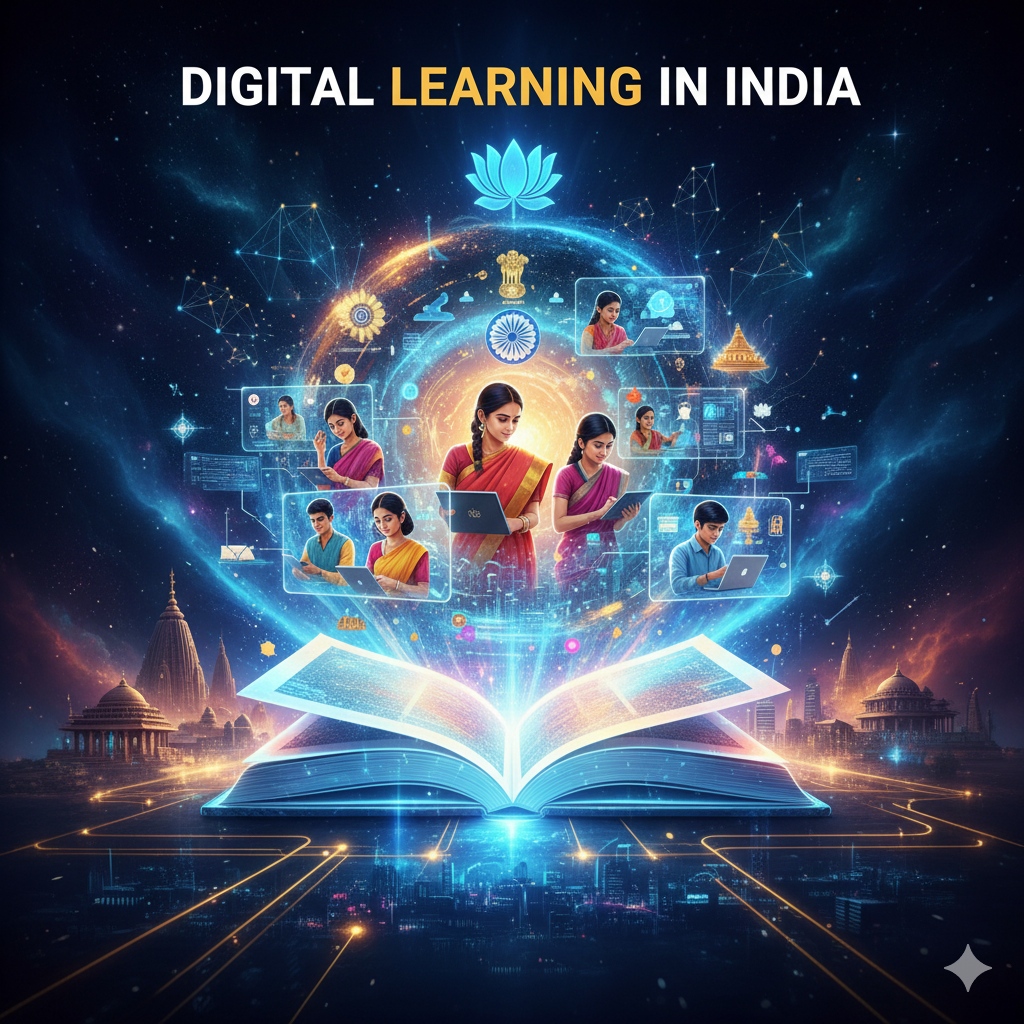
Over the last decade, India’s education system has been undergoing a fundamental transformation driven by digital technologies. What began as supplementary online resources has gradually evolved into an integrated ecosystem combining virtual classrooms, e-content platforms, mobile applications, and artificial intelligence–based learning tools. The COVID-19 pandemic accelerated this transition dramatically, pushing schools, colleges, and training institutions toward remote instruction almost overnight.
Digital learning today is no longer just an emergency response mechanism; it has become a strategic pillar of India’s educational reform agenda. Anchored in policy frameworks such as the National Education Policy 2020, the government envisions technology as a tool for improving access, quality, equity, and lifelong learning opportunities.
India’s digital education journey reflects broader national priorities—demographic dividend utilization, skill development, inclusive growth, and global competitiveness. However, alongside impressive progress, serious challenges remain in infrastructure, teacher preparedness, content localization, and digital equity.
Understanding Digital Learning in the Indian Context
Digital learning refers to the use of electronic platforms and internet-enabled tools to deliver educational content, assess learners, facilitate interaction, and personalize instruction. In India, this model encompasses:
- Online courses and virtual classrooms
- Government-hosted learning portals
- Educational mobile applications
- Digital textbooks and repositories
- AI-supported adaptive learning systems
- Hybrid models combining physical and virtual teaching
Unlike conventional classroom education, digital learning allows asynchronous access, self-paced study, and geographic flexibility. For a country with vast rural populations and uneven institutional distribution, this represents a powerful opportunity to democratize knowledge.
Policy Foundations of Digital Education Reform
The policy momentum behind digital learning gained strength with NEP 2020, which emphasizes technology integration across all levels of education. The policy proposes:
- Creation of digital infrastructure for knowledge sharing
- Virtual laboratories and e-assessment systems
- Teacher training in educational technology
- Development of multilingual digital content
- Promotion of online and blended learning models
Institutionally, digital education is guided by the Ministry of Education, supported by technical bodies such as the National Council of Educational Research and Training.
Major Government Platforms Supporting Digital Learning
India has built a diverse digital education ecosystem aimed at different age groups and learning needs.
DIKSHA Platform
The DIKSHA platform serves as a national digital infrastructure for school education. It hosts textbooks, lesson plans, videos, quizzes, and teacher training modules. Its QR-enabled textbooks allow students to scan physical books and access related digital content instantly.
DIKSHA also supports state-specific curricula, enabling localization while maintaining national standards.
SWAYAM Online Courses
The SWAYAM initiative provides Massive Open Online Courses (MOOCs) for school students, undergraduates, postgraduates, and lifelong learners. Courses are offered by premier institutions and include certification options.
SWAYAM has expanded higher education access by allowing credit transfers into formal degree programs.
PM eVIDYA Programme
Launched during the pandemic, PM eVIDYA integrates multiple digital channels—including TV, radio, mobile apps, and online platforms—to ensure continuity of learning during school closures.
The initiative particularly targets students without internet access by using television-based educational broadcasting.
National Digital Library
The National Digital Library of India aggregates millions of academic resources ranging from textbooks to research papers, providing a centralized knowledge repository for learners across disciplines.
Role of Technology in Enhancing Learning Outcomes
Digital education is not merely about putting content online. Its real potential lies in transforming pedagogy.
Personalized Learning
AI-powered platforms analyze learner behavior to tailor content difficulty, pace, and revision schedules. This supports differentiated instruction, especially beneficial for first-generation learners.
Data-Driven Assessment
Online assessments generate real-time analytics, helping teachers identify conceptual gaps and intervene early.
Teacher Capacity Building
Digital platforms enable continuous professional development for educators, offering micro-courses on pedagogy, subject mastery, and classroom management.
Virtual Labs and Simulations
Science and engineering students increasingly rely on simulations to conduct experiments remotely, reducing dependence on physical infrastructure.
Digital Learning and Equity: Bridging or Widening the Divide?
While digital education promises inclusivity, unequal access threatens to deepen existing disparities.
Urban–Rural Divide
Urban learners typically benefit from better internet connectivity and device availability. Rural regions often struggle with power supply, bandwidth limitations, and lack of trained facilitators.
Gender Gap
In some households, digital devices are prioritized for male members, limiting girls’ access to online education.
Economic Barriers
Smartphones, laptops, and data plans remain unaffordable for many low-income families, especially when multiple children require simultaneous access.
Recognizing these challenges, the government has expanded broadband connectivity under the BharatNet initiative and promoted low-cost digital devices.
Digital Learning in Higher Education and Skill Development
Universities and professional institutions increasingly use blended models combining campus instruction with online modules.
Skill platforms aligned with Skill India Mission provide short-term certification courses in emerging domains such as data analytics, cybersecurity, and renewable energy.
Digital credentials improve employability by offering industry-recognized micro-certifications.
Private Sector and EdTech Contributions
India’s EdTech ecosystem has grown rapidly, driven by startups offering test preparation, interactive tutorials, and AI-based learning companions. These platforms supplement formal education by providing:
- Adaptive practice modules
- Video-based conceptual explanations
- Competitive exam coaching
- Parent dashboards for progress tracking
However, commercialization also raises concerns about affordability, data privacy, and content quality regulation.

Impact on Teachers and Pedagogy
Digital learning is reshaping the teacher’s role from content deliverer to learning facilitator.
Educators now curate resources, guide discussions, and mentor students individually. Yet many teachers require structured digital literacy training to fully leverage technology.
NEP 2020 emphasizes continuous professional development using online platforms, recognizing teachers as central to digital transformation.
Current Challenges Facing Digital Learning in India
Despite progress, several systemic issues persist:
Infrastructure Deficits
Many schools still lack reliable electricity, devices, or internet connectivity.
Language Barriers
Much digital content remains English-centric, limiting usability for vernacular-medium learners.
Quality Assurance
Standardizing online course quality and certification credibility remains a policy challenge.
Cybersecurity and Privacy
Student data protection frameworks are still evolving.
Screen Fatigue and Mental Health
Prolonged online learning can affect attention spans and emotional well-being, especially among younger children.
Way Forward: Strengthening India’s Digital Education Ecosystem
To realize the full potential of digital learning, a multipronged strategy is required:
1. Infrastructure Expansion
Last-mile connectivity and device accessibility must be prioritized, especially in aspirational districts.
2. Localized Content Creation
Digital materials should be developed in regional languages with culturally relevant examples.
3. Teacher Empowerment
Large-scale digital pedagogy training programs are essential.
4. Public–Private Collaboration
Partnerships with EdTech firms can accelerate innovation while ensuring affordability through regulation.
5. Blended Learning Models
Combining classroom teaching with digital tools offers the most sustainable approach.
6. Robust Governance Framework
Clear standards for online education, certification, and data protection are needed.

Conclusion
Digital learning represents one of the most transformative shifts in India’s educational history. It offers unprecedented opportunities to expand access, personalize instruction, and align learning with future workforce needs. At the same time, it exposes structural inequalities that demand urgent policy attention.
If implemented thoughtfully—through infrastructure investment, teacher empowerment, localized content, and inclusive design—digital education can become a powerful equalizer. India’s challenge is not merely to digitize classrooms, but to reimagine learning itself in a way that is equitable, resilient, and future-ready.