Introduction
The framing of the Indian Constitution between 1946 and 1949 remains one of the most remarkable achievements in modern constitutional history. The Constituent Assembly completed the monumental task of drafting a comprehensive constitution for a vast, diverse, and newly independent nation in less than three years. This accomplishment becomes even more impressive when viewed against the backdrop of partition, communal violence, refugee crises, and economic uncertainty.
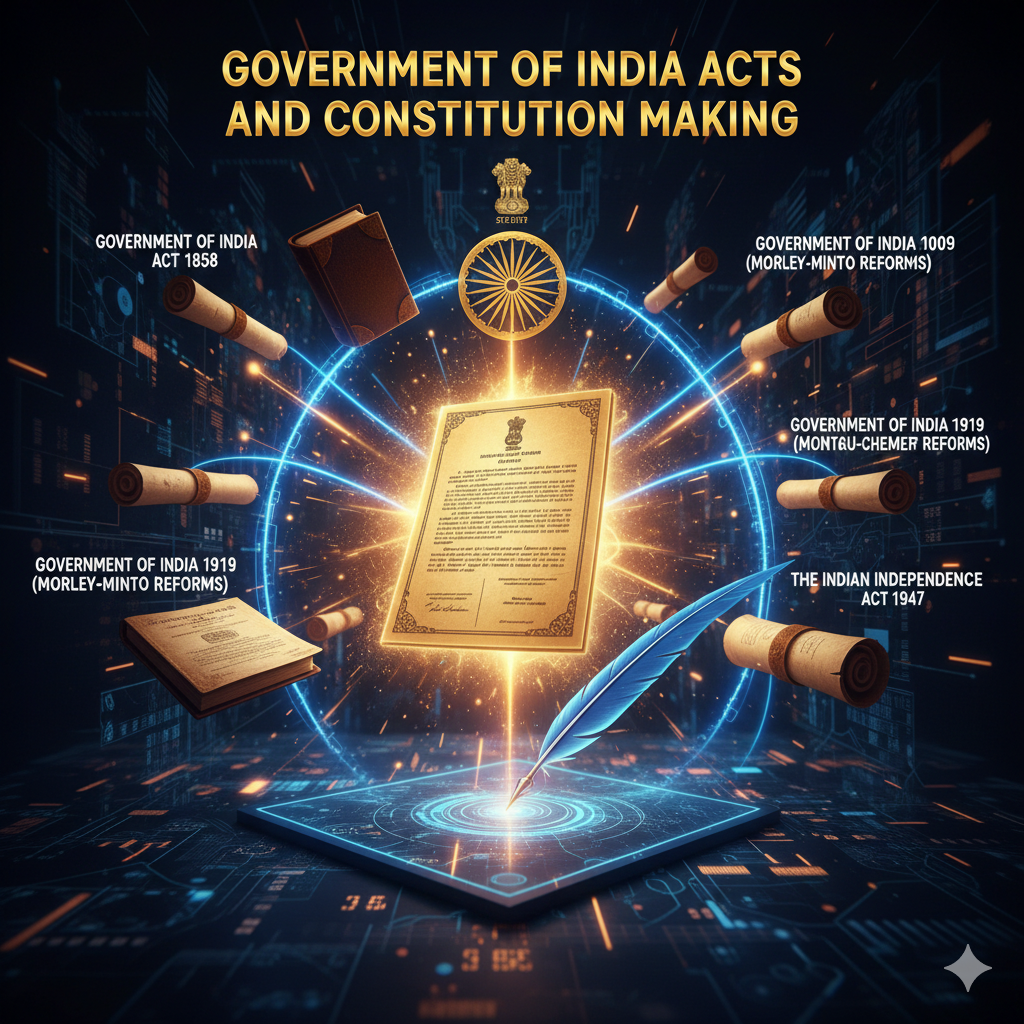
However, this success did not emerge in isolation. The members of the Constituent Assembly inherited decades of administrative and legislative experience under British rule, particularly through successive Government of India Acts. These colonial constitutional frameworks—especially the Acts of 1919 and 1935—provided practical exposure to representative institutions, federal arrangements, executive authority, and judicial processes.
The statement that drafting the Constitution within three years would have been extremely difficult without the experience gained under the Government of India Acts highlights an important historical reality. This article critically examines how colonial constitutional experiments shaped the work of the Constituent Assembly and facilitated the rapid creation of India’s democratic framework.
Background: Evolution of Constitutional Governance in Colonial India
British rule in India gradually introduced legislative and administrative reforms, primarily to manage governance efficiently rather than to empower Indians. Nevertheless, these reforms unintentionally prepared Indian leaders for self-rule.
Major constitutional milestones included:
- Indian Councils Acts (1861, 1892, 1909)
- Government of India Act, 1919
- Government of India Act, 1935
Each stage expanded Indian participation in governance and introduced institutional mechanisms that later influenced the Constitution.
By the time the Constituent Assembly began its work, India already had experience with elections, legislatures, provincial autonomy, and judicial review.
The Government of India Act, 1919: Early Exposure to Responsible Government
The 1919 Act introduced the concept of diarchy in provinces, dividing subjects between elected Indian ministers and British officials. Though limited, this system familiarized Indian leaders with:
- Legislative debates
- Budget discussions
- Administrative accountability
Indian politicians gained firsthand experience in governance, policy-making, and public administration. This exposure helped future constitution-makers understand the practical challenges of running government departments.
The Government of India Act, 1935: The Most Influential Framework
The Government of India Act, 1935 was the most comprehensive constitutional document before Independence and served as a direct foundation for many features of the Indian Constitution.
Federal Structure
The Act proposed an all-India federation and introduced clear divisions between central and provincial powers through legislative lists. This idea later evolved into the Union, State, and Concurrent Lists in the Constitution.
Members of the Constituent Assembly were already familiar with federal principles, making it easier to design India’s federal system.
Provincial Autonomy
Provincial autonomy under the 1935 Act allowed elected governments to function in provinces after the 1937 elections. Indian leaders governed key areas such as education, health, and agriculture.
This experience proved invaluable. Many assembly members had served as ministers or administrators, giving them practical insight into executive functioning.
Parliamentary Practices
The Act established bicameral legislatures in some provinces and introduced parliamentary procedures such as:
- Question hour
- Committees
- Budget debates
- Motions of no-confidence
These practices shaped India’s parliamentary democracy and enabled constitution-makers to design realistic legislative processes.
Judiciary and Rule of Law
The Federal Court established under the 1935 Act familiarized Indian jurists with constitutional interpretation and judicial independence. This experience influenced the creation of the Supreme Court and the strong emphasis on judicial review in the Constitution.
Civil Services and Administrative Continuity
British India had a well-developed bureaucracy. The Constituent Assembly retained this administrative structure, transforming it into All India Services. Familiarity with centralized administration helped maintain stability during the constitutional transition.
Composition of the Constituent Assembly: Experienced Leadership
Many members of the Constituent Assembly were veterans of colonial legislatures and provincial governments. Leaders such as Jawaharlal Nehru, Rajendra Prasad, B.R. Ambedkar, and others had participated in earlier constitutional processes.
Their experience included:
- Lawmaking
- Negotiating with colonial authorities
- Managing provinces
- Drafting legal documents
This institutional memory enabled informed debate and efficient decision-making.
Borrowing and Adapting Existing Provisions
The Assembly did not draft the Constitution from scratch. Several provisions were adapted and refined from the 1935 Act, including:
- Emergency powers
- Office of the Governor
- Public Service Commissions
- Administrative machinery
This continuity saved time and ensured functional stability.
Rather than reinventing governance, the Assembly modified familiar structures to suit democratic ideals.
Committee System and Procedural Efficiency
The Constituent Assembly adopted a committee-based approach similar to colonial legislative practices. Specialized committees handled different aspects such as fundamental rights, union powers, and minority safeguards.
This methodical division of labor accelerated drafting while maintaining depth and quality.
Managing Diversity through Prior Experience
Colonial administration had already confronted India’s linguistic, religious, and regional diversity. Although often exploitative, these experiences helped Indian leaders understand the complexity of governing a plural society.
The Assembly incorporated safeguards for minorities, linguistic groups, and tribal communities based partly on earlier constitutional arrangements.
Challenges Despite Prior Experience
While colonial frameworks provided a foundation, the Assembly still faced unprecedented challenges:
- Partition and mass displacement
- Integration of princely states
- Communal tensions
- Economic instability
Colonial laws offered limited guidance for these issues. The Assembly had to innovate, especially in areas like fundamental rights, social justice, and universal adult franchise.
Why Drafting Would Have Been Difficult Without Colonial Experience
Without prior exposure to constitutional governance, India would have faced:
- Lack of trained administrators
- Absence of legislative culture
- Weak institutional capacity
- Uncertainty about federal design
Drafting a workable constitution under such conditions could have taken decades.
The Government of India Acts provided a rehearsal for independence, allowing leaders to move swiftly from colonial rule to democratic governance.
Transforming Colonial Frameworks into Democratic Institutions
While borrowing structural elements, the Assembly fundamentally transformed their purpose. Colonial provisions designed for control were reshaped to serve liberty and justice.
Examples include:
- Expansion of franchise to all adults
- Enshrining Fundamental Rights
- Parliamentary accountability of the executive
Thus, colonial experience was not copied blindly but creatively reinterpreted.
Conclusion
The Constituent Assembly’s ability to draft India’s Constitution in just three years was not accidental. It was built upon decades of legislative and administrative experience gained under the Government of India Acts, particularly the 1935 framework. These colonial experiments familiarized Indian leaders with federalism, parliamentary procedures, judicial systems, and public administration.
However, the Assembly went far beyond merely adapting colonial models. It infused them with democratic values, social justice, and popular sovereignty. The result was a Constitution that combined institutional continuity with revolutionary change.
Therefore, the statement holds true: without the preparatory experience provided by the Government of India Acts, the Constituent Assembly would have struggled to complete its historic task so swiftly. Yet it was the vision, leadership, and commitment of India’s constitution-makers that transformed inherited structures into the foundation of the world’s largest democracy.