Introduction
India is one of the most linguistically diverse nations in the world, with hundreds of languages and dialects spoken across its vast territory. At the time of Independence in 1947, the newly formed Indian Union inherited administrative boundaries created by colonial rulers, which often ignored linguistic and cultural realities. This mismatch between political boundaries and linguistic identities soon became a source of dissatisfaction among various regions.
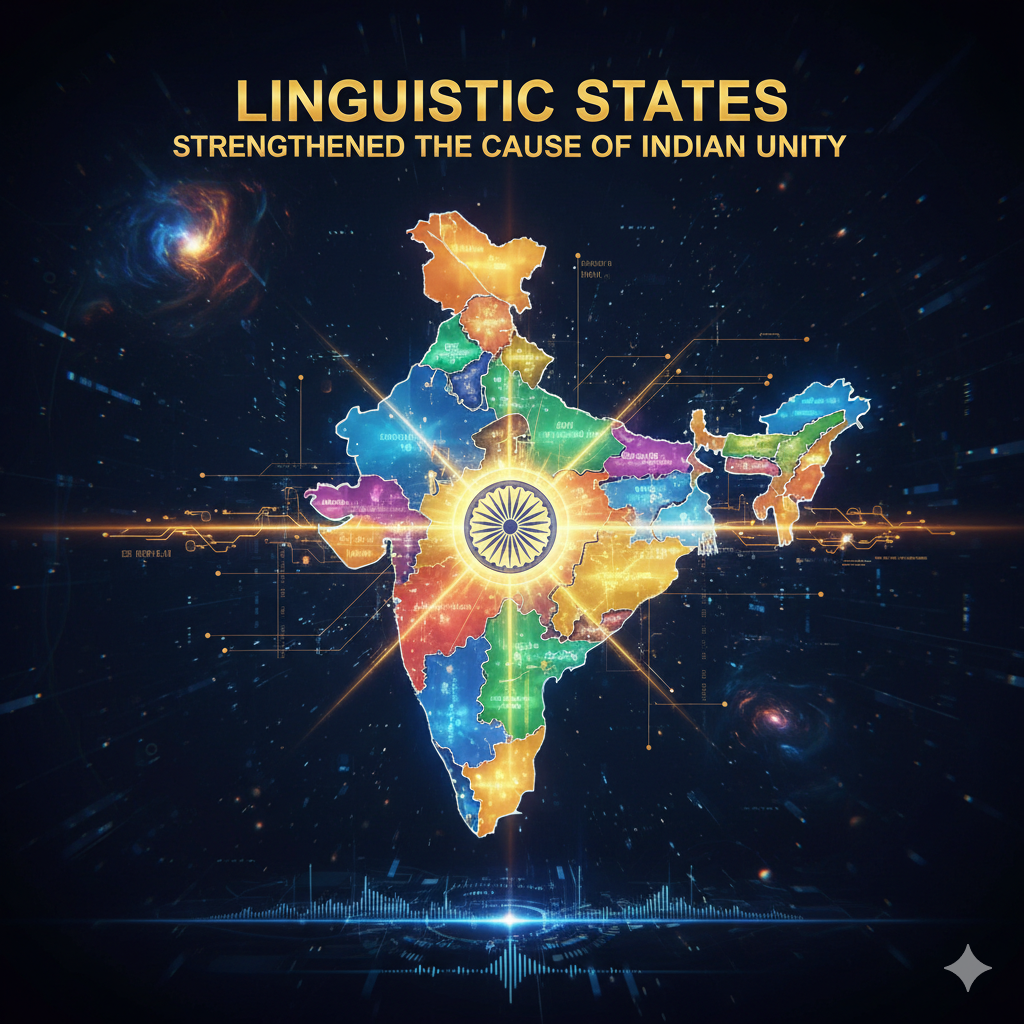
To address these concerns, India undertook a major reorganization of states primarily on linguistic lines in 1956 through the States Reorganisation Act. This decision marked a turning point in India’s federal evolution. While critics feared that linguistic states might weaken national unity and encourage separatism, supporters argued that recognizing linguistic identities would strengthen democratic participation and national integration.
More than six decades later, the question remains relevant: has the formation of linguistic states strengthened the cause of Indian unity, or has it created new challenges?
This article critically evaluates the impact of linguistic reorganization on India’s unity by examining its political, administrative, cultural, and social consequences.
Historical Background of Linguistic Reorganization
During the freedom struggle itself, language emerged as a powerful marker of identity. Leaders such as Mahatma Gandhi believed that provinces based on language would make administration more accessible to the masses. However, the Constituent Assembly initially postponed linguistic reorganization due to fears of instability in the fragile post-Independence period.
The demand for linguistic states gained momentum in the early 1950s, particularly after the creation of Andhra State in 1953 following popular agitation. Subsequently, the States Reorganisation Commission (SRC) was appointed, which recommended reorganizing states primarily on linguistic principles while safeguarding national unity.
The States Reorganisation Act of 1956 reshaped India’s internal map, creating linguistically homogeneous states and laying the foundation of modern Indian federalism.
Arguments Supporting Linguistic States as a Force for Unity
1. Recognition of Cultural Identity within a National Framework
Linguistic states provided constitutional recognition to regional languages and cultures. Rather than suppressing diversity, India chose to accommodate it. This inclusive approach reassured linguistic communities that their identities would be respected within the Indian Union.
By legitimizing regional aspirations, linguistic reorganization transformed potential separatist sentiments into cooperative federal participation. People felt emotionally connected to both their state and the nation, strengthening unity through recognition rather than coercion.
2. Deepening of Democracy and Popular Participation
Language is the primary medium through which citizens engage with governance. Linguistic states made administration more accessible by enabling people to interact with officials, courts, and legislatures in their mother tongue.
This led to:
- Greater voter participation
- Improved communication between government and citizens
- Increased political awareness
Democracy became more meaningful at the grassroots level, reinforcing people’s trust in the Indian state.
3. Reduction of Regional Discontent
Before linguistic reorganization, many regions felt marginalized within large multilingual provinces. The formation of linguistic states addressed grievances related to neglect, discrimination, and unequal development.
By granting autonomy to linguistic regions, India reduced tensions that could have escalated into separatist movements. In this sense, reorganization acted as a safety valve, preserving unity by resolving conflicts peacefully.
4. Administrative Efficiency and Governance
Governance improved as linguistic homogeneity reduced communication barriers. Officials could better understand local needs, customs, and priorities. State governments could design policies suited to regional contexts.
This administrative clarity strengthened state institutions, making federal governance more effective and cohesive.
5. Strengthening Federalism through Accommodation
India adopted a flexible federal model that allowed internal restructuring without threatening sovereignty. Linguistic states demonstrated that unity need not mean uniformity.
By accommodating diversity, India strengthened its federal structure and avoided rigid centralization. This cooperative federalism reinforced national unity while allowing regional self-expression.
Challenges and Criticisms of Linguistic Reorganization
Despite its successes, linguistic state formation also generated concerns and complications.
1. Rise of Regionalism and Identity Politics
Linguistic states sometimes encouraged regional pride to evolve into political regionalism. Certain leaders mobilized language sentiment for electoral gains, occasionally prioritizing state interests over national concerns.
This created tensions in inter-state relations and contributed to competitive rather than cooperative federalism in some cases.
2. Inter-State Disputes
Linguistic boundaries did not resolve all issues. Disputes over water sharing, borders, and resources emerged between neighboring states. Examples include river water conflicts and capital city disagreements.
Such disputes periodically strain national unity and require central intervention.
3. Marginalization of Linguistic Minorities within States
While states became linguistically dominant, minorities within those states sometimes faced disadvantages. Smaller language groups occasionally struggled to access education and employment in their mother tongue.
Thus, linguistic homogeneity at the state level created new minority issues.
4. Economic Imbalances
Some linguistic states progressed rapidly while others lagged behind, widening regional inequalities. Economic disparities sometimes fueled fresh demands for new states or special status.
Unity remains vulnerable when development is uneven.
Linguistic States and National Identity
One of the most remarkable aspects of India’s experience is that linguistic identities did not replace national identity. Indians generally maintain multiple loyalties—to language, region, and nation—without perceiving them as contradictory.
The Constitution reinforced this balance through:
- A common citizenship
- Fundamental Rights
- National institutions
- A shared political culture
Hindi and English served as link languages, while regional languages flourished at the state level. This multilingual framework prevented domination by any single linguistic group.
Comparison with Other Multilingual Nations
Globally, linguistic diversity has often caused political fragmentation. However, India’s approach of democratic accommodation contrasts sharply with coercive assimilation seen elsewhere.
India’s success lies in:
- Peaceful reorganization
- Constitutional safeguards
- Continuous dialogue between Centre and states
This flexible model has allowed unity to coexist with diversity.
Long-Term Impact on Indian Unity
More than sixty years after linguistic reorganization, India remains a unified nation despite immense diversity. Linguistic states have not led to disintegration; instead, they have become pillars of Indian federalism.
They helped:
- Integrate regional aspirations into national politics
- Prevent violent separatism in many areas
- Strengthen democratic legitimacy
While challenges persist, the overall effect has been stabilizing rather than divisive.
Contemporary Relevance
Recent demands for new states are often framed around development rather than language, indicating that linguistic identity has largely been accommodated. This itself reflects the success of linguistic reorganization in addressing a major source of early post-Independence tension.
The focus today has shifted from language to governance quality and economic opportunity.
Conclusion
The formation of linguistic states has, on balance, strengthened the cause of Indian unity. By recognizing cultural identities within a constitutional framework, India transformed diversity from a potential threat into a democratic asset. Linguistic reorganization deepened political participation, reduced regional alienation, and reinforced federal stability.
Although it introduced new challenges such as regionalism and inter-state disputes, these have been managed through institutional mechanisms and dialogue. Crucially, linguistic identities have complemented rather than competed with national identity.
India’s experience demonstrates that unity does not require uniformity. Instead, genuine unity emerges when diversity is respected, voices are heard, and governance adapts to social realities. Linguistic states thus stand as a testament to India’s innovative nation-building strategy—one that continues to inspire pluralistic democracies worldwide.