Introduction
Since Independence, India has repeatedly reorganized its internal political boundaries to improve governance, accommodate regional aspirations, and promote balanced development. While early state formation was primarily based on linguistic identity, recent state creation—such as Chhattisgarh, Jharkhand, Uttarakhand (2000), and Telangana (2014)—has been driven largely by developmental and administrative arguments.
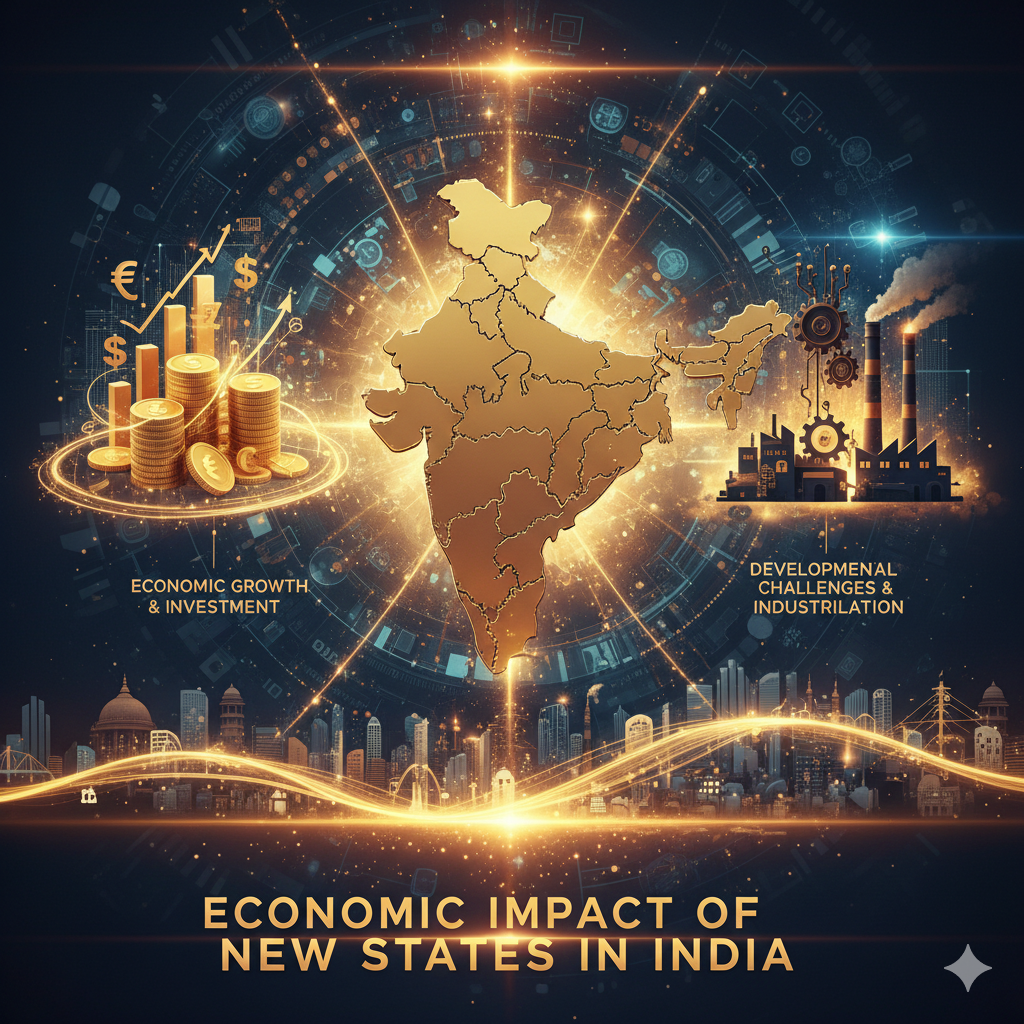
Supporters claim that smaller states enable focused governance and faster economic growth, while critics argue that repeated fragmentation increases fiscal burdens and weakens national planning. The question therefore arises: has the creation of new states in recent times truly benefited India’s economy, or has it introduced new structural challenges?
This article critically examines both perspectives, using economic, administrative, and social parameters to assess the overall impact.
Historical Context of New State Formation
India’s federal structure allows reorganization of states under Article 3 of the Constitution. The States Reorganisation Act, 1956 established linguistic states, but later divisions were motivated by uneven regional development.
The states formed after 2000 were carved out of economically large but administratively complex parent states:
- Chhattisgarh from Madhya Pradesh
- Jharkhand from Bihar
- Uttarakhand from Uttar Pradesh
- Telangana from Andhra Pradesh
The underlying justification was that neglected regions required autonomous governance to unlock economic potential.
Economic Rationale Behind Creating New States
Advocates of state bifurcation argue that smaller political units improve economic outcomes through:
- Better administrative reach
- Tailored development policies
- Improved resource utilization
- Increased political accountability
The assumption is that proximity between government and citizens enhances efficiency and growth.
Economic Benefits of New State Formation
1. Improved Administrative Efficiency and Governance
Smaller states are easier to govern. Administrative machinery becomes more responsive due to reduced territorial size and population pressure.
For example, Uttarakhand could focus on hill infrastructure and disaster management—issues previously sidelined within Uttar Pradesh. Telangana prioritized irrigation and urban development, especially around Hyderabad.
Economically, this translates into:
- Faster project approvals
- Better monitoring of welfare schemes
- Reduced bureaucratic delays
These improvements can stimulate local investment and entrepreneurship.
2. Focused Regional Development
New states enable targeted policies for backward areas. Jharkhand concentrated on mining governance and tribal welfare. Chhattisgarh expanded power generation and rural connectivity.
Such region-specific planning helps address long-standing disparities that large states often overlook.
Key outcomes include:
- Increased rural road density
- Improved electrification
- Expansion of healthcare and education facilities
Over time, these investments strengthen human capital and productivity.
3. Enhanced Capital Formation and Infrastructure Growth
Statehood brings capital cities, administrative complexes, highways, and public institutions. These create immediate economic activity through construction and employment.
Telangana witnessed rapid infrastructure expansion post-2014, especially in IT corridors and metro connectivity. This boosted private investment and service-sector growth.
Smaller states also compete to attract industries by offering incentives, creating a form of “competitive federalism.”
4. Better Fiscal Attention from the Centre
New states often receive special central assistance during initial years. This includes:
- Higher plan allocations
- Infrastructure grants
- Institutional capacity-building support
Such fiscal attention accelerates development momentum, especially in historically neglected regions.
5. Political Empowerment Leading to Economic Participation
Statehood increases political representation for marginalized communities. In Jharkhand and Chhattisgarh, tribal populations gained greater voice in governance.
Economic empowerment follows political inclusion through:
- Local employment schemes
- Forest rights implementation
- Small-scale entrepreneurship
Inclusive growth improves consumption and regional markets.
Economic Challenges and Limitations of New State Formation
Despite visible gains, the creation of new states also introduces serious economic concerns.
1. High Administrative Costs
Each new state requires:
- Separate legislatures
- High courts
- secretariats
- police headquarters
These recurring expenditures strain public finances. Funds that could support productive investment are diverted to maintaining parallel bureaucracies.
For resource-poor states, this becomes a persistent fiscal burden.
2. Weak Revenue Base in Newly Created States
Many new states inherit limited industrial infrastructure and narrow tax bases.
Jharkhand and Uttarakhand remain heavily dependent on central transfers. Low internal revenue generation restricts long-term development planning and increases borrowing.
Without economic diversification, statehood alone cannot guarantee prosperity.
3. Disruption of Established Economic Networks
Bifurcation often breaks integrated supply chains, administrative systems, and infrastructure networks.
The Telangana–Andhra Pradesh separation illustrates this problem, where disputes over power sharing, water resources, and assets created uncertainty that temporarily slowed regional investment.
Economic fragmentation can undermine scale advantages.
4. Rise of Regionalism and Populist Spending
New states may prioritize identity politics over economic discipline. Populist welfare schemes aimed at political consolidation sometimes overshadow capital investment.
Short-term electoral incentives can lead to:
- Rising fiscal deficits
- Debt accumulation
- Reduced private investor confidence
Sustainable growth requires institutional stability, not just political autonomy.
5. Precedent for Further Fragmentation
Successful statehood movements encourage similar demands elsewhere. If unchecked, this could lead to excessive subdivision, weakening national economic planning and coordination.
More states mean more competing demands for central resources, potentially diluting development impact.
Comparative Economic Performance of New States
A mixed picture emerges when examining growth trajectories:
- Telangana and Chhattisgarh show relatively strong GDP growth
- Jharkhand continues to struggle with governance and poverty
- Uttarakhand benefits from tourism but faces ecological vulnerability
This indicates that statehood alone is not decisive—institutional quality, leadership, and policy coherence matter more.
Impact on India’s Overall Economy
At the national level, new states have had neutral to moderately positive impact, provided governance improves. However, economic benefits remain localized and uneven.
India’s macroeconomic performance depends more on:
- National infrastructure
- Trade policy
- Monetary stability
- Human capital development
State reorganization contributes indirectly by enabling localized governance but is not a primary growth driver.
Alternatives to State Creation for Economic Development
Instead of frequent bifurcation, India can consider:
- Strengthening district-level governance
- Decentralizing fiscal powers
- Improving urban planning authorities
- Promoting regional development boards
These approaches can achieve similar outcomes without the high costs of creating new states.
Role of Cooperative Federalism
Economic success of smaller states depends on strong cooperation between Centre and states. Shared responsibility in taxation (GST), infrastructure financing, and welfare delivery ensures balanced growth.
New states must be integrated into national economic frameworks rather than operating in isolation.
Conclusion
The formation of new states in recent times has produced mixed economic outcomes. While it has improved administrative focus and regional participation in several areas, it has also imposed fiscal burdens and sometimes encouraged political fragmentation.
Statehood can act as a catalyst for development—but only when accompanied by good governance, revenue generation capacity, and long-term planning. Without these, new states risk becoming financially dependent and administratively weak.
Therefore, the creation of new states should not be viewed as a universal solution to regional inequality. Instead, it must be approached cautiously, guided by economic viability, institutional preparedness, and national interest.
Ultimately, India’s economic future lies not merely in redrawing boundaries but in strengthening institutions, enhancing cooperative federalism, and ensuring inclusive growth across all regions.