Introduction
The integration of princely states into the Indian Union after Independence in 1947 stands as one of the most remarkable administrative achievements in modern world history. At the time of Independence, India was not a single political entity. Instead, it consisted of British provinces alongside nearly 565 princely states, varying enormously in size, population, governance capacity, and socio-cultural composition. These states were ruled by hereditary monarchs under British paramountcy and were technically free to choose their future after British withdrawal.
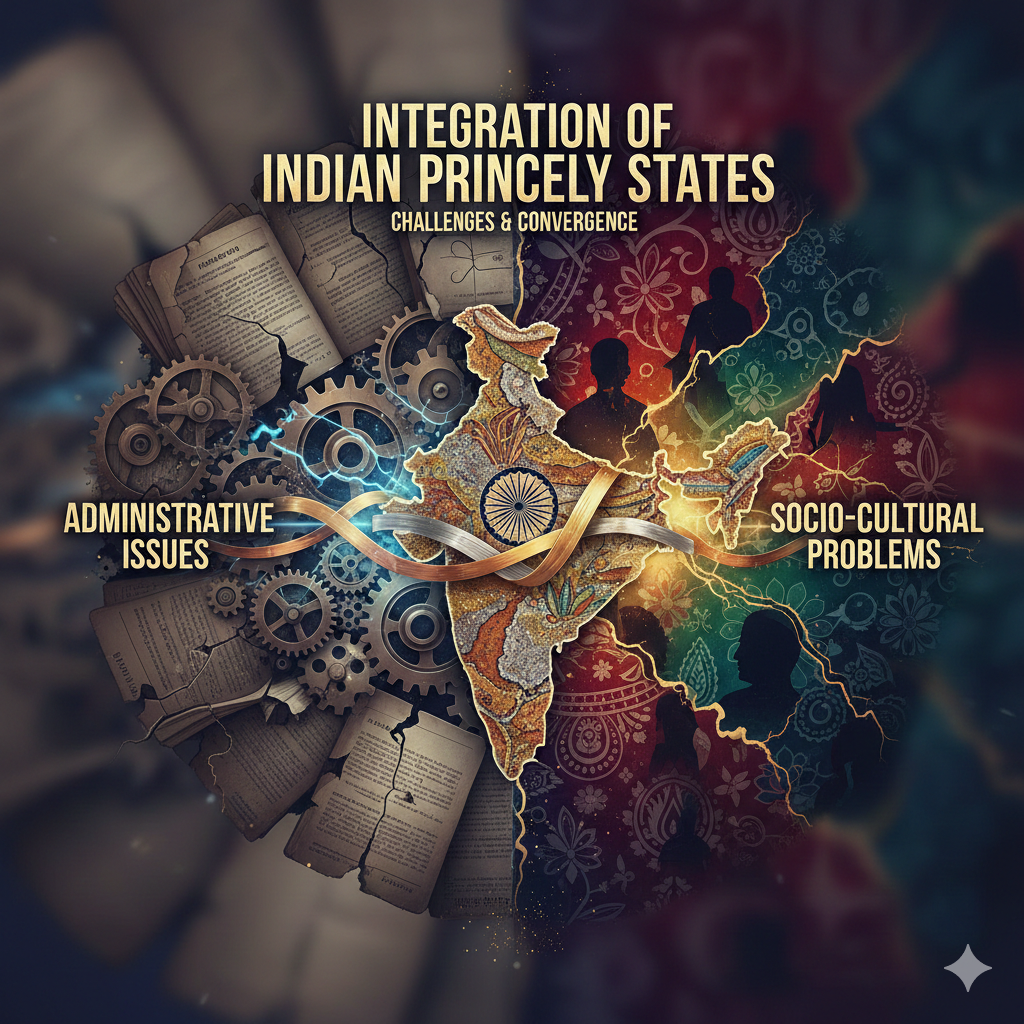
The challenge before India’s leadership—particularly Sardar Vallabhbhai Patel and V.P. Menon—was monumental: to unify this fragmented political landscape into a sovereign democratic republic. While military and diplomatic strategies played a role, the deeper challenges lay in administrative consolidation and socio-cultural harmonization. The integration process was not merely territorial; it demanded institutional restructuring, social reconciliation, and cultural accommodation.
This article critically assesses the major administrative issues and socio-cultural problems encountered during the integration of princely states, highlighting their complexity and long-term implications for Indian nation-building.
Historical Background of Princely States
Before 1947, princely states operated under indirect British control. While they managed internal affairs, external relations and defense were controlled by the British Crown. These states ranged from large entities like Hyderabad, Mysore, and Kashmir to tiny principalities covering only a few villages.
Upon Independence, the lapse of British paramountcy created uncertainty. Rulers were given the option to accede to India, Pakistan, or remain independent. This unprecedented situation posed risks of political fragmentation, foreign interference, and internal instability.
India’s leadership adopted a pragmatic approach combining persuasion, legal instruments (Instrument of Accession), economic incentives (privy purses), and limited coercion to achieve integration.
Major Administrative Issues in the Integration Process
1. Political Fragmentation and Lack of Uniform Governance
One of the foremost administrative challenges was the absence of standardized governance structures. Each princely state followed its own administrative systems, laws, revenue mechanisms, and judicial procedures. This diversity made immediate integration extremely difficult.
Many states had autocratic governance with minimal democratic participation, whereas British provinces had elected legislatures. Bringing these unequal systems under a unified constitutional framework required massive restructuring.
Key administrative problems included:
- Absence of modern bureaucracies in many states
- Inconsistent legal codes
- Varied land revenue systems
- Lack of accountability mechanisms
This fragmentation delayed policy implementation and complicated center-state coordination.
2. Resistance from Rulers and Political Elites
Several rulers were reluctant to surrender sovereignty. Some envisioned independent kingdoms, while others sought better terms for accession. Hyderabad, Junagadh, and Kashmir posed particularly serious challenges.
Administrative negotiations were often prolonged, as rulers demanded guarantees such as:
- Retention of titles
- Privy purses
- Special privileges
Managing these demands without compromising national unity required delicate diplomacy. Resistance from local elites further slowed administrative transition, especially where rulers had entrenched patronage networks.
3. Administrative Vacuum and Transition Management
In many states, governance collapsed after rulers departed or lost authority. This created administrative vacuums characterized by:
- Breakdown of law and order
- Revenue collection failures
- Disruption of public services
The Indian government had to rapidly deploy civil servants, police, and financial administrators to stabilize these regions. The shortage of trained personnel compounded difficulties, especially in remote or backward areas.
4. Integration of Bureaucratic Machinery
Merging princely administrative systems with the Indian Administrative Service was a massive task. Officials from princely states often lacked professional training and experience with democratic governance.
Major problems included:
- Differing service rules
- Varied salary structures
- Resistance from existing staff
- Need for retraining
Creating a unified civil service was essential but time-consuming, affecting administrative efficiency in the early years.
5. Territorial Reorganization and Boundary Disputes
The geographical integration of states posed complex logistical problems. Many princely territories were scattered enclaves surrounded by British provinces.
Later linguistic reorganization (1956) added another layer of complexity. Redrawing boundaries led to disputes over resources, capitals, and administrative jurisdictions, requiring further adjustments.
6. Financial and Economic Integration
Princely states had separate currencies, taxation systems, and fiscal policies. Integrating these into India’s centralized financial framework demanded:
- Harmonization of budgets
- Abolition of internal customs barriers
- Standardization of taxation
Economically weaker states became dependent on central assistance, placing additional strain on national resources.
Socio-Cultural Problems in the Integration Process
While administrative challenges were substantial, socio-cultural integration proved even more sensitive and enduring.
1. Diverse Identities and Regional Loyalties
People in princely states often identified more strongly with their local rulers than with the idea of India as a nation. Centuries-old loyalties could not be replaced overnight.
This resulted in:
- Emotional resistance to merger
- Suspicion of central authority
- Fear of cultural dilution
Building national consciousness required sustained efforts through education, media, and political participation.
2. Religious and Communal Tensions
Several princely states had religiously mismatched rulers and populations, such as Muslim rulers governing Hindu-majority regions. Accession decisions sometimes intensified communal anxieties, especially during the broader context of Partition violence.
Hyderabad and Kashmir exemplified how religious identities complicated integration, leading to prolonged unrest and refugee movements.
3. Tribal and Indigenous Concerns
Many princely states included tribal populations with distinct cultures and traditional governance systems. Integration threatened their autonomy and customary practices.
Problems faced by tribal communities included:
- Loss of land rights
- Cultural marginalization
- Limited political representation
Although constitutional safeguards were later introduced, early integration often overlooked indigenous perspectives.
4. Social Inequality and Feudal Structures
Princely states retained feudal hierarchies with widespread landlordism and social exploitation. Unlike British India, many had not implemented social reforms.
Integration exposed sharp inequalities, necessitating:
- Land reforms
- Abolition of zamindari
- Extension of constitutional rights
However, resistance from powerful elites slowed these reforms, perpetuating rural poverty.
5. Cultural Assimilation versus Preservation
India’s integration strategy emphasized unity while respecting diversity. However, balancing national identity with regional cultures was challenging.
Traditional art forms, languages, and customs faced decline as centralized governance expanded. Communities feared loss of heritage, leading to occasional cultural movements demanding autonomy or recognition.
6. Psychological Impact of Loss of Sovereignty
For many communities, especially royal households and their supporters, integration symbolized loss of pride and historical identity. This psychological transition was difficult and contributed to lingering resentment in some regions.
Measures Taken to Address These Challenges
India adopted several institutional and constitutional mechanisms to manage integration:
Administrative Measures
- Formation of Part A, B, and C states
- Establishment of All India Services
- Gradual democratization of former princely areas
Constitutional Safeguards
- Fundamental Rights
- Special provisions for tribal areas
- Linguistic reorganization of states
Socio-Cultural Strategies
- Promotion of national education curriculum
- Cultural autonomy through language policies
- Federal structure allowing regional self-governance
These steps helped stabilize the integration process over time.
Long-Term Impact on Indian Federalism
The integration of princely states laid the foundation for India’s federal system. It strengthened central authority while gradually accommodating regional aspirations.
However, unresolved socio-cultural issues continue to influence:
- Identity politics
- Demands for new states
- Center-state relations
Thus, integration remains an ongoing process rather than a completed historical event.
Conclusion
The integration of Indian princely states was not merely a political merger but a complex transformation involving administrative overhaul and socio-cultural reconciliation. Administratively, India had to unify diverse governance systems, stabilize fragile regions, and build institutional capacity almost overnight. Socio-culturally, it faced the delicate task of harmonizing varied identities, religions, traditions, and social hierarchies into a cohesive national framework.
Despite formidable obstacles, India succeeded in preventing fragmentation and laying the groundwork for a democratic republic. Yet the process revealed deep structural inequalities and cultural sensitivities that still shape Indian politics today.
The experience demonstrates that nation-building extends beyond territorial unification—it requires sustained efforts toward social justice, cultural respect, and administrative inclusivity. The integration of princely states thus remains a foundational chapter in understanding India’s evolving democracy.