Introduction
Professor Amartya Sen, a Nobel laureate in economics and a leading authority on human development, has consistently emphasized that education and health are not just means to economic growth but central to human freedom, capability, and development. According to Sen, human capabilities—such as the ability to read, write, and access basic health services—are fundamental for expanding opportunities and empowering citizens. He has argued that investing in primary education and primary health care is essential for building a more equitable, prosperous, and inclusive society.
Despite significant policy attention in India over the past decades, the status and performance of primary education and primary health care remain uneven, with persistent challenges in access, quality, and outcomes. These gaps not only undermine human development but also reduce the effectiveness of other social and economic policies.
This essay explores the current challenges in India’s primary education and primary health care systems, examines the relevance of Amartya Sen’s insights, and provides comprehensive suggestions for improving their status and performance.
Part I: Primary Education in India
Current Status
India has made notable strides in primary education, especially after initiatives such as Sarva Shiksha Abhiyan (SSA) and the Right to Education (RTE) Act, 2009. Key achievements include:
- Near-universal enrollment of children in the 6–14 age group
- Increased female participation in schooling
- Expansion of school infrastructure and mid-day meal programmes
However, several challenges persist:
- Quality of Education: High student-teacher ratios, lack of trained teachers, and rote-based teaching methods limit learning outcomes.
- Learning Gaps: Studies show a significant percentage of students in grades 3–5 cannot read basic text or perform simple arithmetic.
- Dropout Rates: Economic pressures, child labor, and inadequate infrastructure contribute to dropouts, especially among marginalized communities.
- Regional Disparities: States differ widely in education quality and enrollment rates. Northern and rural areas often lag behind southern and urban regions.
- Inclusivity Issues: Children with disabilities, girls in rural areas, and children from marginalized communities face structural barriers in access and learning.
Suggestions to Improve Primary Education
1. Improving Teacher Quality and Training
- Introduce continuous professional development for teachers, emphasizing child-centered pedagogy, inclusive education, and digital literacy.
- Revise teacher recruitment to prioritize competence and commitment, rather than merely academic qualifications.
- Implement peer learning and mentoring systems to improve teaching effectiveness.
2. Curriculum Reform
- Shift from rote learning to competency-based learning that develops critical thinking, problem-solving, and creativity.
- Incorporate life skills, health education, and environmental awareness at the primary level.
- Ensure local language and cultural relevance, particularly in tribal and rural schools.
3. Infrastructure Development
- Build and maintain safe classrooms, sanitation facilities, and libraries, especially for girls and children with disabilities.
- Provide digital learning tools, including computers and internet access, to enhance interactive learning.
4. Addressing Dropouts and Retention
- Introduce conditional incentives such as scholarships, mid-day meals, and free textbooks to retain students.
- Engage community participation to monitor school attendance and motivate families to keep children in school.
- Focus on flexible schooling options for working children or those in remote areas.
5. Leveraging Technology
- Deploy digital classrooms and e-learning platforms, especially in rural and underserved regions.
- Use learning analytics to track progress and identify children at risk of falling behind.
- Provide teacher training for effective use of educational technology.
6. Inclusive Education
- Strengthen the implementation of inclusive education policies, ensuring children with disabilities and marginalized groups receive specialized support and assistive devices.
- Promote gender-sensitive pedagogy and mentorship programmes for girls.
7. Community and Parental Engagement
- Encourage School Management Committees (SMCs) to involve parents in decision-making.
- Conduct awareness campaigns about the importance of early education and regular attendance.
8. Monitoring and Accountability
- Introduce robust learning outcome assessments at the block and school level.
- Link funding and recognition to improvement in learning outcomes, rather than mere enrollment numbers.
Part II: Primary Health Care in India
Current Status
Primary health care is the backbone of India’s health system, ensuring access to preventive, promotive, and basic curative services. Programs such as National Rural Health Mission (NRHM), Ayushman Bharat, and immunization drives have improved coverage and access.
Key achievements include:
- Increased immunization rates for children
- Expansion of sub-centres and Primary Health Centres (PHCs)
- Focus on maternal and child health
However, challenges remain:
- Shortage of Health Personnel: Many PHCs lack doctors, nurses, and paramedical staff, especially in rural areas.
- Infrastructure Deficit: Facilities often lack essential drugs, equipment, and clean sanitation.
- Access Disparities: Remote, tribal, and economically weaker populations face barriers in accessing care.
- Preventive Care Gaps: Awareness and uptake of preventive services, such as screening and nutrition programs, remain low.
- Health Outcomes: Infant and maternal mortality, malnutrition, and communicable diseases persist in several regions.
Suggestions to Improve Primary Health Care
1. Strengthening Health Infrastructure
- Ensure adequate staffing at PHCs, sub-centres, and community health centres.
- Provide modern equipment, medicines, and diagnostic facilities, particularly in rural and tribal areas.
- Establish telemedicine and mobile health units for remote populations.
2. Human Resource Development
- Invest in training and capacity building of doctors, nurses, and community health workers.
- Introduce incentives for doctors and paramedics to work in underserved areas.
- Promote task-sharing and use of trained community health workers (e.g., ASHAs) for preventive care.
3. Promoting Preventive and Primary Care
- Strengthen immunization, maternal health, nutrition, sanitation, and hygiene programs.
- Integrate health education in schools, emphasizing personal hygiene and disease prevention.
- Conduct community awareness campaigns to improve health-seeking behavior.
4. Universal Access and Equity
- Target interventions toward marginalized, tribal, and economically weak populations.
- Subsidize or provide free essential medicines and treatments for low-income families.
- Ensure gender-sensitive care, particularly for maternal and reproductive health.
5. Digital Health Integration
- Implement Electronic Health Records (EHRs) for better monitoring of health indicators.
- Use digital platforms for teleconsultation, appointment scheduling, and health tracking.
- Leverage data analytics for early detection of epidemics and resource allocation.
6. Community Participation and Accountability
- Involve local committees and Panchayati Raj institutions in monitoring PHC performance.
- Empower communities to report service gaps and quality issues, promoting transparency.
- Encourage public-private partnerships to enhance service delivery while retaining accountability.
7. Linking Health with Other Development Goals
- Integrate health initiatives with nutrition, water, sanitation, education, and social protection programs.
- Adopt intersectoral approaches, reflecting Amartya Sen’s human capabilities framework.
Lessons from Amartya Sen’s Perspective
- Health and Education as Rights, Not Privileges: Sen emphasizes that access to basic health care and education is a fundamental human right, essential for expanding capabilities.
- Focus on Outcomes, Not Inputs: Policy evaluation should focus on actual improvements in literacy, learning outcomes, child mortality, and life expectancy, rather than just expenditure.
- Empowerment and Agency: Education and health empower citizens to participate fully in economic, social, and political life.
- Equity Matters: Targeting marginalized and vulnerable groups ensures inclusive development.
Applying these insights, India’s policy interventions should move from program-centric approaches to human-centric development.
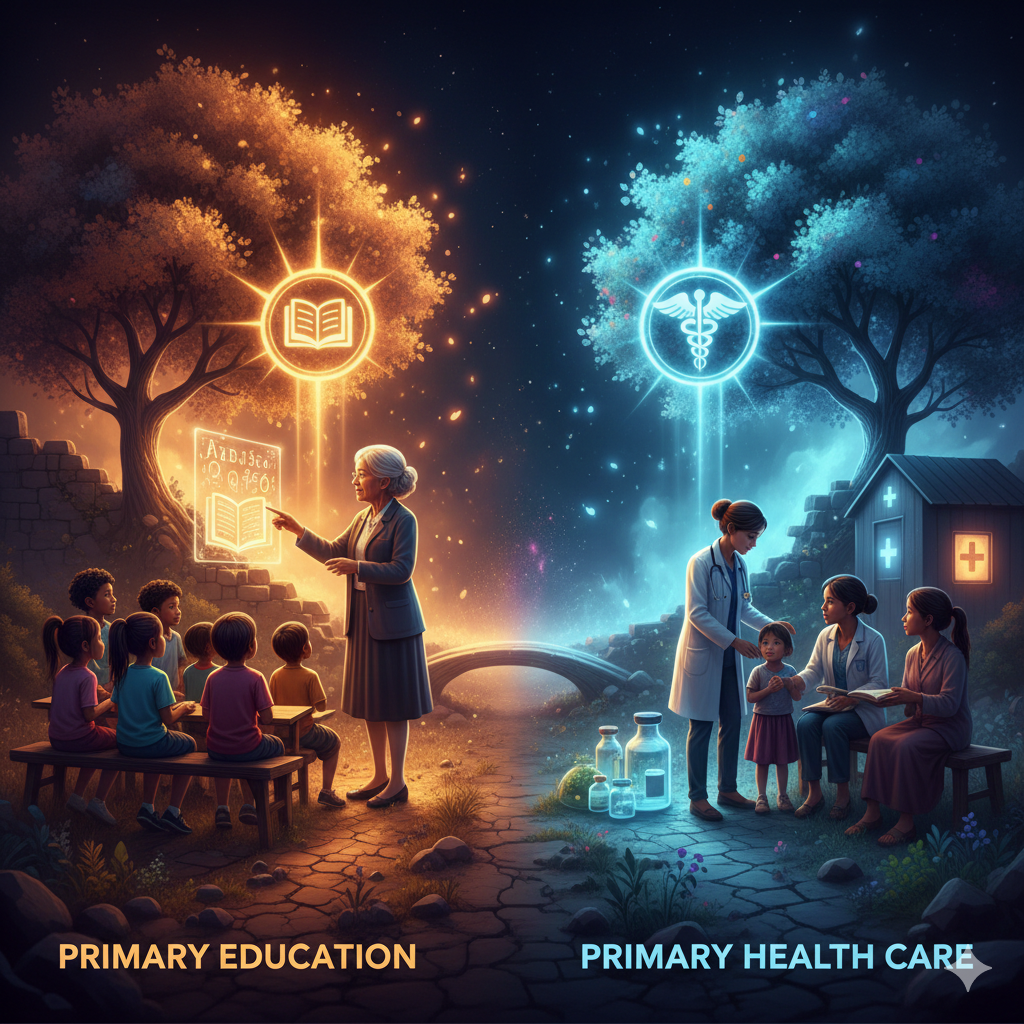
Integrating Primary Education and Health
Education and health are interlinked:
- Healthy children are more likely to attend school regularly and learn effectively.
- School-based interventions, such as mid-day meals and health check-ups, improve both learning and health outcomes.
- Community awareness campaigns combining education, nutrition, and hygiene reinforce each other.
A holistic, integrated approach is essential for achieving sustainable improvements in human development.
Conclusion
Amartya Sen’s advocacy underscores the centrality of primary education and primary health care in human development. India has made significant progress in expanding access to both, but challenges in quality, equity, and outcomes persist.
To improve their status and performance, policy interventions must focus on:
- Teacher quality, curriculum reform, infrastructure, and inclusive pedagogy in education.
- Strengthening health infrastructure, human resources, preventive care, equity, and digital integration in health care.
- Community participation, accountability, and outcome-based monitoring in both sectors.
- Interlinking education, health, nutrition, and social protection to address multidimensional deprivation.
Only by combining strong political will, sustained investment, innovative delivery, and participatory governance can India realize Sen’s vision of empowering citizens through education and health. These reforms will not only reduce deprivation but also strengthen democracy, social justice, and economic development.