Introduction
Artificial Intelligence is rapidly reshaping economies, governance systems, and social services across the world. While many countries focus primarily on building powerful AI models, India is taking a broader and more inclusive approach — developing an AI Applications Stack that connects technology directly with citizens’ everyday needs.
Rather than limiting AI to elite research labs or large corporations, India’s vision is to make AI accessible, affordable, and scalable for sectors such as agriculture, healthcare, education, public administration, and small enterprises. This philosophy aligns with the national objective of technology for social good.
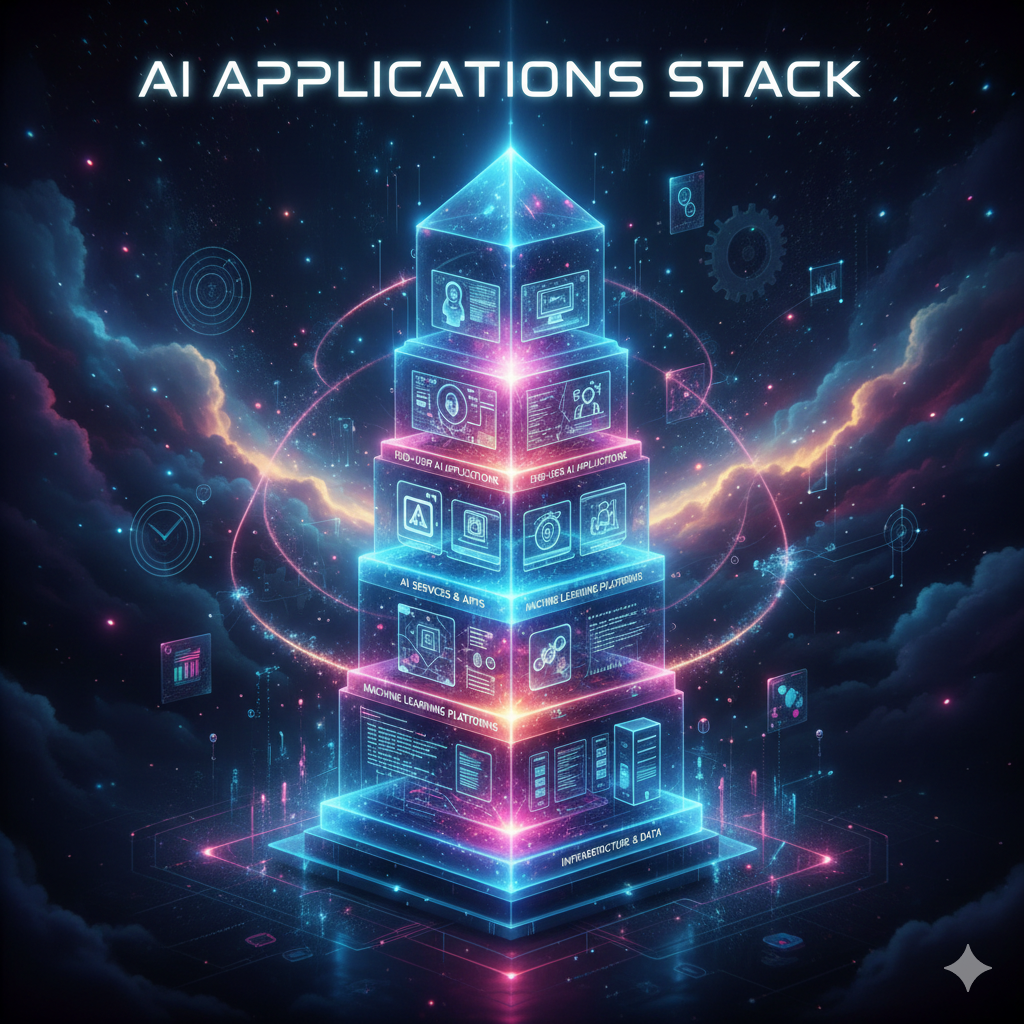
The India AI Applications Stack represents a layered digital ecosystem that integrates applications, AI models, computing infrastructure, data networks, and energy systems to deliver real-world solutions at population scale.
This article explains the concept, structure, significance, opportunities, and challenges of India’s AI Applications Stack in a fully original manner.
Why India Needs an AI Applications Stack
India faces unique developmental realities:
- Massive population
- Linguistic diversity
- Rural–urban divide
- Limited access to specialised services
- Resource constraints
Traditional AI deployment models used in developed economies cannot simply be replicated. India requires a framework that supports:
- Low-cost innovation
- Vernacular language adoption
- Public service delivery
- Startup participation
- Digital inclusion
The AI Applications Stack provides exactly this foundation by enabling multiple stakeholders — government, startups, academia, and industry — to build solutions on shared infrastructure.
Instead of fragmented AI initiatives, the stack creates systemic integration, ensuring that innovation reaches farmers, students, patients, and small businesses.
Understanding the AI Stack Concept
An AI stack refers to the complete pipeline required to operationalise artificial intelligence — from raw computing power to end-user services.
India’s approach mirrors the success of earlier digital public infrastructures such as Aadhaar and UPI, but extends the idea into intelligent systems.
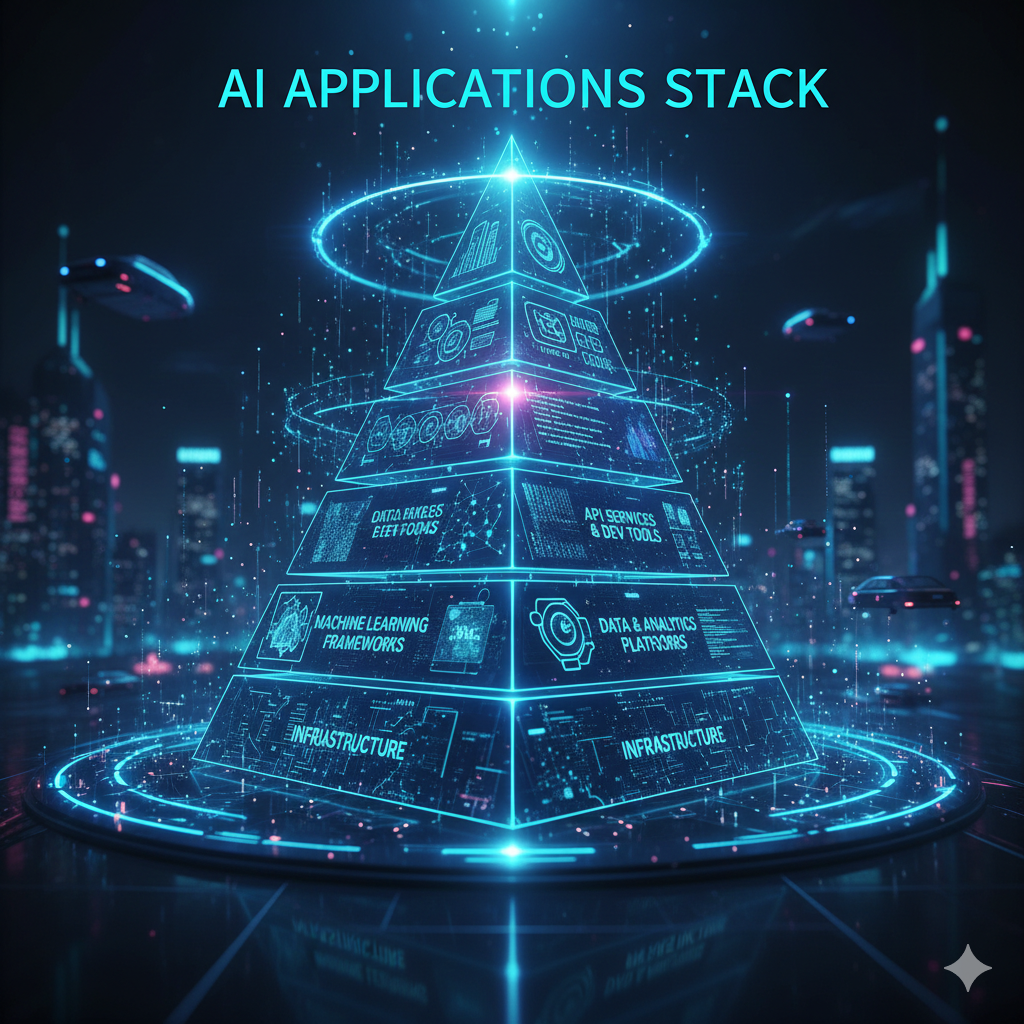
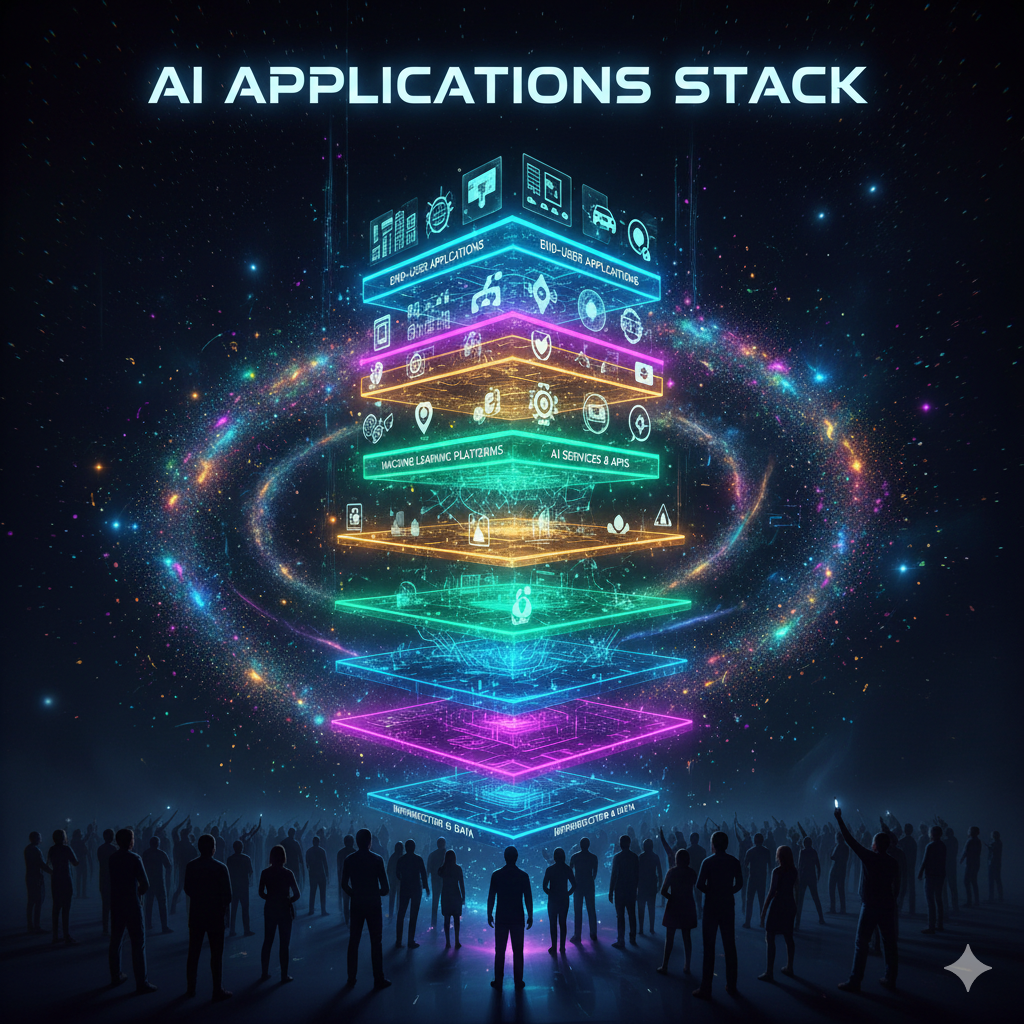
The stack is organised into five interconnected layers.
1. Application Layer: Direct Citizen Impact
This is the topmost layer where people interact with AI.
Examples include:
- AI health screening tools
- Crop advisory platforms
- Smart education portals
- Government service chatbots
- Language translation systems
These applications transform complex AI outputs into simple, actionable services.
For instance, farmers can receive weather-based crop recommendations, students can access personalised learning paths, and citizens can resolve grievances through AI-enabled platforms.
The focus here is practical utility, not technological sophistication alone.
2. Model Layer: Intelligence Core
This layer contains the AI models that power applications.
India is increasingly investing in:
- Multilingual language models
- Domain-specific AI (health, agriculture, governance)
- Indigenous foundational models
Unlike global systems trained primarily on Western datasets, Indian models are being tailored for local languages, cultural contexts, and regional challenges.
This ensures relevance, accuracy, and inclusivity.
It also strengthens technological sovereignty by reducing dependence on foreign proprietary systems.
3. Compute Layer: Processing Capability
AI systems require massive computing resources for training and inference.
India is expanding access to:
- High-performance GPUs
- National AI compute platforms
- Affordable cloud resources
- Shared supercomputing facilities
This layer allows startups, researchers, and public institutions to build AI solutions without prohibitive infrastructure costs.
The objective is democratised computing, enabling innovation beyond large corporations.
4. Digital Infrastructure Layer: Data and Connectivity
Reliable connectivity and secure data pipelines form the backbone of AI deployment.
This includes:
- Nationwide broadband expansion
- 5G networks
- Data centres
- Secure digital identity systems
These components ensure seamless data flow between users and AI systems, particularly in remote and rural areas.
Without this layer, even the most advanced AI models would fail to reach intended beneficiaries.
5. Energy Layer: Sustainable Power for AI
AI workloads consume substantial electricity.
India’s growing renewable energy capacity supports:
- Green data centres
- Sustainable compute infrastructure
- Low-carbon AI expansion
By integrating clean energy into the AI stack, India aims to balance technological growth with environmental responsibility.
Key Characteristics of India’s AI Applications Stack
1. Inclusion First
The stack prioritises underserved communities by embedding affordability and accessibility into design.
AI is treated as a public utility, not a luxury product.
2. Language Diversity
India’s linguistic complexity demands AI systems capable of operating across regional languages.
This enables broader participation and prevents digital exclusion.
3. Sovereign Technology
Local data hosting and indigenous models protect national interests while building domestic expertise.
This approach strengthens strategic autonomy.
4. Open Innovation
Shared infrastructure allows startups and researchers to innovate without rebuilding foundational layers.
This reduces entry barriers and accelerates experimentation.
Institutional Support and National Vision
India’s AI stack is backed by coordinated government efforts involving organisations such as NITI Aayog and Ministry of Electronics and Information Technology.
These institutions are driving:
- IndiaAI Mission
- National datasets platforms
- AI research funding
- Startup incubation
- Ethical AI frameworks
The broader objective aligns with India’s digital transformation agenda and positions India as a responsible global AI leader.
Socio-Economic Benefits
1. Healthcare Transformation
AI enables early disease detection, telemedicine support, and predictive analytics for public health planning.
Rural populations gain access to diagnostics previously available only in cities.
2. Agricultural Productivity
Smart advisories improve crop yields, reduce input waste, and enhance farmer incomes.
Weather modelling and pest prediction systems strengthen climate resilience.
3. Education Personalisation
AI-driven learning platforms adapt content to individual student needs, improving outcomes and reducing dropout rates.
4. Governance Efficiency
Automated document processing, grievance redressal, and decision-support systems increase transparency and service delivery speed.
5. Economic Growth
The AI ecosystem generates employment in data science, cloud operations, cybersecurity, application development, and research.
It also attracts global investment and strengthens startup ecosystems.
Ethical and Regulatory Dimensions
AI adoption must be accompanied by strong safeguards.
India is working toward:
- Data protection frameworks
- Algorithmic transparency
- Bias mitigation
- Accountability mechanisms
Responsible AI ensures that automation does not deepen inequality or compromise privacy.
Challenges Ahead
Despite progress, several hurdles remain:
Infrastructure Scale
High-performance computing and data centres require massive investment.
Skill Gaps
Advanced AI development needs specialised talent.
Regulatory Balance
Innovation must coexist with citizen protection.
Global Competition
India must accelerate development to remain competitive internationally.
Addressing these challenges will determine the long-term success of the AI stack.
India’s Global Role in AI
India’s approach offers a replicable model for developing nations — demonstrating how AI can support inclusive development rather than elite automation.
By focusing on applications rather than only models, India is redefining how emerging economies participate in the AI revolution.
Conclusion
The India AI Applications Stack represents a paradigm shift from isolated AI projects to a unified national ecosystem.
By integrating applications, models, compute, infrastructure, and energy, India is building an AI framework that prioritises:
- Accessibility
- Sovereignty
- Sustainability
- Social impact
This stack is not merely a technological architecture — it is a developmental strategy.
If implemented effectively, it can transform governance, uplift livelihoods, enhance education, strengthen healthcare, and position India as a global leader in ethical, inclusive artificial intelligence.